
The AI that replaces the interviewer, not just the phone call
A full voice-AI stack that dials respondents, conducts the interview, and reports results straight into Voxco
2026
16 أسبوعًا
أبحاث السوق / الذكاء الاصطناعي
Starting position
النقطة الأساس
- 100%
Interviews requiring a live human interviewer
Every CATI call staffed and conducted by a person
- Bound by interviewer headcount
Concurrent interviews possible
Scaling a campaign meant scaling the shift roster
- Fixed shift hours
Interview availability
No calling outside staffed hours
- Manual re-scheduling
Callback / appointment handling
An interviewer had to remember and redial
حجم السوق
Thousands of dialled cases per campaign, across concurrently running projects
CATI interviews run through FFIND's Voxco operation
الميزانية التقريبية
200,000 – 999,999 €
توزيع الميزانية
Budget bucket per Clutch.co project cost category. Exact figures under NDA.
4-phase delivery
16 weeks
- 1
Weeks 1-4
SIP/PBX core + dialer architecture
- 2
Weeks 5-9
AI voice pipeline: speech-to-text, LLM answer matching, text-to-speech
- 3
Weeks 10-13
Voxco/iWeb survey driver, disposition codes & scheduler
- 4
Weeks 14-16
Operations dashboard, QA and production rollout
The interviewer was the bottleneck, not the phone system
FFIND runs CATI market research campaigns on Voxco, an industry-standard survey platform - but every single call still needed a human interviewer on the line to ask questions, understand answers, and record a result. That capped how many interviews could run at once, when they could run, and how fast a campaign could finish.
Campaign throughput was capped by interviewer headcount, not by how many lines could dial
Calls could only happen during staffed shift hours
An AI replacement had to run a real structured interview - not just transcribe a conversation
Results had to land back in Voxco using the exact disposition codes the rest of the operation already relies on
A voice-AI agent that plugs directly into the existing CATI workflow
We built a Go-based SIP/dialer engine paired with a self-hosted AI voice pipeline. The agent pulls the next case straight from Voxco's live sample, dials it, conducts the interview turn by turn against the real questionnaire, and writes the outcome back using Voxco's own disposition vocabulary - so the rest of FFIND's reporting and QA never has to know the interviewer was an AI.
Autonomous campaign dialer
Pulls the next respondent straight from the Voxco sample, keeps a configurable number of calls concurrently in flight, and idles/re-polls automatically when the sample runs low instead of ending the campaign.
Self-hosted AI voice pipeline
Speech-to-text, an LLM, and text-to-speech run on our own GPU infrastructure - no per-minute cloud voice API, full control over latency and data residency.
Live questionnaire driver
Speaks the actual Voxco questionnaire turn by turn, matches the caller's spoken answer to the right question option, rewrites terse survey-script text into natural spoken language, and re-asks rather than records when a transcript looks like a mishearing.
Voxco-compatible dispositions
Every call ends in the same disposition codes (interview completed, refusal, callback, wrong number, answering machine, do-not-call, etc.) FFIND's Voxco setup already expects.
Scheduler for callbacks & appointments
When a respondent asks to be called back at a specific time, the job is queued and automatically redialled at the agreed moment - no manual re-scheduling.
Operations dashboard
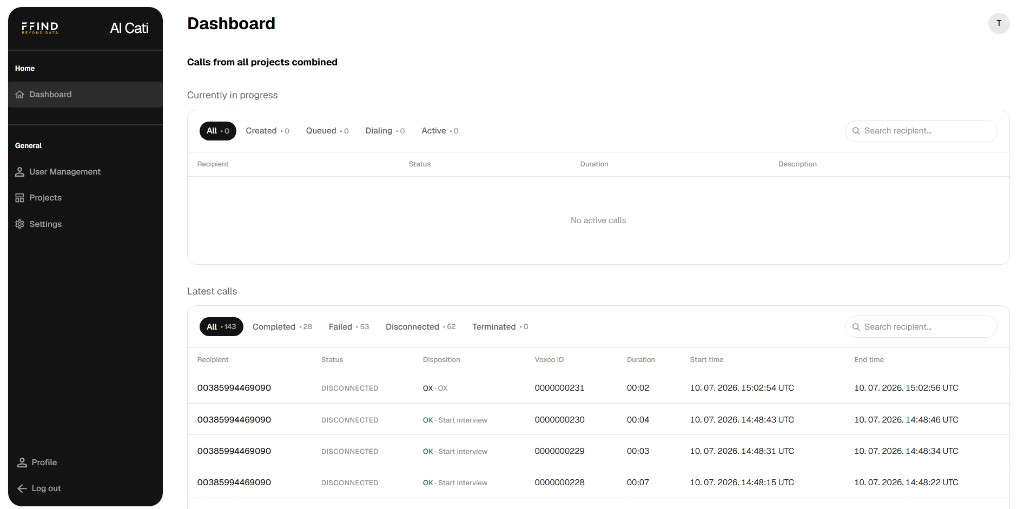
A management console for FFIND staff to watch calls live, review recordings and dispositions, manage projects, quotas and users.
How the interview delivery model changed
The phone call, the questionnaire and the reporting stayed the same - what changed is who is on the other end of the line.
Interview delivery
Before
Live human interviewer, every call
After
AI voice agent, questionnaire-aware
Removes the interviewer as the hard limit on campaign throughput.
Concurrent interviews
Before
Bound by interviewer headcount
After
Bound by telephony/infrastructure capacity
Scaling a campaign no longer means scaling a shift roster.
Calling hours
Before
Fixed staffed shifts
After
Scheduler-driven, including automatic callbacks
Calls and callbacks happen exactly when agreed, without a person remembering to redial.
Result reporting
Before
Manual disposition entry per call
After
Automatic, Voxco-compatible disposition codes
Existing QA and reporting pipelines keep working unchanged.
Interview capacity that scales with infrastructure, not headcount
Scales with telephony/GPU capacity, not headcount
campaign throughput is no longer capped by how many interviewers are on shift
Interviewer labor cost avoided per completed interview
modeled against standard CATI interviewer rates for an equivalent completed-interview volume
200,000 – 999,999 €
فترة الاسترداد
Depends on sustained campaign volume; not yet independently audited
الطريقة
Comparison of AI-agent operating cost (compute + telephony) against the standard cost of a live CATI interviewer per completed interview
درجة الثقة
Medium - based on operating-cost modeling, not an audited financial report
This figure describes operating-cost avoidance, not FFIND revenue; exact volumes and figures are commercially confidential.
A CATI operation that can run without an interviewer on every call
The system is in production, dialling and interviewing directly against FFIND's Voxco sample. Live campaign volumes belong to FFIND; the figures below describe what changed operationally.
Interviews requiring a live human interviewer
قبل
100%
بعد
Conducted end-to-end by the AI voice agent
In production
Concurrent interviews in flight
قبل
Bound by interviewer headcount
بعد
Configurable dialer concurrency
Per campaign
Disposition & result reporting
قبل
Manual, per call
بعد
Automatic, Voxco-compatible codes
Every call
Callback / appointment follow-up
قبل
Manual re-scheduling
بعد
Automatic redial at the agreed time
Ongoing
“We didn't want a chatbot bolted onto a phone line - we needed something that could actually run our questionnaire, the way our interviewers do. It dials our own Voxco sample, asks the real questions, and the results come back in the same format we already report on.”
Operations Lead
FFIND
قد تعجبك هذه المشاريع أيضاً

مساعد محادثة بالذكاء الاصطناعي لبيجو كرواتيا