Real-time diabetes data, one secure record
Unifying patient devices, manual entries and clinician oversight - with ML-based insulin-dose prediction
2024
تسليم متعدّد المراحل
التقنية الصحية / إدارة السكري
Starting position
النقطة الأساس
- 4+ disconnected sources
Apps and notes per patient
Device apps, food logs, paper notes - nothing synced
- None
Clinical visibility between visits
Only point-in-time snapshots during appointments
- Manual estimation only
Insulin dosing support
Patients estimate doses from experience, no data-driven aid
- None
Access control over health data
No structured roles, no audit trail
حجم السوق
≈ 540 million worldwide
People living with diabetes
الميزانية التقريبية
50,000 – 199,999 €
توزيع الميزانية
Budget bucket per Clutch.co project cost category. Exact figures under NDA.
4-phase delivery
Multi-phase
- 1
Phase 1
Discovery, clinical workflow research, security baseline
- 2
Phase 2
Platform architecture, device integration spec, role model
- 3
Phase 3
Core patient record, real-time sync, ML insulin-dose model
- 4
Phase 4
Beta with clinical partners, audit and production rollout
Fragmented diabetes data across devices and channels
Patients managing diabetes typically juggle continuous glucose monitors, glucometers, food logs and paper notes - none of which sync. Clinicians see only snapshots during appointments, and insulin dosing relies entirely on the patient's own estimation.
Glucose readings live in proprietary device apps with no shared view
Manual entries (meals, insulin, activity) often stored in separate notes
Clinicians lack a continuous longitudinal record between visits
Insulin doses estimated by feel, with no data-driven support
Sensitive health data requires strict access control and auditability
Unified patient record with ML-based insulin prediction
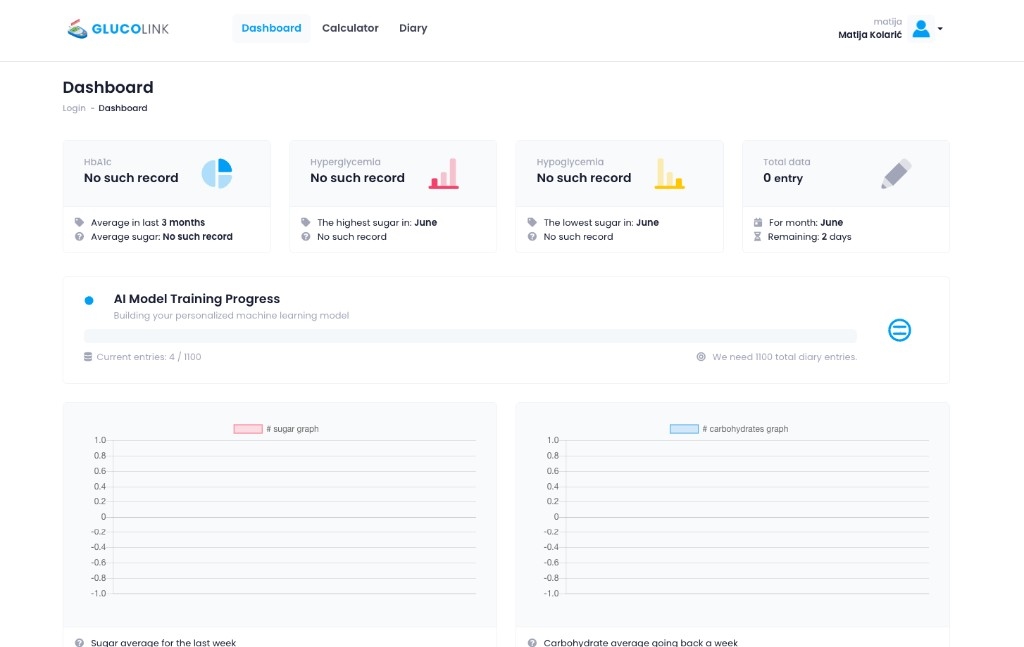
We built a secure cloud platform that ingests device readings, accepts manual entries, and exposes role-scoped views for patients, family caregivers and clinicians. On top of the unified record we developed a machine-learning model that predicts each patient's required insulin dose from their own glucose, meal and activity history.
Real-time data sync
Device readings and manual entries propagate to all authorised viewers within seconds.
Insulin-dose prediction (ML)
A Random Forest regression model, trained and tuned per patient, predicts the required insulin dose once enough diary history is collected.
Role-based access
Granular permissions separate patient, caregiver and clinician views with full audit logging.
Privacy-by-design
Encrypted storage, GDPR-aligned data handling and explicit patient consent flows.
How the patient + clinician offering changed
Capabilities reframed end-to-end so glucose data becomes a continuous shared record rather than scattered snapshots - and dosing gets data-driven support.
Data location
Before
Locked in proprietary device apps
After
Unified cloud record across devices
One shared source of truth for patient, caregiver and clinician.
Insulin dosing
Before
Manual estimation by the patient
After
Per-patient ML dose prediction
The model learns from the patient's own history instead of rules of thumb.
Clinical visibility
Before
Snapshots during appointments
After
Continuous longitudinal record
Decisions based on trends, not point-in-time readings.
Privacy posture
Before
Ad-hoc storage and sharing
After
Encrypted + GDPR-aligned by design
Health data handled to the standard the regulation demands.
From scattered notes to a data product with predictive value
≈ 2-3x
modeled platform value vs. running cost, first year
≈ 10-15 h / month
estimated time reclaimed per patient on manual logging and data reconstruction
50,000 – 199,999 €
فترة الاسترداد
Within the first year of operation
الطريقة
Pre/post comparison of time spent gathering and reconstructing patient data, patients and clinicians combined
درجة الثقة
Medium - based on beta-period usage; no clinical-outcome claims are made
Figures describe workflow efficiency only; medical outcomes are the domain of the clinical partners.
A single record replacing four fragmented systems
The platform consolidated glucose readings, meal logs, insulin tracking and activity data from separate apps into one continuous, clinician-accessible record - with a machine-learning model that predicts each patient's required insulin dose at its core.
Patient data sources
قبل
4+ separate device apps
بعد
1 unified timeline
At platform launch
Insulin-dose prediction
قبل
Manual estimation by the patient
بعد
Per-patient ML model
Trained and tuned per patient
Clinical visibility
قبل
Snapshots at appointments
بعد
Continuous real-time record
For authorised clinicians
Access roles supported
قبل
No structured access model
بعد
Patient · Caregiver · Clinician
With full audit logging
“I used to spend the first ten minutes of every appointment reconstructing what happened since the last one. Now I open the record and the whole period is already there - including what the model suggested and what the patient actually took.”
Endocrinologist, clinical beta partner
Confidential - Diabetes Management Platform