

Process Automation Guide for Mid-Sized Enterprises 2026

Process automation promises massive efficiency gains and cost savings, yet many mid-sized enterprises watch their initiatives stall or fail entirely. You’re not alone if your automation project delivered disappointing results or never made it past the pilot stage. The problem isn’t automation itself but how organizations approach implementation. This guide reveals proven methods to avoid common pitfalls and accelerate your automation success, cutting typical timelines from over a year to just a few months while delivering measurable operational improvements.
Table of Contents
- Understanding Common Challenges In Process Automation
- Preparing For Process Automation: Essential Prerequisites
- Executing Automation With The 123MAPPA Method For Rapid Results
- Verifying Success And Sustaining Automation Benefits
- Boost Your Automation Success With NULLBIT Solutions
- FAQ
Key takeaways
| Point | Details |
|---|---|
| Redesign before automation | Automating broken processes locks in inefficiency and wastes resources |
| 123MAPPA accelerates results | This method delivers outcomes in 3-4 months versus 12-18 months traditionally |
| High failure rates plague RPA | 30-50% of implementations fail when organizations skip process analysis |
| Preparation drives success | Mapping workflows and engaging stakeholders before deployment improves outcomes |
Understanding common challenges in process automation
Most automation projects stumble because organizations rush to deploy technology without addressing fundamental process problems. RPA implementations fail 30-50% of the time, with many abandoned within 18 months of launch. The culprit isn’t the technology but the approach.
You’ve probably seen this pattern in your own organization. Teams identify a manual process, purchase automation software, and expect immediate transformation. Instead, they automate inefficient workflows that were already problematic. The result? Faster execution of flawed processes that still produce poor outcomes. Bots get deployed, initial excitement fades, and within months the automated process requires constant manual intervention or gets abandoned entirely.
Several critical mistakes drive these failures:
- Organizations treat automation as a technology problem rather than a process redesign opportunity
- Teams skip thorough analysis of current workflows and pain points
- Leadership sets unrealistic expectations about transformation timelines and impact
- Enterprises focus on bot deployment metrics instead of business outcome improvements
- IT departments implement solutions without sufficient input from operational staff who understand the work
RPA’s architectural limitations compound these issues. The technology excels at mimicking human actions in existing systems but can’t fundamentally transform how work gets done. When you automate a seven-step approval process that should only require three steps, you’ve simply created a faster version of waste.
“The greatest value of RPA lies not in the bots themselves but in forcing organizations to examine and redesign their processes first.”
This reality check explains why enterprises investing heavily in automation tools often see minimal returns. They’re applying advanced technology to yesterday’s processes, expecting tomorrow’s results. The solution requires shifting focus from tool selection to business process optimization before any automation begins.
Successful automation demands realistic expectations. You won’t eliminate all manual work overnight. Complex processes require careful analysis, stakeholder alignment, and iterative improvement. Organizations that accept this reality and invest in proper preparation see dramatically better outcomes than those chasing quick wins through technology alone.
Preparing for process automation: essential prerequisites
Effective automation starts long before you deploy any bots or software. Your preparation phase determines whether your initiative delivers lasting value or becomes another failed project statistic. Start by mapping current processes in exhaustive detail, documenting every step, decision point, exception, and handoff.

This mapping exercise reveals inefficiencies that aren’t obvious during daily operations. You’ll discover redundant approvals, unnecessary data transfers, and workarounds employees created to bypass broken systems. Document these findings without judgment. The goal is understanding reality, not assigning blame for inefficient processes that evolved over time.
Next, engage stakeholders across functions who interact with the target process. Include frontline staff who execute the work daily, managers who oversee operations, and customers or internal users who receive the output. These conversations surface pain points, constraints, and improvement opportunities that process documentation alone misses. Frontline employees especially offer insights into workarounds and exceptions that formal procedures don’t capture.
Process redesign comes before automation, not after. Use your mapping and stakeholder input to reimagine how work should flow in an ideal state. Question every step. Does this approval add genuine value or just satisfy outdated policies? Can you eliminate handoffs between departments? Should certain decisions happen earlier or later in the workflow?
Establish clear, measurable goals that extend beyond simple automation metrics. Don’t just aim to “automate invoice processing.” Define specific targets:
- Reduce invoice processing time from 5 days to 24 hours
- Cut processing costs by 40% within six months
- Improve accuracy to 99.5% or better
- Free up 20 hours per week of staff time for higher-value work
These concrete objectives let you measure success and make data-driven decisions about which processes to automate first. Prioritize processes with high volume, clear rules, and significant time consumption. Save complex, exception-heavy workflows for later phases after you’ve built automation expertise.
Prepare your organization for change beyond just the technical implementation. Automation shifts how people work, which roles require what skills, and how teams collaborate. Address these human factors early through transparent communication about goals, timeline, and impact on individual roles. Employees resist automation when they fear job loss but embrace it when positioned as eliminating tedious work so they can focus on meaningful tasks.
Pro Tip: Never automate a process you wouldn’t be comfortable scaling 10x in its current form. If inefficiencies exist today, automation magnifies them tomorrow.
Finally, assess your technical infrastructure and data quality. Automation requires reliable systems, clean data, and appropriate integration capabilities. Identify gaps in your current environment and address them before deployment. Poor data quality sabotages even well-designed automation, producing unreliable outputs that erode trust in the entire initiative.
Executing automation with the 123MAPPA method for rapid results
The 123MAPPA method offers mid-sized enterprises a structured framework that delivers results in 3-4 months instead of the 12-18 months typical of traditional automation initiatives. This accelerated approach works particularly well for organizations with moderate process complexity that need quick wins to build momentum and stakeholder confidence.
The method breaks implementation into clear, sequential phases:
- Mapping involves documenting current-state processes with precision, capturing every step, decision, and exception without attempting improvement yet
- Analysis examines mapped processes to identify bottlenecks, redundancies, and improvement opportunities using data and stakeholder input
- Process redesign reimagines workflows to eliminate waste and optimize for automation, creating future-state process maps
- Pilot implementation tests redesigned processes with automation on a limited scale to validate assumptions and refine approaches
- Performance monitoring tracks results against defined KPIs and gathers feedback for continuous improvement
- Adjustment incorporates lessons learned to optimize automated processes before broader rollout
- Full deployment scales successful pilots across the organization with appropriate training and support
This structured progression prevents the chaos that derails many automation projects. Each phase builds on previous work, creating a solid foundation before moving forward. You validate assumptions early when corrections are inexpensive rather than discovering problems after full deployment.
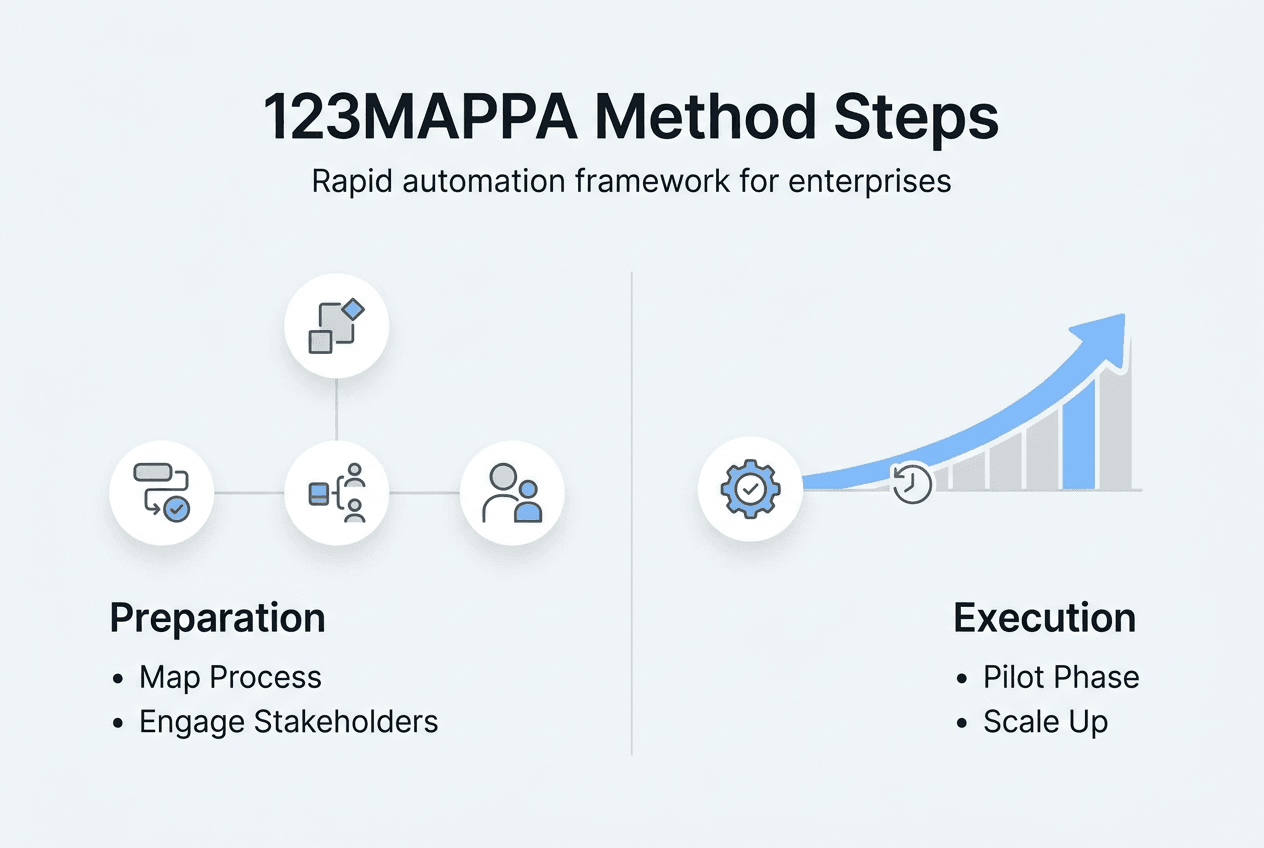
| Approach | Timeline | Resource Intensity | Success Rate | | — | — | — | | 123MAPPA Method | 3-4 months | Moderate | High | | Traditional BPM | 12-18 months | Very High | Moderate | | Ad Hoc Automation | Varies widely | Low initially | Low |
The compressed timeline doesn’t mean rushing through steps. Instead, 123MAPPA eliminates the bureaucratic overhead and analysis paralysis that plague traditional business process management initiatives. You focus on practical outcomes rather than perfect documentation. This pragmatic approach suits mid-sized enterprises that lack the resources for extensive consulting engagements but need professional-grade results.
Cross-functional collaboration accelerates every phase. Form a core team representing IT, operations, and business units affected by the target process. This team drives daily progress while a steering committee of senior leaders provides direction and removes obstacles. Regular touchpoints keep everyone aligned and surface issues before they become blockers.
Pro Tip: Schedule weekly working sessions where team members collaboratively map processes and design improvements rather than working in isolation and presenting completed work. Real-time collaboration catches misunderstandings early and builds shared ownership.
The pilot phase deserves special attention. Select a process segment that’s representative but limited in scope. Run the automated process in parallel with the existing manual process initially, comparing outputs to verify accuracy and identify edge cases your design didn’t anticipate. This parallel operation provides safety while building confidence in the automated approach.
Document everything during pilot implementation. Capture what works, what doesn’t, and why. These insights prove invaluable when scaling to full deployment and tackling subsequent automation projects. Your organization builds institutional knowledge about effective automation practices rather than starting from scratch each time.
Integration with existing systems often presents technical challenges during execution. Work closely with IT to ensure automated processes can access necessary data, trigger appropriate actions in other systems, and handle errors gracefully. Robust error handling separates successful automation from brittle implementations that require constant manual intervention. For complex integration needs, consider leveraging expertise in AI automation implementation and understanding different AI integration approaches available to enterprises.
The 123MAPPA framework’s flexibility lets you adapt to your specific context. Adjust phase durations based on process complexity, available resources, and organizational readiness. The key is maintaining the sequential structure while customizing details to fit your situation.
Verifying success and sustaining automation benefits
Automation success isn’t measured at deployment but through sustained performance over time. Establish comprehensive monitoring from day one to track whether automated processes deliver promised benefits and identify opportunities for further optimization.
Define KPIs aligned with your original goals before automation began. If you aimed to reduce processing time, track cycle time from process initiation to completion. If cost reduction drove the initiative, monitor labor hours saved and operational expenses. Common automation KPIs include:
- Process cycle time and throughput
- Error rates and quality metrics
- Cost per transaction or process execution
- Employee time freed for other work
- Customer or user satisfaction scores
- Exception handling frequency
Collect baseline data before automation so you can demonstrate actual improvement rather than relying on estimates. Concrete before-and-after comparisons prove value to stakeholders and justify investment in additional automation initiatives.
Implement real-time monitoring dashboards that surface issues immediately rather than discovering problems during monthly reviews. Automated processes can fail silently, processing transactions incorrectly for extended periods before anyone notices. Dashboard alerts for unusual patterns, error spikes, or performance degradation let you intervene quickly and minimize impact.
Schedule regular process reviews even after automation runs smoothly. Business conditions change, systems get updated, and new requirements emerge. Quarterly reviews let you assess whether automated processes still align with business needs and identify enhancement opportunities. These reviews also catch process drift where employees create workarounds that bypass automation, gradually eroding benefits.
Create feedback loops that capture input from employees who interact with automated processes and customers who experience the results. Frontline staff notice issues that don’t show up in quantitative metrics. Customers provide perspective on whether automation improved their experience or created new friction points. Act on this qualitative feedback to refine automated processes continuously.
Plan for scaling successful automation gradually rather than attempting organization-wide transformation immediately. Start with one department or process area, prove results, refine your approach, then expand to similar processes elsewhere. This measured progression builds expertise and confidence while limiting risk.
Document lessons learned from each automation initiative in a centralized knowledge base. Capture what worked, what didn’t, and why. Include technical details about integration challenges, organizational insights about change management, and process-specific nuances. Future automation projects benefit from this accumulated wisdom, accelerating implementation and avoiding repeated mistakes.
Invest in ongoing training so employees can work effectively with automated processes and identify improvement opportunities. Automation changes how work gets done, requiring new skills and different ways of thinking about tasks. Regular training sessions keep capabilities current as your automation footprint expands.
Consider establishing a center of excellence for process optimization that maintains standards, shares best practices, and provides support for automation initiatives across the organization. This centralized function prevents duplicated effort and ensures consistent approaches to automation challenges.
Boost your automation success with NULLBIT solutions
Implementing effective process automation requires more than off-the-shelf tools. You need custom software development that fits your specific workflows, integrates seamlessly with existing systems, and adapts as your needs evolve. NULLBIT specializes in creating tailored automation solutions that deliver measurable ROI for mid-sized enterprises.
Our agile development approach ensures your automation initiative stays aligned with changing business priorities. We work iteratively, delivering functional components quickly so you see results while development continues. This flexibility proves essential for automation projects where requirements become clearer through implementation experience.
Complex automation demands robust technical architecture. Our system engineering services design scalable infrastructure that supports current automation needs while accommodating future expansion. We handle integration challenges, ensure data flows reliably between systems, and build error handling that keeps processes running smoothly.
Ready to transform your operations through effective process automation? Contact NULLBIT to discuss your specific challenges and explore how our expertise accelerates your automation success.
FAQ
What are the biggest risks when starting automation projects?
The greatest risk is automating flawed processes without redesign, which locks in inefficiency and wastes resources. Other major risks include setting unrealistic expectations, insufficient stakeholder engagement, and inadequate preparation of technical infrastructure and data quality.
How long does it typically take to see results from process automation?
Using structured methods like 123MAPPA, you can see initial results in 3-4 months from project start to pilot deployment. Full organizational benefits typically materialize within 6-9 months as you scale successful pilots and optimize based on early learnings.
Can automation work without redesigning current processes?
Automation can technically proceed without redesign but rarely delivers significant value. You’ll simply execute inefficient processes faster, missing opportunities for genuine transformation. Process optimization before automation dramatically improves outcomes and ROI.
How do I choose the right automation tools for my enterprise?
Start by defining your specific process requirements, integration needs, and scalability expectations before evaluating tools. Prioritize solutions that fit your technical environment, offer appropriate customization capabilities, and provide reliable vendor support. Consider custom development when off-the-shelf tools can’t address your unique workflows.
What metrics should I track to measure automation success?
Track metrics directly tied to your original goals such as process cycle time, cost per transaction, error rates, and employee hours freed for higher-value work. Include qualitative measures like employee and customer satisfaction to capture the full impact beyond operational efficiency.
Recommended
- How to Implement AI Automation for Enterprise Success | NULLBIT
- AI Automation: Transforming Enterprise Operations Globally | NULLBIT
- How to Implement AI Workflow for Enterprise Efficiency | NULLBIT
- Scalable AI Solutions Guide for Enterprise Success | NULLBIT
- AI Agents in Business Automation 2025 | - Proud Lion Studios
- The Ultimate Guide to Automation Tools for 2025: LinkedIn & Email Marketing - Sales Label IT Consulting