

How to Implement AI Automation for Enterprise Success

Deploying AI automation across an enterprise reveals unexpected hurdles long before the technology goes live. For many North American organizations, the real obstacles emerge in areas like data quality, skill gaps, and governance rather than algorithms or code. Focusing on a comprehensive AI readiness framework helps CTOs pinpoint where true investment is needed, reducing risk and setting the stage for operational gains. This guide breaks down proven steps for assessing needs, building roadmaps, deploying solutions, and validating impact at scale.
Table of Contents
- Step 1: Assess Business Needs And AI Readiness
- Step 2: Design AI Automation Roadmap
- Step 3: Deploy AI Solutions Across Workflows
- Step 4: Validate Automation Performance
Quick Summary
| Significant Insight | Detailed Explanation |
|---|---|
| 1. Assess AI Readiness Carefully | Evaluate current infrastructure, skills, and governance to determine readiness before starting AI projects. |
| 2. Focus on High-Impact Areas | Prioritize AI initiatives that promise measurable business outcomes and have strong data foundations. |
| 3. Implement in Phases | Roll out AI solutions gradually to minimize disruption and allow for troubleshooting during deployment. |
| 4. Establish Clear Metrics | Define success metrics upfront to measure the AI’s impact on business performance and accountability. |
| 5. Ongoing Performance Validation | Regularly monitor AI systems and retrain models to ensure they adapt to changing business conditions. |
Step 1: Assess Business Needs and AI Readiness
Before deploying AI automation, you need a clear picture of where your organization stands. This assessment determines which processes benefit most from AI and reveals gaps in infrastructure, skills, or governance that could derail your initiative.
Start by mapping your business challenges. What operational bottlenecks consume the most resources? Where are your teams making repetitive decisions? Document these pain points across departments. Your goal is identifying processes where automation delivers measurable ROI, not automating for automation’s sake.
Next, evaluate your current state across eight critical dimensions:
- Strategy alignment: Does AI support your long-term business objectives?
- Data quality and availability: Can you access clean, organized data for AI systems?
- Technology infrastructure: What platforms and tools do you already have?
- People and skills: Do you have data scientists, engineers, and AI-literate leaders?
- Organizational culture: Will employees embrace AI-driven changes?
- Current processes: How mature are your existing workflows?
- Governance framework: Do you have policies for AI ethics and risk management?
- Regulatory compliance: What industry standards apply to your operations?
Use an AI readiness framework with a structured maturity model to benchmark where you stand. This prevents overestimating capabilities and reveals exactly where investments are needed.
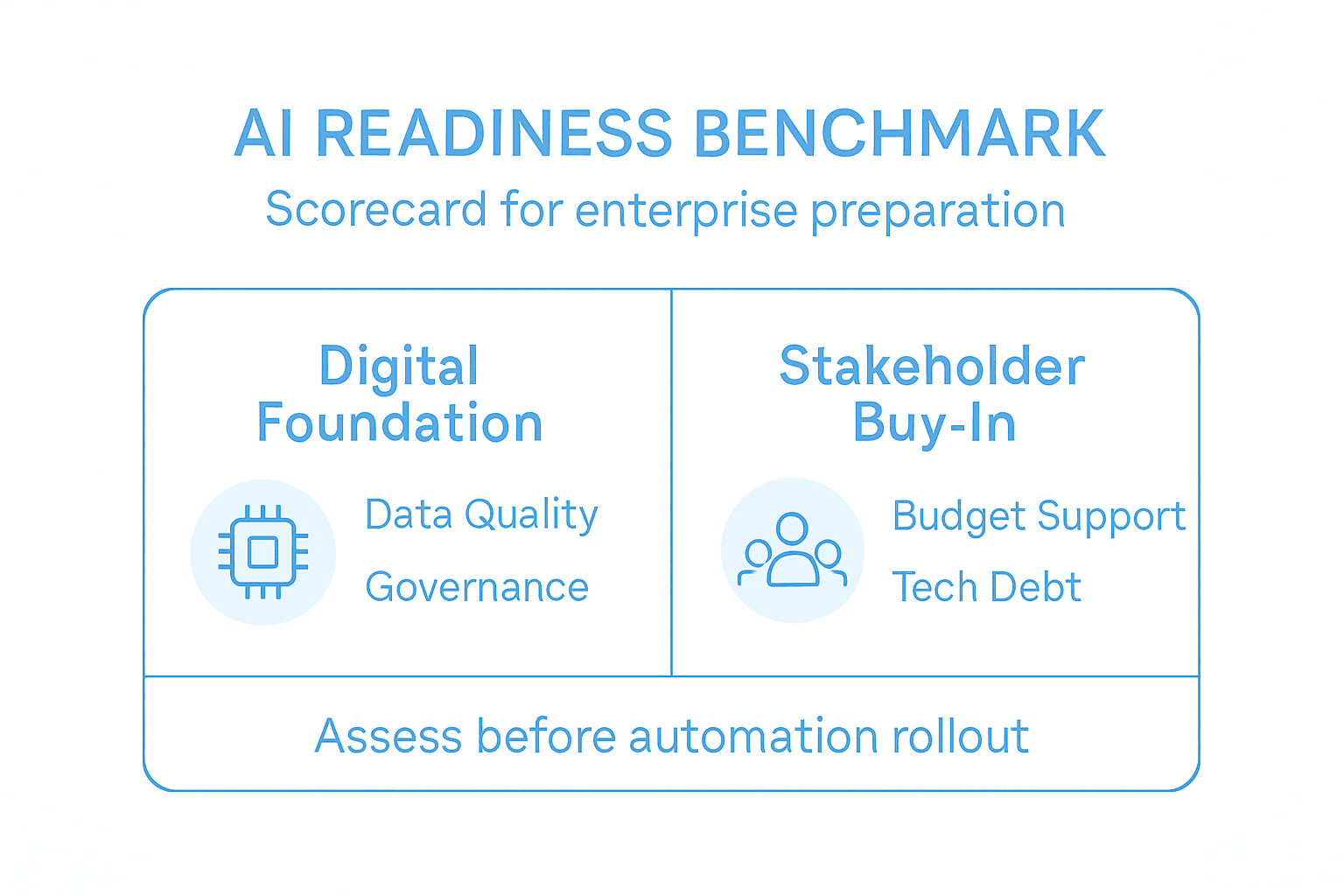
Assess your digital foundation next. Organizations lacking strong data infrastructure or unclear governance often struggle with AI implementation. Your organization’s digital maturity and AI readiness directly impacts how quickly you can scale AI solutions.
Conduct honest conversations with stakeholders. Ask CTOs about technology debt. Interview business leaders about budget constraints. Talk with frontline employees about pain points. This cross-functional input prevents implementing solutions that solve the wrong problems.
Document your findings in a readiness scorecard. Rate each dimension on a 1-5 scale. Areas scoring below 3 represent immediate investment priorities before launching AI pilots.
Here’s a summary of the eight AI readiness dimensions and what to look for at each stage:
| Readiness Dimension | Key Focus Area | High Readiness Indicator |
|---|---|---|
| Strategy Alignment | Linking AI to business goals | AI initiatives drive specific business value |
| Data Quality & Availability | Clean, accessible data sources | Well-maintained, governed company datasets |
| Technology Infrastructure | Supportive software, hardware, cloud | Modern tools and scalable architecture |
| People & Skills | Technical talent and leadership | Experienced engineers and AI advocates |
| Organizational Culture | Employee openness to AI | Broad support for digital transformation |
| Current Processes | Workflow maturity | Standardized, well-documented procedures |
| Governance Framework | AI oversight and risk management | Formal policies for AI ethics and security |
| Regulatory Compliance | Industry standards and laws | Systems monitor and adapt to compliance needs |
Organizations fail at AI not because the technology doesn’t work, but because they underestimated readiness gaps in data, people, and governance.
Pro tip: Focus your initial assessment on one high-impact business area where data quality is strong and stakeholder buy-in exists. This proves AI value quickly and builds momentum for broader implementation.
Step 2: Design AI Automation Roadmap
With your readiness assessment complete, you now translate findings into a concrete roadmap. This roadmap prioritizes initiatives, sequences implementations, and aligns AI projects with business objectives over the next 12 to 24 months.
Start by ranking opportunities discovered during your assessment. High-impact projects should have three qualities: measurable business outcomes, strong data foundation, and executive sponsorship. Rank each opportunity on impact versus implementation difficulty. Quick wins in the bottom-left quadrant build momentum and prove ROI early.
Your roadmap should include three phases:
- Foundation phase (months 1-4): Build infrastructure, hire talent, establish governance, and launch your first pilot project.
- Expansion phase (months 5-12): Scale successful pilots, train teams on AI tools, and integrate automation into key workflows.
- Optimization phase (months 13-24): Refine models based on production data, expand to additional business units, and establish continuous improvement processes.
Define clear milestones for each phase. Instead of vague goals like “implement AI,” set specific targets: “reduce manual data entry by 60% in finance” or “cut customer support response time to 2 hours.” These measurable outcomes drive accountability and help you track progress.
Identify resource requirements upfront. Determine how many engineers, data scientists, and domain experts you need. Budget for technology infrastructure, vendor tools, and training programs. Most enterprises underestimate people costs. Data scientists command premium salaries, and hiring delays derail timelines faster than technical obstacles.
Establish decision gates at key intervals. After the pilot, decide whether to expand, modify, or discontinue that initiative. This prevents sunk-cost fallacies where organizations continue failing projects because they’ve already invested heavily.
Consider AI automation implementation strategies that balance quick wins with long-term transformation. Your roadmap should reflect your organization’s appetite for change and capacity to absorb new processes.
A roadmap without clear milestones and resource allocation is just a wish list. You need specific timelines, budgets, and ownership.
Pro tip: Schedule quarterly roadmap reviews with stakeholders to adjust timelines based on resource availability, business priorities, or technical learnings. Rigid roadmaps become obsolete fast in AI projects.
Step 3: Deploy AI Solutions Across Workflows
Deployment transforms your roadmap from strategy into operational reality. This step moves AI from pilot projects into production systems where it handles real transactions, processes, and decisions at scale.
Begin with your first high-priority workflow. Have your technical team build a minimal viable product (MVP) that addresses the core business problem without unnecessary complexity. An MVP for automating invoice processing might extract data from PDFs and validate vendor information, skipping advanced features until you validate basic functionality.

Before full deployment, run parallel testing. Have your AI system process data alongside your existing process for two to four weeks. Compare outputs between the AI solution and your current approach. This reveals edge cases, data quality issues, and gaps in the model’s training. You might discover the AI struggles with certain document formats or vendor categories that need retraining.
Roll out in phases to minimize disruption:
- Phase 1: Deploy to a subset of users or a single department. Monitor performance closely and gather feedback.
- Phase 2: Expand to additional departments after addressing Phase 1 issues.
- Phase 3: Scale across the entire organization with full training and support infrastructure.
Set clear success metrics for each phase. Define what success looks like: accuracy rates, processing speed improvements, cost savings, or employee time freed up. Track these metrics weekly during deployment.
Address the human side actively. Train employees on the new workflow, explain how AI augments their role, and create clear escalation paths for cases the AI cannot handle. Resistance often stems from uncertainty, not actual performance issues. Transparency builds trust.
Integrate AI-powered solutions into your existing systems carefully. Determine whether the AI works as a standalone tool, integrates with your current software, or requires custom middleware. Poorly planned integrations create data silos and operational friction.
Monitor production closely after launch. Track accuracy, failure rates, and user feedback. AI models degrade over time as data patterns shift, so plan for ongoing monitoring and retraining.
Deployment success depends on parallel testing and phased rollouts more than on model accuracy alone. Rushing to full scale without validation leads to failures that damage adoption.
Pro tip: Assign a dedicated AI operations team to monitor model performance, handle escalations, and coordinate retraining cycles. This prevents AI systems from silently degrading in production while teams focus on other priorities.
Step 4: Validate Automation Performance
Validation ensures your AI automation actually delivers the business results you promised. This step moves beyond testing accuracy to measuring real-world performance against business metrics that matter to stakeholders.
Start by establishing baseline metrics before full deployment. If you are automating invoice processing, measure your current cycle time, error rate, and cost per invoice. These become your comparison points for proving AI impact.
Define three categories of validation metrics:
- Quality metrics: Accuracy, precision, recall, and error rates that show technical performance.
- Safety metrics: Compliance violations, security breaches, or harmful outputs that could damage your business.
- Business metrics: Cost savings, time reduction, revenue impact, or customer satisfaction that justify the investment.
Business metrics drive adoption more than technical metrics. A 95 percent accurate system that saves three hours weekly per employee is more compelling to leadership than discussing F1 scores. Connect every technical metric back to business impact.
Implement continuous testing and human evaluation throughout the AI lifecycle to catch performance degradation early. AI models degrade as real-world data drifts from training data. Set up weekly performance monitoring dashboards that alert your team when metrics drop below thresholds.
Combine three validation approaches. Use automated testing to check if the system handles expected inputs correctly. Conduct human review where subject matter experts evaluate a random sample of outputs monthly. Apply statistical benchmarking to compare your AI performance against industry standards or competitor capabilities.
The evaluation gap between lab conditions and production performance is where most AI failures happen. A system scoring 94 percent accuracy in testing might drop to 87 percent in production when handling edge cases, seasonal patterns, or unusual data formats.
Document failures and retraining triggers. Define what prompts model retraining: “Accuracy drops below 90 percent for three consecutive weeks” or “Error volume exceeds 50 cases monthly.” Automatic retraining prevents manual intervention bottlenecks.
Use this table to compare validation metrics and their primary business impact:
| Metric Type | Example Metrics | Business Impact |
|---|---|---|
| Quality | Accuracy, recall, error rate | Reduces mistakes and rework |
| Safety | Compliance, security breaches | Prevents legal and reputational risk |
| Business | Cost savings, cycle time | Direct ROI and productivity gains |
Validation is not a one-time event after deployment. It is an ongoing process that determines whether your AI remains valuable as business conditions change.
Pro tip: Create a validation scorecard that tracks quality, safety, and business metrics side by side. Review it monthly with technical and business stakeholders to ensure the AI remains aligned with organizational priorities.
Accelerate Your AI Automation Journey with NULLBIT
Implementing AI automation in your enterprise is complex. You need to overcome challenges like assessing AI readiness, designing a clear roadmap, and deploying solutions that align with your business goals. Common pain points include managing data quality, bridging skill gaps, establishing governance, and ensuring continuous validation to maintain AI performance. These steps require more than just technology—they demand a strategic partner who understands how to turn your AI ambitions into real-world value.
At NULLBIT, we specialize in delivering tailored AI automation solutions that address exactly these challenges. Our expertise spans from assessing your organization’s digital maturity and developing comprehensive AI strategies to implementing scalable AI systems integrated seamlessly into your operations. Whether you need help building a strong AI foundation or deploying advanced automation workflows, we provide dedicated teams and proven methodologies focused on measurable ROI and long-term success.
Ready to transform your enterprise with AI automation that truly works? Discover how our AI-powered solutions can accelerate your digital transformation. Partner with us today to create an actionable roadmap, mobilize expert resources, and validate your automation impact with confidence.
Frequently Asked Questions
How do I assess my organization’s AI readiness?
Start by evaluating your business challenges and documenting operational bottlenecks. Use an AI readiness framework to score your organization across dimensions like strategy alignment, data quality, and technology infrastructure.
What steps should I take to design an AI automation roadmap?
Begin by ranking high-impact opportunities from your readiness assessment based on measurable business outcomes and implementation difficulty. Outline clear phases for foundation, expansion, and optimization, setting specific milestones for each phase.
How can I ensure a successful AI deployment across workflows?
Deploy your initial AI project as a minimal viable product (MVP) and run parallel testing alongside your existing process. Gradually roll out to more users or departments while closely monitoring performance and gathering feedback.
What metrics should I use to validate the performance of AI automation?
Establish baseline metrics like error rates and cycle times before deployment. Track quality metrics (accuracy), safety metrics (compliance), and business metrics (cost savings) to ensure the AI delivers the promised results consistently.
How often should I review and adjust my AI automation strategy?
Schedule quarterly roadmap reviews with stakeholders to assess progress and adapt to resource availability or shifting business priorities. This regular evaluation helps keep your AI initiatives aligned with organizational goals.
What human factors should I consider when implementing AI automation?
Focus on training employees to work with the new systems and clearly communicate how AI will enhance their roles. Establish transparency to build trust and address any resistance stemming from uncertainty about AI’s impact.
Recommended
- AI Automation Services | Workflow Automation & AI Agents | NULLBIT
- AI Solutions | Copilots, RAG Systems & AI Features | NULLBIT
- MCP Development | Model Context Protocol Integration | NULLBIT
- Digital Business DNA - ChatGPT & Gemini Ready | NULLBIT
- Balancing Innovation, Clarity, and Time in an AI-Driven World
- Dot Data Labs — High-Quality Data for Training AI Models — Providing datasets for AI training
- How to Deploy GPU Servers for AI and Model Training