

Streamline your Industry 4.0 implementation workflow

Operations executives face mounting pressure to modernize manufacturing systems, yet Industry 4.0 adoption remains fragmented across most enterprises. Without a structured implementation workflow, digital transformation initiatives frequently stall, waste resources, or fail to deliver measurable returns. This guide provides a proven, phased approach to help you navigate the complexity of Industry 4.0 deployment. You will learn how to assess organizational readiness, select appropriate technologies, execute controlled rollouts, and verify results through continuous improvement practices that drive sustained competitive advantage.
Table of Contents
- Key takeaways
- Understanding the Industry 4.0 implementation workflow
- Preparing your organization for Industry 4.0 adoption
- Executing the Industry 4.0 workflow: step-by-step implementation
- Verifying and optimizing your Industry 4.0 implementation
- Enhance your Industry 4.0 journey with expert digital solutions
- FAQ
Key Takeaways
| Point | Details |
|---|---|
| Phased implementation | A structured, phased workflow guides readiness, pilot testing, and scaling to deliver measurable value. |
| Maturity based readiness | Tailored maturity models establish baseline capabilities to tailor technology choices and deployment plans. |
| Start small first | Starting with small pilots controls risk while proving value before committing significant capital. |
| Verification gates | Regular checkpoints verify performance and business cases before expanding beyond pilots. |
Understanding the Industry 4.0 implementation workflow
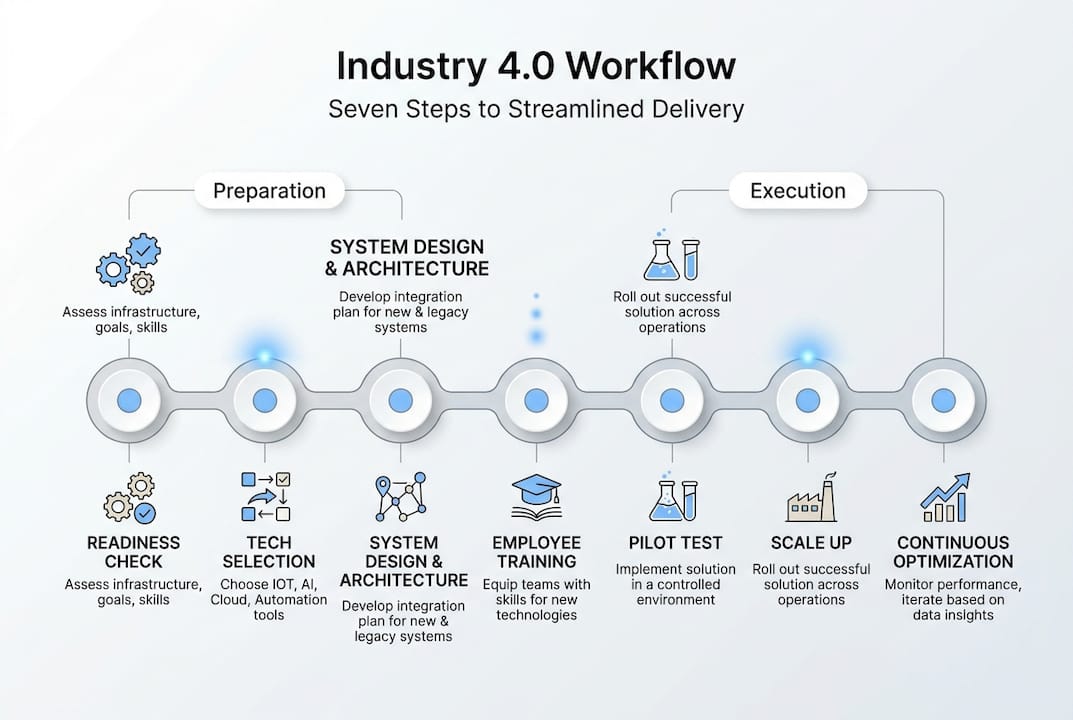
A maintenance optimization model includes 7 phases such as maturity diagnostic and tech selection, providing a proven framework for systematic deployment. These phases create a logical progression from initial assessment through full-scale implementation, ensuring each step validates assumptions before advancing. The workflow begins with organizational readiness evaluation, moves through technology selection and pilot testing, then scales proven solutions across operations.
Assessing organizational readiness establishes your starting point and identifies capability gaps that could derail implementation. This diagnostic evaluates your current automation level, data infrastructure maturity, workforce digital skills, and change management capacity. Without this baseline, you risk selecting technologies your organization cannot effectively absorb or sustain. The assessment also reveals quick wins that build momentum and stakeholder confidence.
Each implementation phase builds deliberately on previous accomplishments, creating a controlled progression that minimizes disruption. Early phases focus on foundational elements like data collection infrastructure and process standardization. Middle phases introduce automation and analytics capabilities that leverage this foundation. Final phases optimize the integrated system and scale successful patterns across the enterprise. This layered approach prevents the common mistake of deploying advanced technologies before basic process discipline exists.
The structured workflow also incorporates feedback loops that allow course correction before problems compound. Regular verification checkpoints between phases ensure technical performance meets expectations and business cases remain valid. These gates prevent premature scaling of solutions that need refinement. Following digital transformation steps tailored to manufacturing contexts helps maintain this disciplined progression.
Key workflow components include:
- Maturity diagnostic to establish baseline capabilities and readiness
- Technology selection aligned with organizational capacity and strategic priorities
- Pilot deployment to validate technical feasibility and business value
- Incremental scaling that extends proven solutions systematically
- Continuous improvement mechanisms that optimize performance over time
This structured approach transforms Industry 4.0 from an overwhelming technological shift into manageable projects with clear milestones. You gain visibility into progress, can demonstrate value incrementally, and build organizational confidence through repeated successes. The workflow also creates natural decision points where you can adjust strategy based on actual results rather than theoretical projections.
Preparing your organization for Industry 4.0 adoption
Preparation determines whether your Industry 4.0 initiative delivers transformative results or becomes another failed technology project. SMEs need tailored maturity models and frameworks like TOES (Technology, Organization, Environment, Sustainability) for holistic adoption that addresses technical and cultural dimensions simultaneously. This comprehensive assessment reveals whether your organization possesses the foundational capabilities required for successful implementation or needs preliminary development work.
The TOES framework evaluates four critical dimensions that collectively determine readiness. Technology assessment examines your current automation level, data infrastructure quality, and systems integration capability. Organizational evaluation focuses on workforce skills, leadership commitment, and change management capacity. Environmental analysis considers supplier readiness, customer expectations, and competitive pressures. Sustainability review ensures solutions align with long-term viability and regulatory requirements. Weaknesses in any dimension create implementation risks that must be addressed.
Selecting initial technology requires matching solution complexity to organizational absorption capacity. Start with technologies that solve pressing operational problems and fit within existing technical capabilities. Avoid the temptation to deploy cutting-edge solutions that exceed your team’s ability to configure, maintain, and optimize. The goal is building capability through successful implementation, not showcasing technological sophistication. Choose solutions with clear ROI paths and manageable learning curves.

Creating a culture supportive of digital change reduces the resistance that kills many transformation initiatives. Communicate how Industry 4.0 enhances rather than replaces human capabilities, emphasizing augmentation over automation. Involve operational staff early in technology selection and pilot design so they become advocates rather than obstacles. Provide training that builds confidence and demonstrates personal benefit. Address job security concerns directly with transparent communication about workforce evolution. Following a process automation guide helps frame changes as operational improvements rather than threats.
Pro Tip: Start with a single critical process that causes frequent problems or bottlenecks rather than attempting comprehensive transformation. Success on a focused pilot builds organizational confidence, validates your approach, and creates internal champions who accelerate subsequent phases. This strategy also limits financial exposure while you refine implementation methodology.
Essential preparation activities include:
- Conducting comprehensive maturity assessment across all TOES dimensions
- Identifying capability gaps that require development before technology deployment
- Selecting pilot technology aligned with organizational readiness and strategic priorities
- Building change management plans that address cultural and skill development needs
- Establishing clear success metrics and governance structures for implementation oversight
Thorough preparation creates the foundation for smooth execution and sustainable results. You avoid the common pattern of deploying sophisticated technology into organizations unprepared to leverage it effectively. This disciplined approach may feel slow initially but prevents the costly failures that result from premature implementation.
Executing the Industry 4.0 workflow: step-by-step implementation
Execution transforms preparation into operational reality through disciplined project development and controlled rollout. I4.0 enhances lean continuous improvement via automated OEE and real-time data, with AI decision-making key for scaling beyond initial deployments. The implementation process follows a structured sequence that validates each element before advancing to more complex integration.
- Deploy pilot system in controlled environment with clear success criteria and measurement protocols.
- Integrate data collection infrastructure to establish real-time visibility into process performance.
- Implement automated monitoring systems that track operational equipment effectiveness without manual intervention.
- Validate technical performance against baseline metrics to confirm improvement hypotheses.
- Refine system configuration based on operational feedback and performance data.
- Document lessons learned and update implementation methodology for subsequent phases.
- Scale proven solutions to additional processes or production lines using refined approach.
- Integrate AI analytics to identify optimization opportunities and enable autonomous decision-making.
Automated OEE monitoring provides the data foundation for continuous improvement by eliminating manual tracking errors and delays. Real-time visibility into availability, performance, and quality metrics reveals improvement opportunities that manual systems miss. This automation also frees operational staff to focus on problem-solving rather than data collection. The continuous data stream enables statistical process control and predictive maintenance that prevent problems before they cause downtime.
AI integration amplifies improvement velocity by processing operational data at scale and identifying patterns humans cannot detect. Machine learning models predict equipment failures, optimize production scheduling, and recommend process adjustments that improve efficiency. These capabilities become increasingly valuable as you scale Industry 4.0 across operations, creating a self-improving system that continuously enhances performance. Implementing AI workflow capabilities systematically ensures they deliver measurable value rather than becoming expensive experiments.
| Automation Approach | Implementation Complexity | Time to Value | Scalability | Expected OEE Improvement |
|---|---|---|---|---|
| Manual data collection with basic analytics | Low | 2-3 months | Limited | 5-8% |
| Automated monitoring with dashboard reporting | Medium | 4-6 months | Moderate | 12-18% |
| AI-powered predictive analytics and optimization | High | 8-12 months | High | 20-30% |
| Fully autonomous adaptive systems | Very High | 12-18 months | Very High | 30-45% |
This comparison illustrates the tradeoff between implementation complexity and potential impact. Starting with simpler automation builds capability and demonstrates value while you develop skills for more sophisticated solutions. Each level creates a foundation for the next, making the progression manageable rather than overwhelming.
Pro Tip: Resist the temptation to skip foundational automation in pursuit of advanced AI capabilities. Organizations that jump directly to complex solutions typically struggle with data quality issues, lack the process discipline to leverage insights effectively, and face change management challenges that undermine adoption. Build capability incrementally for sustainable results.
Successful execution requires maintaining focus on business outcomes rather than technological sophistication. Every implementation decision should connect directly to operational improvements and financial returns. This discipline prevents scope creep and ensures resources concentrate on high-value activities. Regular stakeholder reviews keep projects aligned with strategic priorities and allow course correction when results diverge from expectations.
Verifying and optimizing your Industry 4.0 implementation
Verification confirms your Industry 4.0 investment delivers promised returns and identifies optimization opportunities that enhance performance. Key metrics for system effectiveness include OEE improvement percentages, defect rate reductions, downtime decreases, and throughput increases compared to baseline measurements. Financial metrics like ROI, payback period, and total cost of ownership validate business case assumptions. Operational metrics such as mean time between failures, changeover duration, and first-pass yield reveal specific improvement areas.
Post-deployment optimization follows two primary approaches with distinct advantages and applications. Iterative optimization refines existing systems through continuous small improvements, parameter tuning, and capability additions. This approach maintains operational stability while incrementally enhancing performance. Full reimplementation replaces systems that have reached optimization limits or no longer align with strategic direction. This approach delivers step-change improvements but requires significant disruption and investment.
| Optimization Approach | Best Used When | Typical Duration | Disruption Level | Performance Gain |
|---|---|---|---|---|
| Iterative refinement | System meets core requirements but underperforms | Ongoing | Minimal | 5-15% improvement |
| Targeted upgrades | Specific bottlenecks limit overall performance | 2-4 months | Low to moderate | 15-25% improvement |
| Full reimplementation | Fundamental design limits prevent further gains | 6-12 months | High | 30-50% improvement |
Common implementation challenges include data quality issues that undermine analytics accuracy, integration problems between legacy and new systems, and workforce resistance to changed processes. Hype leads to resistance when organizations focus on technology rather than process discipline, creating failure modes that starting small helps avoid. Addressing these challenges requires systematic troubleshooting that identifies root causes rather than treating symptoms.
Data quality problems typically stem from inadequate sensor calibration, inconsistent collection protocols, or insufficient validation rules. Resolve these by implementing automated data quality checks, standardizing collection procedures, and providing clear feedback loops when issues occur. Integration challenges often reflect incomplete requirements definition or underestimated system complexity. Address them through thorough interface documentation, incremental integration testing, and dedicated technical resources for problem resolution.
Continuous improvement practices sustain performance gains and prevent regression:
- Regular performance reviews comparing current metrics to baseline and targets
- Structured problem-solving processes that engage operational staff in identifying improvements
- Technology refresh cycles that prevent obsolescence and maintain vendor support
- Skills development programs that keep workforce capabilities aligned with system evolution
- Benchmarking against industry standards to identify performance gaps and opportunities
These practices create a self-reinforcing cycle where Industry 4.0 systems continuously enhance operational performance. You avoid the common pattern where initial gains erode over time due to neglect or complacency. Exploring AI automation benefits helps identify new optimization opportunities as your implementation matures.
Risk reduction requires maintaining process discipline even as systems become more sophisticated. Document configuration changes, maintain version control for software modifications, and conduct impact assessments before major updates. Create rollback procedures that allow quick recovery if changes cause problems. These safeguards prevent optimization efforts from inadvertently degrading performance or creating new failure modes.
Enhance your Industry 4.0 journey with expert digital solutions
Navigating Industry 4.0 complexity becomes significantly easier when you partner with experienced digital solution providers who understand both technology and operational realities. NULLBIT specializes in custom software development that addresses unique manufacturing challenges standard platforms cannot solve. Our team designs solutions aligned with your specific workflow requirements, integration constraints, and scalability objectives.
Our AI solutions transform operational data into actionable insights through machine learning models, predictive analytics, and autonomous optimization systems. We focus on practical applications that deliver measurable ROI rather than experimental technologies with uncertain value. This pragmatic approach ensures your AI investments enhance decision-making and operational efficiency from deployment.
Complex Industry 4.0 implementations require robust system engineering services that integrate diverse technologies into cohesive solutions. Our engineers handle architecture design, component integration, performance optimization, and ongoing support. This comprehensive approach accelerates your digital transformation while reducing technical risk and implementation complexity. Partnering with experts allows your team to focus on core operations while we handle technical challenges.
FAQ
What is the typical timeline for Industry 4.0 implementation?
Average timelines range from 6 months for focused pilot projects to 2-3 years for comprehensive enterprise transformation. Duration depends on organizational maturity, solution complexity, and implementation scope. An incremental phased approach delivers value faster than attempting complete transformation simultaneously, allowing you to demonstrate ROI and build capability progressively.
How can SMEs tailor Industry 4.0 adoption effectively?
Utilize tailored maturity models and the TOES framework to assess readiness across technology, organizational, environmental, and sustainability dimensions. Focus on scalable, cost-effective technologies that solve pressing operational problems and align with current capabilities. Starting with targeted solutions that deliver clear value builds confidence and resources for broader adoption.
What are common pitfalls during Industry 4.0 implementation?
Hype-driven initiatives that prioritize technological sophistication over process improvement frequently fail due to workforce resistance and misaligned expectations. Lack of process discipline before automation creates technology debt that undermines performance. Starting small with focused pilots, maintaining clear business case focus, and building capability incrementally mitigates these failure modes effectively.
How do AI and automation enhance Industry 4.0 workflows?
AI enables real-time data analysis at scale, identifying optimization opportunities and enabling autonomous decision-making that humans cannot match. Automation improves operational equipment effectiveness by eliminating manual tracking errors, providing continuous visibility, and enabling predictive maintenance. Together, these technologies create self-improving systems that continuously enhance operational performance and competitive advantage.