


Why digital marketing matters: ROI and growth strategies

Many marketing professionals still believe traditional marketing delivers superior ROI, but recent data tells a different story. Digital marketing delivers on average $5 revenue per $1 spent, with some channels reaching even higher returns. For innovative enterprises pursuing transformation and competitive advantage, understanding why digital marketing matters is no longer optional. This article breaks down the financial impact, measurement nuances, and strategic frameworks that make digital marketing essential for growth. You’ll learn how AI personalization, incrementality testing, and hybrid approaches drive measurable business outcomes while avoiding common pitfalls that undermine marketing effectiveness.
Table of Contents
- Key takeaways
- Understanding digital marketing’s superior ROI and impact
- Nuances in measuring digital marketing ROI and incrementality
- Balancing digital innovation with traditional marketing strengths
- Practical strategies for innovative enterprises to leverage digital marketing
- Enhance your digital marketing with expert services
- FAQ
Key Takeaways
| Point | Details |
|---|---|
| Digital ROI edge | Digital marketing delivers five dollars in revenue for every one dollar spent, with email marketing delivering the strongest returns. |
| Email ROI leadership | Email marketing ROI reaches 36 to 42 dollars per dollar spent. |
| AI driven personalization impact | AI driven personalization and data driven marketing boost conversions and reduce customer acquisition costs. |
| Incrementality matters | Incremental net profit ROI accounts for costs, COGS, and baseline sales to reveal true marketing value. |
| Hybrid strategy value | Hybrid digital and traditional marketing strategies leverage the strengths of both channels for greater impact. |
Understanding digital marketing’s superior ROI and impact
The financial case for digital marketing has never been stronger. Digital marketing delivers on average $5 revenue per $1 spent, significantly outperforming most traditional channels. Email marketing leads the pack with ROI reaching $36-42 per $1, making it one of the most efficient marketing investments available.
Real-world results validate these statistics. Nike achieved over 50% of revenue via digital sales by implementing AI-driven personalization across their digital channels. Their approach delivered a 30% conversion lift while reducing customer acquisition costs. This demonstrates how innovative enterprises can leverage digital marketing to transform business outcomes at scale.
Digital marketing’s advantages extend beyond raw ROI numbers:
- Global reach with minimal infrastructure investment
- Precise audience targeting based on behavior and demographics
- Real-time campaign optimization using performance data
- Measurable attribution across the entire customer journey
- Scalable automation that reduces manual effort
Marketing professionals gain competitive advantage by understanding how to deploy these capabilities strategically. The key lies in combining data-driven tactics with creative execution that resonates with target audiences.
“Digital marketing’s true power comes from its ability to test, measure, and optimize in real time. Traditional channels simply cannot match this level of precision and agility.”
For enterprises focused on innovation and transformation, lasting ROI from digital marketing requires more than adopting new channels. Success depends on building integrated systems that connect data, creative, and technology. This foundation enables continuous improvement and sustainable growth.
The challenge for marketing professionals is moving beyond surface-level metrics to understand what drives true business value. Streamlining your digital marketing strategy workflow helps teams focus on high-impact activities while eliminating waste. This operational discipline separates leaders from laggards in competitive markets.
Nuances in measuring digital marketing ROI and incrementality
Most organizations calculate marketing ROI incorrectly, leading to flawed budget decisions and missed opportunities. The standard revenue-to-cost ratio ignores critical factors that determine true profitability. Incremental net profit ROI accounts for costs, COGS, and baseline sales, providing a far more accurate picture of marketing effectiveness.
Calculating incremental ROI requires a systematic approach:
- Identify incremental revenue generated specifically by marketing activity
- Subtract all associated costs including agency fees, technology, and labor
- Remove cost of goods sold (COGS) to isolate actual profit
- Subtract baseline sales that would have occurred without marketing
- Divide incremental net profit by total marketing investment
This methodology reveals whether marketing truly drives growth or simply claims credit for sales that would have happened anyway. Many campaigns appear successful using simple metrics but actually destroy value when measured correctly.
The Marketing Efficiency Ratio (MER) provides another essential benchmark. A target MER of around 5:1 indicates healthy marketing performance across channels. This ratio compares total revenue to total marketing spend, offering a blended view that accounts for attribution gaps and multi-touch journeys.
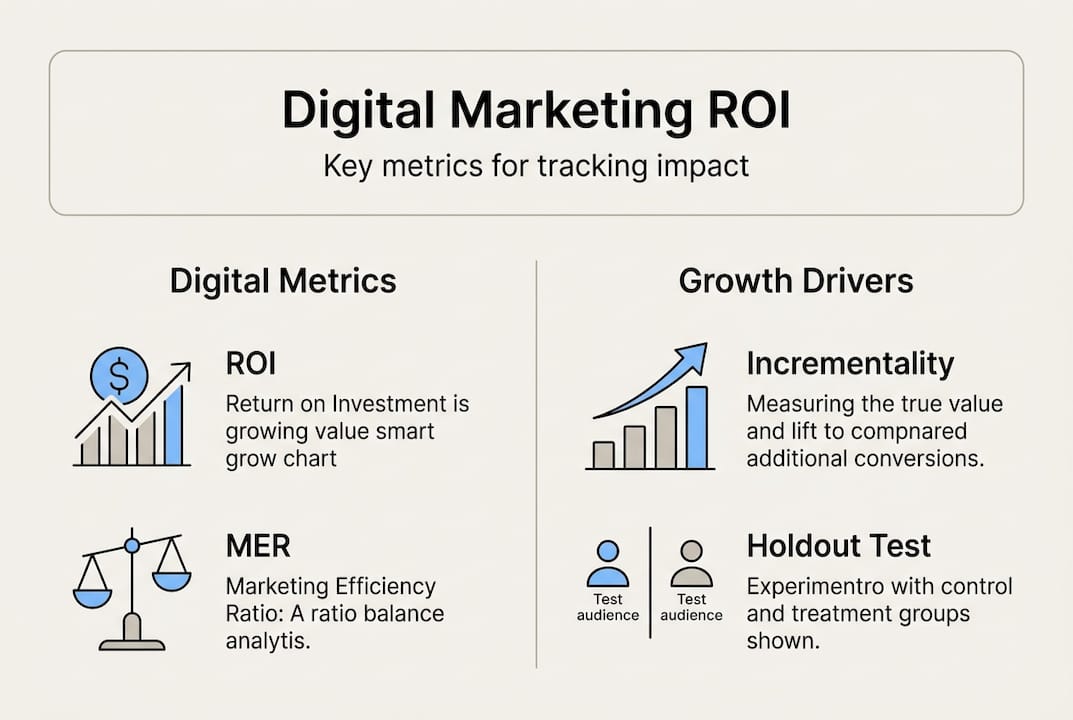
Pro Tip: Run holdout tests with 10% of your audience to measure true incrementality. Compare conversion rates between exposed and unexposed groups to isolate marketing impact from organic demand.
Understanding these measurement nuances helps marketing professionals combat burnout and budget pressure. When you can prove true incremental value, justifying investment becomes straightforward. Investing in digital marketing ROI pays dividends when measurement systems accurately capture business impact.
The distinction between correlation and causation matters enormously. A campaign might correlate with increased sales without actually causing them. Sophisticated measurement isolates causal relationships, enabling confident optimization decisions. This analytical rigor separates mature marketing organizations from those flying blind.
Marketing professionals must also account for time lag effects. Digital marketing often influences purchases that occur days or weeks later, especially in considered purchase categories. Attribution models that ignore this reality systematically undervalue top-of-funnel activities and overvalue last-click channels.
Balancing digital innovation with traditional marketing strengths
The digital versus traditional debate misses a crucial point: the most effective strategies leverage both approaches strategically. Digital marketing excels in targeting, measurement, and cost-efficiency, while traditional marketing builds trust and brand recall in competitive markets. Understanding when to deploy each approach maximizes overall impact.

| Dimension | Digital Marketing | Traditional Marketing |
|---|---|---|
| Targeting precision | Behavior and demographic-based | Geographic and demographic-based |
| Cost structure | Variable, pay-per-performance options | Fixed, upfront commitments |
| Measurement | Real-time, granular attribution | Delayed, survey-based estimates |
| Trust building | Requires consistency over time | Immediate credibility boost |
| Scalability | Highly scalable with automation | Limited by production constraints |
| Privacy compliance | Complex, evolving regulations | Simpler regulatory environment |
Digital marketing faces growing challenges that traditional channels avoid. Privacy regulations like GDPR and CCPA restrict targeting capabilities, forcing marketers to find new approaches. Cookie deprecation eliminates longstanding attribution methods, creating measurement gaps. Ad saturation reduces effectiveness as consumers develop banner blindness and ad fatigue.
These limitations create opportunities for traditional marketing to complement digital efforts:
- Print and outdoor advertising build brand awareness without privacy concerns
- Direct mail achieves higher engagement rates in oversaturated digital environments
- Event marketing creates memorable experiences that digital cannot replicate
- Broadcast media reaches audiences who actively avoid digital advertising
Hybrid strategies combine the strengths of both approaches while mitigating weaknesses. A campaign might use traditional media to build awareness and trust, then leverage digital channels for targeted conversion. This integrated approach acknowledges that customer journeys span multiple touchpoints across both digital and physical environments.
Human creativity remains essential despite AI saturation. As more organizations deploy AI-generated content, authentic human insight becomes a differentiator. Marketing professionals who blend AI efficiency with creative originality capture attention in crowded markets. This balance prevents the commoditization that occurs when everyone uses identical AI tools.
Understanding digital marketing ROI within this broader context helps allocate budgets effectively. The goal is not choosing digital over traditional, but rather optimizing the mix based on audience behavior, competitive dynamics, and business objectives. Flexibility and continuous testing beat rigid adherence to any single approach.
Practical strategies for innovative enterprises to leverage digital marketing
Marketing professionals at innovative enterprises need actionable frameworks to translate strategy into results. The following approaches drive measurable impact while building organizational capabilities for sustained growth.
Leverage AI-driven personalization to enhance engagement and conversions. Machine learning algorithms analyze behavioral patterns to deliver customized experiences at scale. This technology enables one-to-one marketing without manual segmentation. Innovative enterprises prioritize AI personalization to stay competitive as customer expectations rise.
Deploy first-party data strategies for better targeting and compliance:
- Build direct relationships through owned channels like email and apps
- Implement progressive profiling to gather data over time without friction
- Use customer data platforms (CDPs) to unify information across touchpoints
- Create value exchanges that motivate customers to share information willingly
First-party data becomes increasingly valuable as third-party cookies disappear. Organizations that invest now gain sustainable competitive advantages over those relying on deprecated tracking methods.
Conduct incrementality tests using holdout groups to validate true marketing impact. Holdout groups of around 10% provide statistical power while minimizing opportunity cost. Compare conversion rates between exposed and unexposed audiences to isolate causal effects. This methodology eliminates the guesswork that plagues traditional attribution models.
Pro Tip: Test incrementality at the campaign level, not just the channel level. Two campaigns in the same channel can have vastly different incremental impact based on creative, targeting, and timing.
Adopt hybrid digital-traditional campaigns for broader reach and trust building. Coordinate messaging across channels to create cohesive brand experiences. Use traditional media to establish credibility, then retarget engaged audiences with digital precision. This approach maximizes efficiency while maintaining the trust-building power of traditional channels.
Monitor Marketing Efficiency Ratio (MER) and incremental ROI to justify budgets:
| Metric | Target Range | Action Threshold |
|---|---|---|
| Marketing Efficiency Ratio | 4:1 to 6:1 | Below 3:1 requires channel audit |
| Incremental Net Profit ROI | 200% to 400% | Below 150% signals optimization need |
| Customer Acquisition Cost | Industry dependent | Rising trend demands intervention |
| Customer Lifetime Value | 3x to 5x CAC | Below 3x indicates retention issues |
These metrics provide early warning signals when campaigns underperform. Regular monitoring enables proactive optimization before small problems become budget disasters.
Marketing professionals should also invest in cross-functional collaboration. Digital marketing services deliver maximum value when integrated with product development, sales, and customer success. Siloed marketing limits impact and creates disconnected customer experiences.
AI solutions accelerate implementation of personalization and automation strategies. Organizations that lack internal AI expertise benefit from partnerships that provide both technology and strategic guidance. Implementing AI automation requires change management and technical integration that specialized partners facilitate.
The key to success lies in systematic experimentation combined with rigorous measurement. Marketing professionals who embrace this discipline continuously improve performance while building organizational knowledge. This approach transforms marketing from a cost center into a growth engine that drives enterprise transformation.
Enhance your digital marketing with expert services
Transforming digital marketing strategy into measurable results requires specialized expertise and integrated technology. NULLBIT provides digital marketing services tailored for innovative enterprises seeking competitive advantage through data-driven campaigns. Our approach combines strategic planning with technical execution, ensuring your marketing investments generate documented ROI.
We help organizations implement AI solutions that personalize customer experiences at scale while reducing acquisition costs. From predictive analytics to automated optimization, our AI capabilities accelerate your digital transformation journey. Marketing professionals gain the tools and insights needed to prove value and justify continued investment.
Our custom software development services integrate marketing technology with your existing systems, creating seamless data flows that enable sophisticated measurement and attribution. This technical foundation supports the incrementality testing and MER tracking that drive informed budget decisions. Partnering with specialists who understand both marketing strategy and technical implementation maximizes your digital marketing effectiveness while building internal capabilities for sustained growth.
FAQ
What is the most effective digital marketing channel for ROI?
Email marketing delivers the highest ROI at $36-$42 revenue per $1 spent, significantly exceeding other digital channels. This performance stems from direct audience relationships, low delivery costs, and sophisticated personalization capabilities. Search engine marketing and social media advertising also generate strong returns, but email consistently leads in efficiency metrics.
How can innovative enterprises measure true digital marketing ROI?
Calculate incremental revenue minus all costs, COGS, and baseline sales to determine true incremental net profit ROI. This methodology isolates marketing’s actual contribution by removing sales that would have occurred without marketing activity. Use holdout tests with control groups to validate incrementality and ensure accurate attribution.
Why combine digital and traditional marketing strategies?
Digital excels in targeting and measurement while traditional builds trust and brand recall, making hybrid approaches optimal for comprehensive market coverage. This combination addresses privacy challenges and digital saturation while maintaining measurement precision. Integrated campaigns leverage each channel’s strengths to maximize overall marketing efficiency.
How does AI personalization improve digital marketing performance?
AI analyzes behavioral patterns to deliver customized experiences that increase engagement and conversions. Machine learning algorithms optimize messaging, timing, and offers in real time based on individual user characteristics. This technology enables one-to-one marketing at scale, driving the 30% conversion lifts seen in leading implementations.
What is Marketing Efficiency Ratio and why does it matter?
MER compares total revenue to total marketing spend, providing a blended performance view that accounts for attribution gaps. A target ratio around 5:1 indicates healthy marketing performance across all channels. This metric helps marketing professionals justify budgets and identify when optimization is needed, offering a simpler complement to complex attribution models.


