

AI Automation: Transforming Enterprise Operations Globally

Sorting fact from fiction can be the toughest part of adopting AI automation. Many leaders think they are choosing between trusting software and trusting people, but the reality is more nuanced. AI does not think like humans—it processes data using algorithms, not consciousness or subjective experience. This introduction guides CTOs and innovation leaders through the real-world potential and limitations of AI automation, helping you make confident, evidence-based decisions.
Table of Contents
- AI Automation Defined And Common Misconceptions
- Major Types Of AI Automation Solutions
- How AI Automation Reshapes Enterprise Workflows
- Strategic Benefits And Measurable ROI Impact
- Key Risks, Integration Challenges, And Best Practices
Key Takeaways
| Point | Details |
|---|---|
| AI Automation Enhances Efficiency | AI automation optimizes workflows by handling repetitive tasks, allowing teams to focus on strategic work and enhancing overall productivity. |
| Managing Data Bias is Crucial | Organizations must audit their training data regularly to prevent AI from perpetuating biases that can lead to reputational and legal risks. |
| Integration Requires Thoughtful Planning | Proper integration involves assessing existing systems and ensuring data quality to avoid complexities that can derail projects. |
| Long-Term ROI is Achievable | Companies can expect measurable returns within 6-12 months, but success is contingent on clear metrics and ongoing evaluation of AI initiatives. |
AI Automation Defined and Common Misconceptions
AI automation combines artificial intelligence with business processes to execute tasks without human intervention. Think of it as software that learns patterns from data and performs actions based on those patterns. Unlike traditional automation, which follows rigid pre-programmed rules, AI automation adapts and improves as it encounters new information.
Here’s what actually happens under the hood:
- Pattern recognition: AI analyzes historical data to identify trends and correlations
- Decision-making: The system applies learned patterns to new situations automatically
- Continuous improvement: Performance metrics guide refinements over time
- Integration: AI works alongside existing enterprise systems, not replacing them entirely
The gap between perception and reality is significant. AI does not think like humans—it processes statistical patterns through algorithms without consciousness or subjective insight. Your team won’t be handing decision-making to sentient machines. Instead, you’re deploying mathematical models that recognize patterns faster than humans can.
Misconception: AI Is Unbiased
This one costs enterprises real money. AI systems inherit biases from their training data. If your historical hiring records show gender bias, the AI learns and replicates it. AI outputs reflect biases in their training data and are shaped by human-defined objectives, not by objective truth.
The misconception exists because people assume automation equals objectivity. It doesn’t. Data quality determines output quality.
Misconception: AI Will Replace Your Workforce
What actually happens is role transformation, not elimination. AI automation handles repetitive, high-volume tasks—expense report processing, data entry, routine customer inquiries. Your team shifts to higher-value work: strategy, complex problem-solving, client relationships.
CTOs and innovation leaders should view AI automation as:
- Freeing skilled employees from tedious work
- Reducing error rates on high-volume operations
- Accelerating decision cycles by providing faster insights
- Creating new roles in AI oversight and management
AI automation is a tool that amplifies human capability, not a replacement for human judgment in strategic decisions.
Misconception: AI Delivers Perfect Results
AI systems have precision limits. They perform best within clearly defined scopes. A machine learning model trained on 95% accuracy performs exactly that way—it fails 1 in 20 times. Your enterprise needs monitoring systems to catch failures before they impact operations.
This is why successful AI automation includes humans-in-the-loop: critical decisions get human verification before execution.
Pro tip: Start AI automation pilots on low-risk, high-volume processes—like invoice categorization or customer ticket routing—where mistakes have minimal business impact while you build organizational confidence.
Major Types of AI Automation Solutions
AI automation comes in several distinct flavors, each suited to different operational challenges. Understanding which type matches your enterprise needs prevents costly implementation missteps. The major categories differ fundamentally in complexity, cost, and what they accomplish.
Robotic Process Automation (RPA) is the starting point for many enterprises. RPA bots mimic human actions—clicking buttons, entering data, navigating systems. They follow precise, predetermined workflows without decision-making capability. Think of RPA as sophisticated macro automation: fast, reliable, but inflexible when exceptions occur.
RPA works best for:
- Invoice processing and data entry
- Customer record updates across multiple systems
- Report generation and formatting
- Repetitive administrative tasks with zero variation
Intelligent Automation (IA) adds decision-making to the equation. IA combines RPA with machine learning, enabling bots to handle variations and exceptions. When an invoice deviates from standard format, IA recognizes it and routes it appropriately. IA adapts to changing conditions without requiring code rewrites.

Machines performing complex decision-making tasks traditionally requiring human intelligence characterize true AI automation. This is where IA lives—between simple RPA and fully autonomous systems.
Cognitive Automation tackles knowledge-intensive work. It processes unstructured data like emails, documents, and images. Cognitive systems extract meaning, understand context, and make nuanced decisions. A cognitive automation solution might analyze contract language, flag risks, and summarize terms for your legal team.
Key Differences at a Glance
These three types serve progressively complex scenarios:
Here’s how the main types of AI automation differ in enterprise settings:
| Solution Type | Decision-Making Ability | Data Required | Example Use Case |
|---|---|---|---|
| RPA | None; follows fixed rules | Structured data only | Bulk invoice processing |
| Intelligent Automation | Handles minor exceptions | Structured, semi-structured data | Non-standard invoice routing |
| Cognitive Automation | Advanced judgment and context | Unstructured data | Contract risk analysis |
- RPA: Structured, repetitive, rule-based work
- Intelligent Automation: Repetitive work with occasional variations
- Cognitive Automation: Knowledge work requiring interpretation and judgment
The sophistication of your automation solution should match the complexity of your problem, not exceed it—over-engineering drives costs without proportional returns.
Your team’s current system architecture matters too. RPA integrates with existing applications without modification. Intelligent Automation may require data science support. Cognitive Automation demands robust data infrastructure and ongoing model management.
Most successful enterprises implement these progressively. Start with high-volume, low-complexity RPA pilots. Build internal expertise. Then advance to IA and cognitive solutions as you mature your AI capabilities.
Pro tip: Audit your top 20 time-consuming manual processes first—map which involve structured rules versus judgment calls—then select RPA for rule-based work and reserve IA investment for tasks requiring adaptation.
How AI Automation Reshapes Enterprise Workflows
AI automation doesn’t just speed up existing processes—it fundamentally redesigns how work happens. The shift from “automate what we do” to “reimagine how we work” separates mature AI programs from failed pilots.
Traditional workflow automation follows a linear path: task A leads to task B, then task C. Human oversight happens at predefined checkpoints. AI automation enables parallel, adaptive workflows where decisions happen in real time and the next step depends on outcomes, not predetermined sequences.
Consider expense management. The old workflow: employee submits report, manager approves, accounting codes it, system processes it. With AI automation, the system reads the receipt instantly, categorizes it, flags policy violations, and auto-approves routine expenses while routing exceptions to humans. The workflow compresses from days to minutes and adapts to each expense type.
How Workflows Actually Change
AI automation reshapes workflows through three mechanisms:
- Decision automation: AI evaluates situations and chooses actions without human intervention
- Real-time routing: Work moves to the right person or system based on intelligent assessment, not fixed rules
- Continuous learning: Workflows improve as AI encounters more variations and edge cases
AI-driven process redesign enables companies to improve efficiency by automating decisions and workflows at scale, making operations more agile and responsive. Your enterprise doesn’t just operate faster—it responds to market changes differently.
The structural impact is significant. Departments previously organized around approval hierarchies reorganize around value creation. Team members shift from execution to exception handling and strategic work. New roles emerge: AI trainers, outcome monitors, and exception specialists.
Workflow Redesign in Practice
Successful AI automation requires rethinking work end-to-end. You cannot simply bolt AI onto broken processes. Embedding intelligence directly into work processes requires human-AI collaboration redesigned around outcomes, not tasks.
This means:
- Mapping decision points, not just task sequences
- Identifying where human judgment adds irreplaceable value
- Creating feedback loops so AI learns from exceptions
- Building transparency into AI decisions for compliance and trust
Workflow redesign driven by AI automation produces compounding returns—early improvements inform better redesigns, which enable further automation and optimization.
Your competitive advantage isn’t the AI tool. It’s how thoughtfully you restructure work around the capabilities AI unlocks. Teams that simply automate existing workflows see modest improvements. Teams that fundamentally reimagine workflows see transformational gains.
Pro tip: Map your most critical workflow by decision point, not task—identify where AI can safely decide and where humans must verify—then pilot AI automation on that specific decision layer before redesigning the entire workflow.
Strategic Benefits and Measurable ROI Impact
AI automation generates returns that go beyond simple cost savings. The strategic benefits compound over time, creating competitive advantages that multiply financial gains.
Cost reduction is the obvious win. AI handles high-volume, repetitive work at a fraction of human cost. A single RPA bot processes invoices for the cost of 0.3 full-time employees and runs 24/7. But this misses the bigger picture.
Where Real Value Emerges
The transformational benefits arrive when you measure beyond labor arbitrage:
- Speed-to-decision: AI analyzes market data in hours, not weeks, enabling faster strategic responses
- Accuracy improvement: Fewer human errors means fewer expensive mistakes in compliance, operations, and customer interactions
- Scalability without headcount: Handle 10x transaction volume without proportional team growth
- Customer experience: Faster response times and personalized interactions increase retention and lifetime value
AI augments cognitive processes, enabling faster and higher-quality strategic analyses that directly impact firm outcomes and competitive positioning. Your organization makes better decisions, faster, with the same leadership team.
Quantifying ROI in Real Terms
The best AI automation investments show measurable returns within 6-12 months. Consider a financial services firm automating loan pre-qualification: processing time drops from 10 days to 2 days, loan approval rates increase 18%, and customer satisfaction improves measurably. The calculation is straightforward.
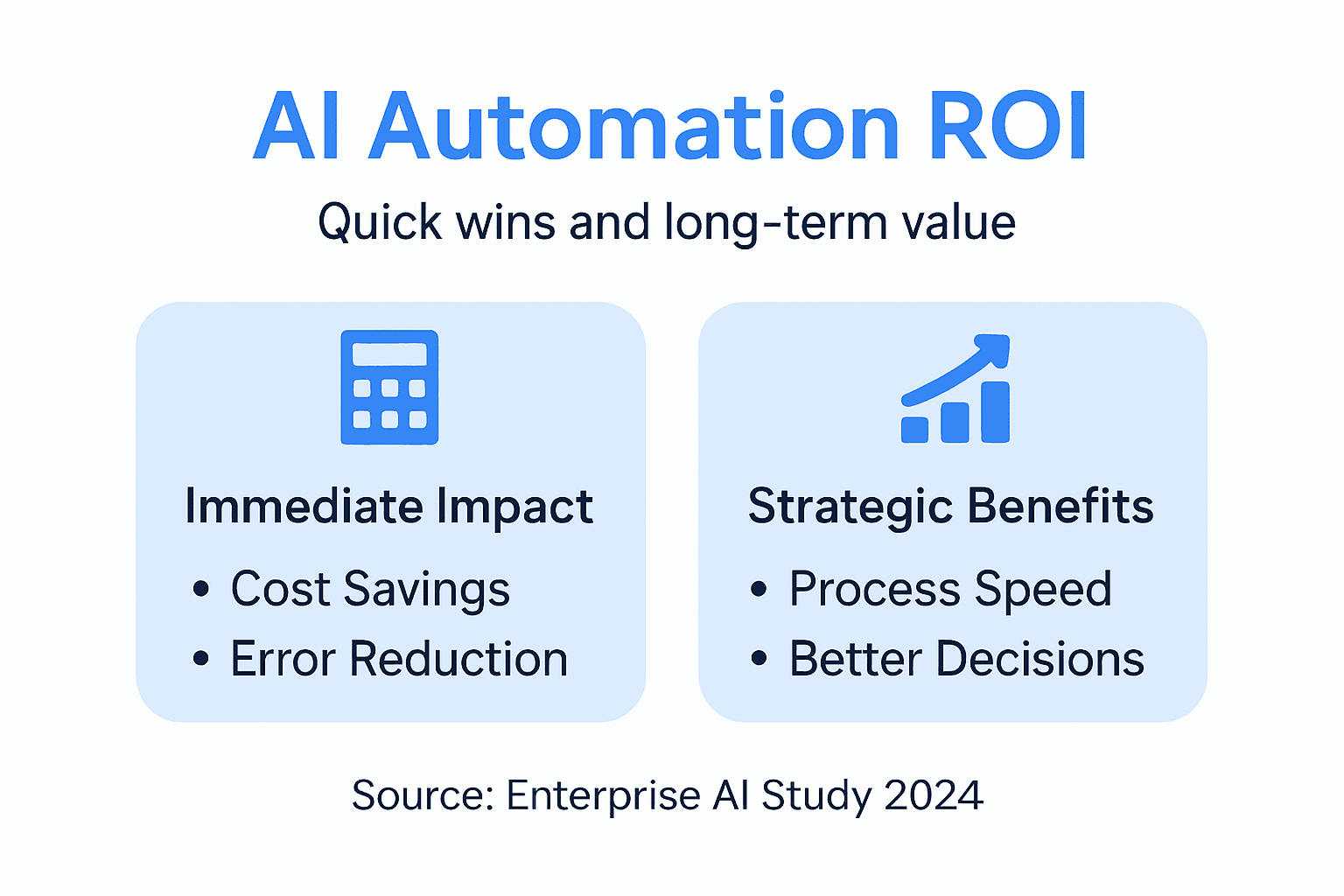
AI implementation delivers significant strategic benefits such as enhanced decision making and process efficiency contributing to measurable ROI improvements across business units. These improvements compound when you redeploy labor savings to higher-value work.
A manufacturing company we worked with automated quality control inspections. Direct savings: 2 FTEs per shift. Indirect benefit: caught defects 72 hours earlier in production, preventing costly rework. The rework prevention alone justified the investment.
The Maturity Effect
Firms implementing AI automation across multiple workflows see exponential returns:
- Year 1: Cost savings from initial process automation (10-20% efficiency gain typical)
- Year 2: New process redesigns unlock additional value; savings accelerate
- Year 3+: Organizational learning compounds; teams identify new automation opportunities independently
ROI improves predictably as your organization matures—early investments create capability that enables better, faster, cheaper implementations later.
This is why CTOs should view AI automation as infrastructure investment, not one-off cost reduction. The compounding returns justify aggressive initial spending.
One caveat: not all AI automation projects deliver equal returns. Projects lacking clear metrics, poor data quality, or unrealistic automation targets underperform. Success requires disciplined measurement from day one.
Pro tip: Establish baseline metrics before implementation—measure process cost, cycle time, error rates, and customer impact—then track monthly improvement gains to build business case for scaling automation across other workflows.
Key Risks, Integration Challenges, and Best Practices
AI automation delivers massive benefits, but deployment without proper safeguards creates substantial risks. CTOs who gloss over these challenges end up with expensive failures that damage organizational trust in AI.
The primary risk categories emerge repeatedly across enterprises worldwide. Understanding them prevents costly mistakes.
Critical Risk Areas
Data bias remains the most insidious threat. If your training data reflects historical discrimination or incomplete information, AI perpetuates and amplifies those biases at scale. A hiring AI trained on past hiring patterns will systematically disadvantage underrepresented groups. A lending model trained on biased historical approvals will deny credit unfairly.
AI integration risks include bias amplification, privacy breaches, and security vulnerabilities requiring proactive governance frameworks and risk management policies. These aren’t theoretical concerns—they carry legal liability and reputational damage.
Other critical risks include:
Key risk domains and mitigation strategies for AI automation:
| Risk Area | Description | Mitigation Strategy |
|---|---|---|
| Data Bias | Training data reflects harmful patterns | Audit datasets regularly |
| System Reliability | AI may fail without warning | Implement real-time monitoring |
| Data Security | Sensitive data exposed to threats | Encrypt and restrict access |
| Regulatory Issues | Compliance requirements frequently change | Build in regular legal review |
| Change Management | Staff resistance slows adoption | Communicate and upskill teams |
- System reliability: AI models fail silently; you won’t know until customers report problems
- Data security: Training data contains sensitive information that competitors or attackers target
- Regulatory exposure: Compliance requirements vary by jurisdiction and evolve constantly
- Change management: Workforce resistance derails implementation when people fear job loss
Integration Challenges That Derail Projects
Integration complexity catches many teams unprepared. Your existing systems weren’t built for AI. Legacy databases lack the data quality AI requires. Teams lack machine learning expertise. Budget overruns are common.
The technical debt problem is real. Organizations with fragmented systems, poor data governance, and undocumented processes struggle to implement AI automation. You cannot automate what you haven’t documented.
Organizational challenges matter equally. Departments protecting territory resist automation that threatens their headcount. Executives demand immediate ROI from technology requiring 6-12 months to mature. Skills gaps force reliance on external consultants rather than building internal capability.
Best Practices That Actually Work
Continuous monitoring, stakeholder collaboration, and accountability measures ensure trustworthy AI adoption. These aren’t optional—they’re foundational.
Implement these practices from day one:
- Start small: Pilot on low-risk processes with clear metrics before scaling
- Build governance: Establish clear accountability for AI decisions and outcomes
- Audit continuously: Monitor AI performance against baseline metrics; drift indicates problems
- Document decisions: Record why AI made specific choices for compliance and learning
- Engage stakeholders: Include compliance, HR, legal, and affected teams in design
Risk management isn’t overhead—it’s the foundation that enables confident scaling and organizational trust in AI systems.
Successful enterprises treat AI automation as infrastructure requiring ongoing investment, not one-time projects. They establish centers of excellence to build internal AI expertise. They require explainability in models. They run regular bias audits.
Pro tip: Create a pre-implementation checklist: audit data quality, map system integrations, identify bias sources in training data, and assign clear accountability for monitoring performance—address gaps before deployment, not after.
Unlock the Full Potential of AI Automation with NULLBIT
The challenges outlined in the article highlight how implementing AI automation requires more than just technology. From managing biases in data and integrating complex systems to redesigning workflows for real-time decision-making, enterprises face critical hurdles when striving to transform operations efficiently. If you are looking to move beyond basic automation and embrace intelligent, scalable AI solutions that accelerate decision cycles and drive measurable ROI, these pain points and goals are exactly where NULLBIT brings unmatched value.
At NULLBIT, we specialize in delivering custom AI solutions, system engineering, and cloud infrastructure optimization tailored for businesses ready to reimagine workflow processes and harness AI-driven automation. Whether you are beginning with robotic process automation or advancing toward cognitive automation, our dedicated teams ensure that your enterprise avoids costly pitfalls such as bias amplification and integration bottlenecks while accelerating digital transformation safely and effectively. Explore how our expertise in developing AI architectures and digital systems across industries can help you surpass operational challenges and unlock exponential improvements. Take the first step toward a more agile and intelligent enterprise by visiting NULLBIT today.
Ready to turn your AI automation vision into reality Take advantage of our long-term partnership model designed to build sustainable value and intelligence into your workflows Start your journey with a detailed assessment designed specifically for enterprises ready to scale AI capabilities Visit https://nullbit.co/ to learn more and connect with our experts now.
Frequently Asked Questions
What is AI automation?
AI automation combines artificial intelligence with business processes to perform tasks without human intervention, adapting and improving as it learns from data patterns.
What are the common misconceptions about AI automation?
Common misconceptions include the belief that AI is unbiased, that it will replace the workforce, and that it delivers perfect results. In reality, AI can inherit biases from training data, transform job roles instead of eliminating them, and may not always produce flawless output.
How does AI automation impact enterprise workflows?
AI automation fundamentally redesigns workflows by enabling parallel, adaptive processes where decisions are made in real time. This leads to greater efficiency and responsiveness within organizations.
What types of AI automation solutions are available?
The main types of AI automation solutions include Robotic Process Automation (RPA), Intelligent Automation (IA), and Cognitive Automation, each suited to different operational challenges and complexity levels.