

Step by Step Digital Transformation for Manufacturers

Every manufacturing IT manager faces the challenge of balancing legacy systems with the urgent need for smarter, automated operations. Achieving measurable improvements starts with understanding your current capabilities before jumping into new technology initiatives. By following step-by-step digital transformation strategies rooted in AI and automation, you can create lasting operational efficiency while avoiding common pitfalls. This guide provides practical instructions for each phase, empowering you to build a solid foundation and advance your manufacturing maturity.
Table of Contents
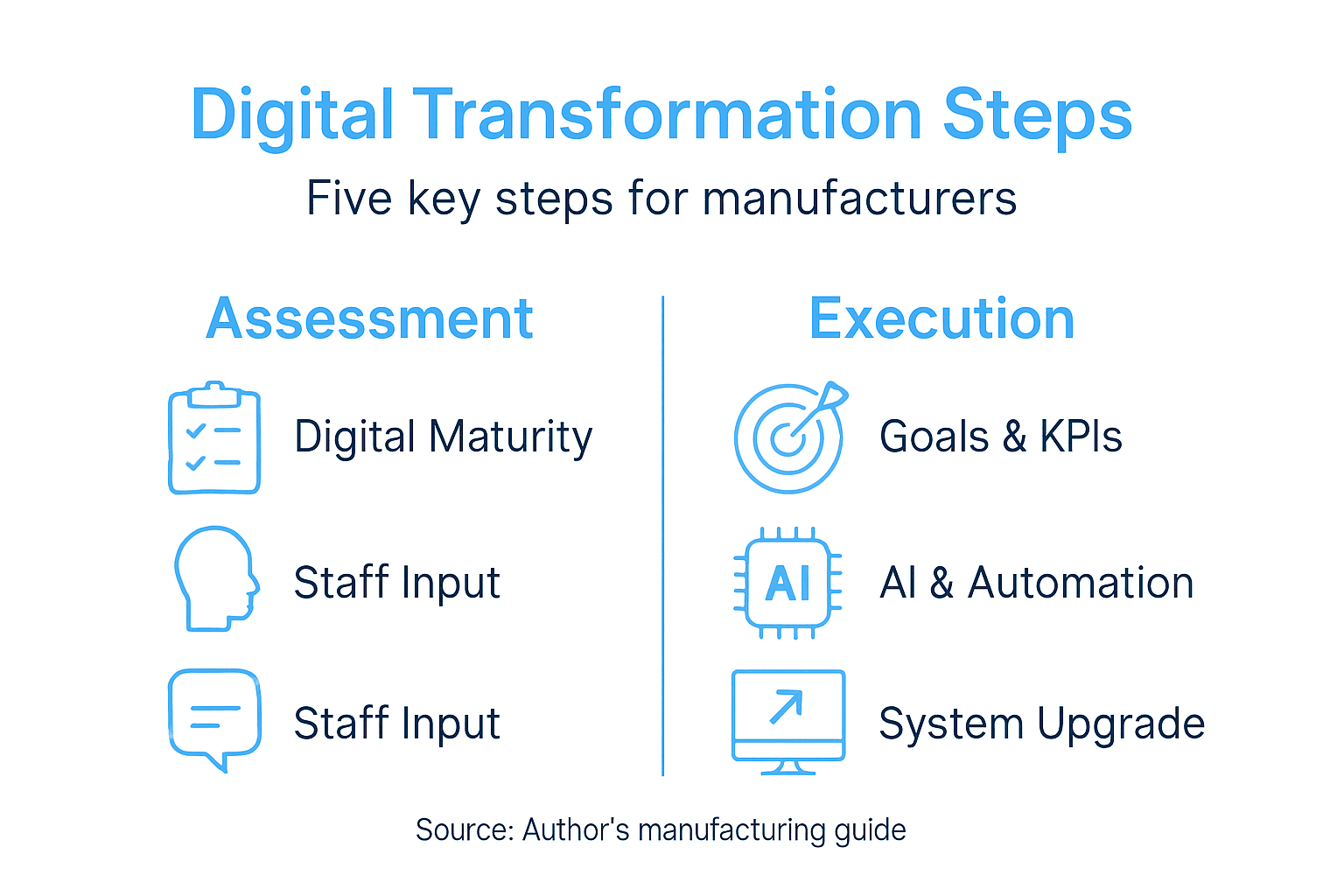
- Step 1: Assess Current Digital Maturity
- Step 2: Define Transformation Goals And KPIs
- Step 3: Deploy AI And Automation Initiatives
- Step 4: Optimize Systems And Infrastructure
- Step 5: Verify Outcomes And Continuously Improve
Quick Summary
| Key Insight | Explanation |
|---|---|
| 1. Assess Digital Maturity First | Understand your current capabilities to gauge areas needing improvement and prioritize digital investments effectively. |
| 2. Set Clear Transformation Goals | Establish measurable objectives aligned with your business strategy to ensure focused and meaningful digital transformation. |
| 3. Start with Pilot Projects | Implement small-scale pilots to tackle specific issues, building confidence and proof points for larger initiatives. |
| 4. Audit and Upgrade Infrastructure | Evaluate your current systems and move toward cloud-native solutions that facilitate agile and scalable manufacturing processes. |
| 5. Monitor Outcomes and Adjust | Continuously measure results against KPIs and use feedback to refine processes, ensuring sustained improvements in operations. |
Step 1: Assess Current Digital Maturity
You cannot transform what you don’t understand. Before implementing any digital strategy, you need a clear picture of where your manufacturing operations stand today. This assessment becomes your baseline for measuring progress and identifying the biggest gaps that need addressing first.
Start by mapping your current capabilities across core manufacturing functions. Think about design processes, production systems, quality control, maintenance operations, and logistics networks. Each area likely sits at a different maturity level, and that’s completely normal. Most manufacturers find their digital readiness varies significantly between departments.
Use a structured approach to evaluate maturity. A digital readiness framework similar to capability maturity models helps you score each operational dimension consistently. This gives you quantifiable data instead of guesswork. You’ll identify which processes are fully manual, partially automated, or already digitized.
Your assessment reveals not just gaps, but also which areas are ready for immediate digital investment and where foundational work must happen first.
Here’s what to examine during your assessment:
- Production workflows and how data currently flows between machines and systems
- Quality tracking methods and whether inspections are manual or sensor-driven
- Maintenance practices and predictive capability versus reactive repair cycles
- Logistics coordination across suppliers, internal operations, and customers
- Integration level between your ERP, manufacturing execution systems, and shop floor equipment
- Staff skills and readiness to work with digital tools
Collect honest input from operators, supervisors, and technicians. They see the real inefficiencies daily. Document where processes break down, where data gets lost, and where decisions happen too slowly because information isn’t available.
Score each area on a scale from 1 to 5, where 1 means completely manual processes and 5 means fully automated, AI-driven operations. This produces a maturity map showing your strengths and critical improvement priorities.
To clarify digital maturity scoring, here’s a breakdown of typical score levels and their operational meaning:
| Score Level | Process Type | Business Impact |
|---|---|---|
| 1 | Fully manual | Slow, error-prone, no real-time data |
| 2 | Partially manual | Some automation, limited data access |
| 3 | Semi-automated | Most data captured, moderate efficiency |
| 4 | Digitized | Integrated systems, reliable real-time data |
| 5 | AI-driven | Optimized decisions, maximum efficiency |
Pro tip: Create a simple spreadsheet documenting current state for each function, then calculate the average score across all areas—this single number becomes your digital maturity baseline, making future progress measurable and visible to leadership.
Step 2: Define Transformation Goals and KPIs
Without clear goals, your digital transformation becomes a collection of random technology purchases. You need specific, measurable objectives that align with your business strategy and create competitive advantage. Goals give your team direction and help justify investments to leadership.
Start by connecting transformation objectives to your overall business strategy. Ask yourself what competitive problems you’re solving. Are you losing speed to competitors? Struggling with quality consistency? Missing market opportunities because decisions take too long? Your transformation goals should directly address these business challenges, not just technology adoption for its own sake.
Next, establish measurable KPIs that track progress toward each goal. Setting measurable KPIs linked to digital initiatives ensures your transformation delivers sustainable competitive advantage and profitable growth. Without metrics, you cannot tell if your investments are working.
Your KPIs should be outcome-focused, not activity-focused. Measure results, not effort.
Here are common KPI categories for manufacturing transformation:
- Production efficiency: cycle time reduction, equipment utilization rates, throughput per hour
- Quality metrics: defect rates, first-pass yield, customer returns
- Cost management: labor hours per unit, material waste reduction, energy consumption
- Delivery performance: on-time shipment percentage, lead time reduction
- Workforce capability: training completion rates, automation readiness scores
- Data availability: system uptime, real-time visibility into operations
Make each KPI specific and time-bound. Instead of “improve quality,” commit to “reduce defects by 35% within 18 months.” Instead of “faster decisions,” target “reduce decision cycle time from 48 hours to 4 hours for production scheduling.”
Here’s a summary of manufacturing KPI categories and practical outcome examples:
| KPI Category | Sample KPI | Business Outcome |
|---|---|---|
| Production Efficiency | Cycle time reduction | Faster shipments, higher throughput |
| Quality Metrics | First-pass yield | Fewer defects, improved compliance |
| Cost Management | Material waste reduction | Lower expenses, higher profits |
| Delivery Performance | On-time shipment rate | Improved customer satisfaction |
| Workforce Capability | Training completion rate | Higher staff readiness, fewer errors |
| Data Availability | System uptime | Reliable operations, less downtime |
Involve stakeholders from operations, finance, and the shop floor when defining goals. They understand what’s realistic and what truly matters. Their buy-in makes the difference between goals that stay on paper and transformation that actually happens.
Pro tip: Assign ownership to specific leaders for each KPI and review progress monthly—accountability keeps momentum alive and surfaces obstacles early before they derail the entire program.
Step 3: Deploy AI and Automation Initiatives
This is where transformation moves from planning to action. Deploying AI and automation requires careful sequencing and readiness checks. Rush this step and you risk failed implementations that damage team confidence and waste resources.

Start small with pilot projects that solve real operational problems. Choose areas where you have solid data quality and strong process documentation. A successful pilot on production scheduling or predictive maintenance builds momentum and provides proof points for larger rollouts.
Systematically evaluating readiness before implementing AI-driven automation is essential for advancing your digital maturity. This structured approach improves operational efficiency and supports sustainable transformation rather than one-off technology experiments.
Start with processes that generate the most friction or cost, where automation delivers immediate, measurable value.
Consider these deployment categories as you prioritize which initiatives to launch first:
- Process automation: invoice processing, order entry, quality alerts, maintenance scheduling
- Predictive analytics: equipment failure prediction, demand forecasting, quality defect forecasting
- Intelligent monitoring: real-time production dashboards, anomaly detection, energy consumption tracking
- Decision support: automated recommendations for production parameters, supplier selection, inventory levels
- Robotic process automation: data entry, report generation, compliance documentation
Before deploying any solution, verify your data foundation. AI and automation thrive on clean, consistent data. If your data is incomplete or unreliable, your solution fails. Test your data quality actively and clean it if necessary.
Involve operators in the design phase. They know where manual work hurts most. When they see themselves in the solution, adoption happens naturally. Provide training before go-live and stay available during the critical first weeks of deployment.
Measure results against your KPIs immediately. Track whether cycle times dropped, defect rates improved, or decision speed increased. Communicate wins quickly to build trust in your transformation approach.
Pro tip: Document your first three pilots thoroughly—failures and successes—so your team learns patterns about what works in your specific environment rather than repeating mistakes across future deployments.
Step 4: Optimize Systems and Infrastructure
Your AI and automation initiatives only work as well as the systems supporting them. Legacy infrastructure creates bottlenecks that slow everything down. This step focuses on building a technical foundation that scales with your transformation ambitions.
Start by auditing your current infrastructure. Document what systems you have, how they communicate, and where data gets stuck in silos. You need a clear picture of your technical landscape before making upgrade decisions. This assessment reveals which components can stay and which must go.
Consider moving toward cloud-native architecture. Upgrading to digitally-enabled platforms and cloud-native solutions facilitates agile manufacturing processes and supports scalable growth. Cloud platforms offer flexibility to add computing power when you need it, reduce upfront capital costs, and provide built-in tools for data analytics and AI integration.
The right infrastructure becomes invisible. You stop worrying about servers and focus on business problems.
Key infrastructure priorities for manufacturing transformation:
- Real-time data pipelines that connect shop floor equipment to analytics systems
- Scalable storage solutions for the massive volumes of sensor and production data you’ll generate
- API layers that let different systems talk to each other without custom integrations
- Security architecture that protects sensitive manufacturing data and IP
- Redundancy and backup systems that prevent production outages
- Monitoring and alerting infrastructure that tells you instantly when something breaks
Integration is critical. Your ERP system, MES, quality management platform, and new AI tools must exchange data seamlessly. APIs and middleware reduce manual data transfers that introduce errors and delays. Plan for integration complexity early rather than discovering it mid-implementation.
Don’t rip and replace everything at once. Transition gradually while maintaining current production. Run parallel systems during the switchover period. This approach costs more upfront but protects your business from catastrophic failures.
Build for continuous improvement. Continuous refinement of systems maintains alignment with your evolving digital maturity. Your infrastructure needs will change as you add new AI capabilities and automation initiatives.
Pro tip: Establish an infrastructure governance committee with representatives from IT, operations, and engineering to review architecture decisions quarterly—this prevents infrastructure from drifting out of alignment with your transformation strategy.
Step 5: Verify Outcomes and Continuously Improve
Transformation doesn’t end at deployment. The real work begins when you measure whether your investments actually delivered the promised results. Verification reveals what worked, what needs adjustment, and where to focus your next round of improvements.
Compare your actual results against the KPIs you defined earlier. Did cycle times drop by the target percentage? Are defect rates moving in the right direction? Is your workforce adopting the new tools? Honest assessment matters more than hitting every target perfectly.
Track results across multiple dimensions. Production metrics tell part of the story, but you also need to measure adoption rates, employee satisfaction, and cost savings. A technically successful automation that nobody uses delivers zero value.
Celebrate wins, learn from misses, and iterate. Transformation is a continuous cycle, not a finish line.
Key metrics to monitor during verification:
- Production efficiency gains against baseline measurements from your digital maturity assessment
- Cost reduction in labor, materials, energy, or quality rework
- Speed improvements in decision-making, cycle times, and order fulfillment
- Quality metrics including defect rates, customer complaints, and first-pass yield
- System performance including uptime, data accuracy, and integration reliability
- Workforce adoption measured by tool usage, training completion, and engagement scores
Create feedback loops that surface problems quickly. Monthly reviews with operations teams identify what’s broken before small issues become major headaches. Listen to frontline workers who operate the systems daily. They spot inefficiencies that dashboards miss.
Identify improvement opportunities in three categories. First, quick wins that take days to implement and deliver immediate value. Second, medium-term initiatives requiring weeks of work. Third, strategic improvements that reshape how you operate. Balance addressing immediate frustrations with building toward your long-term vision.
Scale what works and adjust what doesn’t. Some automation may need parameter tuning. Others might require process redesign. A few initiatives might fail entirely, and that’s acceptable learning. Document why something didn’t work so you avoid repeating the same mistake.
Plan your next transformation wave based on what you learned. Your maturity increases with each iteration. Use that knowledge to tackle bigger, more complex problems next time.
Pro tip: Create a monthly transformation scorecard visible to all stakeholders showing progress on each KPI, wins achieved, and challenges being addressed—transparency builds confidence and keeps leadership aligned with your transformation pace.
Accelerate Your Manufacturing Digital Transformation with NULLBIT
Manufacturers face complex challenges like uneven digital maturity, fragmented data, and slow decision-making that block progress. This step-by-step guide reveals the importance of measuring your current state, setting clear KPIs, and deploying AI-driven automation effectively. If you recognize these pain points in your operations and want to build a resilient, future-ready foundation, you need a strategic partner who understands how to turn these concepts into real, measurable results.
NULLBIT specializes in delivering tailored digital solutions that align with your transformation goals. From custom software development and AI-powered automation to cloud infrastructure optimization, we empower manufacturing companies to close their digital gaps efficiently. Our expertise in structuring data pipelines, integrating AI models like RAG architectures, and ensuring seamless system interoperability means you can confidently advance your transformation journey without costly trial and error. Explore how our proven approach can help you unlock operational excellence and sustained competitive advantage at NULLBIT.
Don’t let digital maturity challenges delay your success. Visit NULLBIT’s transformation services to start assessing your readiness, defining precise KPIs, and rolling out effective AI initiatives now. Take action today and turn your digital vision into operational reality.
Frequently Asked Questions
What is the first step in the digital transformation for manufacturers?
To begin your digital transformation, assess the current digital maturity of your manufacturing operations. Map out your current capabilities across core areas like production workflows and quality control, then score each area on a scale of 1 to 5 to identify strengths and gaps.
How can I define measurable goals for my manufacturing transformation?
Define specific, measurable goals by linking them to your overall business strategy. Focus on addressing competitive problems, such as reducing defects by 35% within 18 months, to create clear objectives that guide your transformation efforts.
What should I prioritize when deploying AI and automation initiatives?
Prioritize pilot projects that address real operational problems and have solid data quality. Start small with areas like predictive maintenance or production scheduling where immediate, measurable value can be realized.
How can I ensure my systems and infrastructure support digital transformation?
Audit your current infrastructure to identify bottlenecks and document how systems communicate. Upgrade to cloud-native platforms and ensure real-time data pipelines for seamless integration, which will support scalable growth moving forward.
How do I verify the outcomes of my transformation initiatives?
Verify the success of your initiatives by comparing actual results against your established KPIs. Regularly track metrics such as production efficiency, defect rates, and system performance to identify areas for improvement and celebrate wins.
What are some quick win opportunities during digital transformation?
Identify quick win opportunities that can be implemented in days and deliver immediate value, such as streamlining invoice processing or reducing decision cycle times. Balancing these quick wins with medium and long-term initiatives keeps your transformation momentum going.