

What Is Artificial Intelligence? Impact for Innovators

Defining artificial intelligence clearly is more than a technical exercise for CTOs and innovation leaders. The way you describe a machine-based system sets the foundation for evaluating performance, managing risk, and ensuring compliance across global standards like those from the OECD. This guide provides actionable insight on what AI truly is, its core principles, and the practical frameworks that help your organization deliver responsible, effective solutions as part of your digital transformation.
Table of Contents
- Defining Artificial Intelligence And Its Core Principles
- Key Types Of Artificial Intelligence Explained
- Real-World AI Applications In Modern Enterprises
- AI Risks, Challenges, And Prohibited Practices
- AI Regulations And Compliance For 2026 And Beyond
Key Takeaways
| Point | Details |
|---|---|
| Importance of Definition | Clearly defining AI shapes how organizations measure success and manage risks in deployments. |
| Three AI Domains | Focus on operational, epistemic, and normative domains to ensure AI solutions align with values and deliver value. |
| Compliance Necessity | By 2026, organizations must document governance and comply with regulatory standards to avoid penalties. |
| Bias and Fairness | Proactively audit datasets for bias to ensure fairness and transparency in AI systems before deployment. |
Defining Artificial Intelligence and Its Core Principles
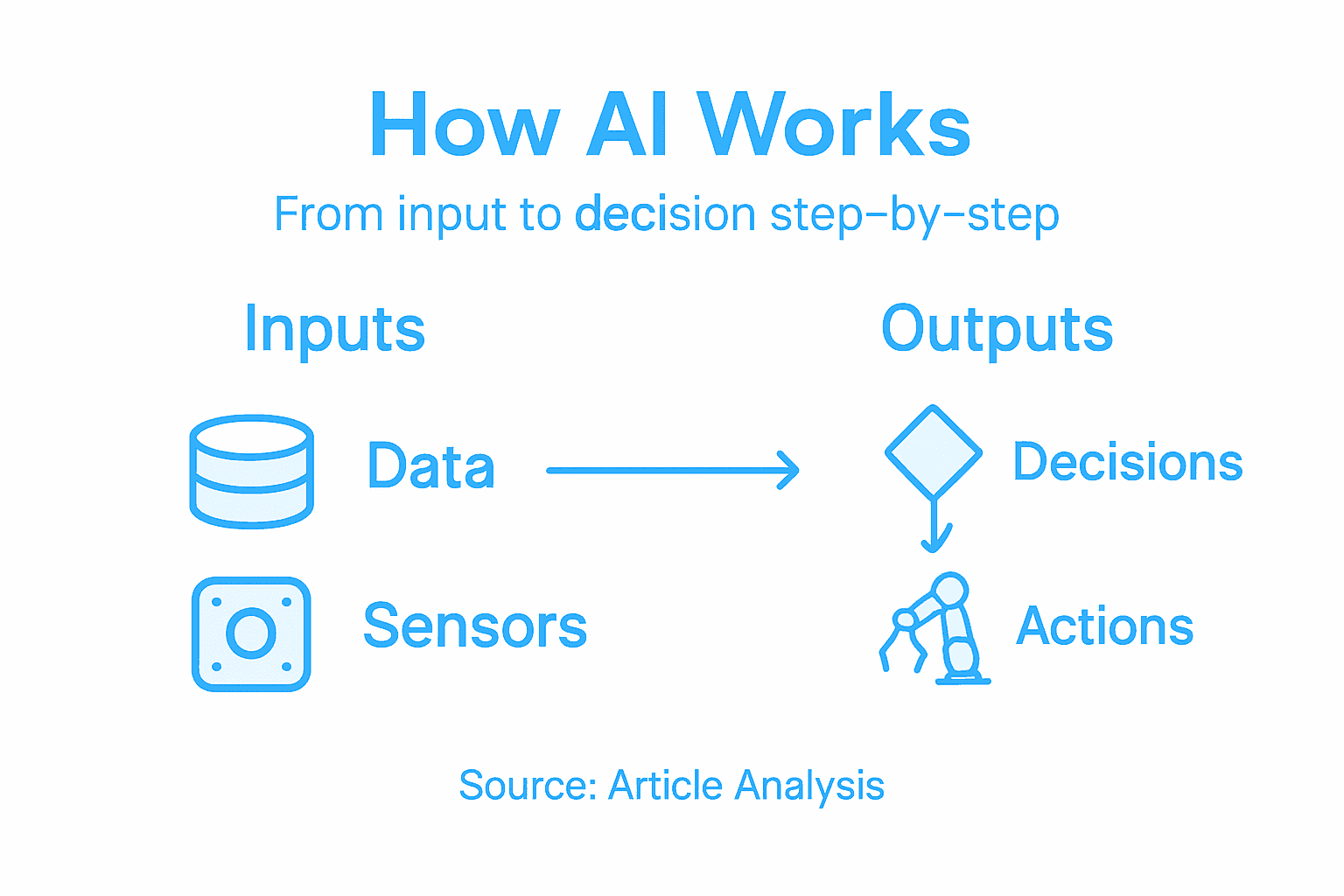
Artificial intelligence isn’t magic. It’s a machine-based system that takes inputs and learns how to generate outputs like predictions or decisions that affect real-world outcomes.
The definition matters because it shapes how you’ll evaluate, deploy, and govern AI in your organization. Without clarity, you’ll struggle to measure success or manage risks.
What AI Actually Does
AI systems display intelligent behavior by taking autonomous actions guided by specific objectives. Think of it as software that learns patterns from data rather than following rigid, pre-programmed instructions.
The system observes inputs, recognizes patterns, and produces outputs. These outputs can influence physical or virtual environments—from automating warehouse operations to optimizing supply chain decisions.
The Three Domains of AI Systems
AI operates across three critical dimensions that matter for your implementation:
- Operational domain: How the system actually functions, processes data, and delivers results in production
- Epistemic domain: How the system “knows” what it knows, its reasoning transparency, and knowledge reliability
- Normative domain: How the system aligns with your values, ethics, governance requirements, and business rules
Most organizations focus only on operations. That’s a mistake. The epistemic and normative domains determine whether your AI solution creates competitive advantage or legal liability.
Here’s a summary comparing the three core domains of AI systems and their practical significance:
| Domain | Focus Area | Why It Matters for Business |
|---|---|---|
| Operational | System functionality and outputs | Ensures reliable day-to-day results |
| Epistemic | Knowledge transparency and logic | Builds stakeholder trust and clarity |
| Normative | Alignment with ethics and values | Reduces legal and reputational risks |
Core Principles for Trustworthy AI
OECD AI principles establish a global standard for responsible AI deployment. These principles guide responsible innovation across your organization:
- Inclusive growth: AI solutions should benefit your business and stakeholders, not concentrate value
- Fairness and transparency: Systems must explain decisions in understandable terms and treat users equitably
- Robustness and accountability: Solutions need to perform reliably and trace decisions back to responsible parties
- Respect for human rights: AI cannot undermine democratic values or violate privacy
These aren’t theoretical. Organizations like the European Union and United Nations use these principles to regulate AI deployment. Your compliance depends on understanding them.
AI systems that operate across operational, epistemic, and normative domains simultaneously demand governance frameworks that span technology, data, and ethics—not just one dimension.
Why Definition Shapes Implementation
A vague definition leads to unclear success metrics. You won’t know whether your machine learning model solves a real business problem or simply processes data.
Precise definition means you can identify which systems require human oversight, which decisions demand explainability, and which governance controls apply.
Pro tip: Before implementing any AI solution, document how it aligns with the three domains—operational capability, epistemic reliability, and normative governance—to ensure you’re building defensible, trustworthy systems that deliver real business value.
Key Types of Artificial Intelligence Explained
Not all AI works the same way. Understanding the different types helps you identify which solutions fit your operational challenges and competitive priorities.
AI divides into categories based on capability level and functional scope. Your organization likely needs narrow AI today, but knowing the broader landscape matters for strategic planning.
Narrow AI vs. General AI
Narrow AI performs specific tasks exceptionally well within defined boundaries. This is everything you interact with today—recommendation engines suggesting products, chatbots answering customer questions, predictive models forecasting demand.
General AI would match human-level intelligence across any task. It doesn’t exist yet. This theoretical system would reason, problem-solve, and learn across domains without retraining.
Narrow AI capabilities power most enterprise solutions. Your supply chain optimizer, fraud detection system, and demand forecasting model are all narrow AI working within specific domains.
To help you differentiate Narrow AI from General AI, review this side-by-side comparison:
| Attribute | Narrow AI | General AI |
|---|---|---|
| Example Applications | Chatbots, fraud detection | Human-like reasoning everywhere |
| Learning Scope | One task, domain-specific | Any task, unlimited adaptability |
| Current Availability | Widely deployed in enterprises | Not yet achieved |
| Risk Level | Clear, manageable in scope | Theoretical, potential unknowns |
The Technologies Behind the Types
Understanding the toolset clarifies what your AI solution can actually do:
- Machine learning: Systems learn patterns from data without explicit programming instructions
- Deep learning: Neural networks process multiple layers of data for complex pattern recognition
- Natural language processing: AI understands and generates human language for customer service and content analysis
- Robotics: Physical systems combined with AI for automation and autonomous operations
Machine learning is the most common approach in enterprise settings. Your models train on historical data, identify patterns, and make predictions on new data.

Why This Matters for Your Operations
Narrow AI dominates because it delivers measurable ROI quickly. A system trained on your specific warehouse operations outperforms generic solutions.
General AI remains theoretical. Building your strategy around capabilities that exist now—not hypothetical future systems—keeps your timelines realistic and budgets controlled.
Narrow AI solves specific business problems efficiently; general AI remains science fiction. Focus your investment on what works today and scales with your operations.
Practical AI Deployment for Your Organization
Most organizations deploy multiple narrow AI systems working together. Your organization might use natural language processing for customer interactions, machine learning for operational optimization, and robotics for physical automation.
Each system specializes in its domain but contributes to larger business objectives. When evaluating AI solutions, assess whether the system’s narrow focus aligns with your specific operational need.
Pro tip: Start with narrow AI solving your highest-impact problem—whether that’s cost reduction, revenue enhancement, or operational efficiency—before attempting to integrate multiple AI systems across your enterprise.
Real-World AI Applications in Modern Enterprises
AI isn’t theoretical anymore. It’s running in your competitor’s warehouse, optimizing their supply chain, and automating tasks your team still does manually.
Your organization needs concrete examples of what AI actually delivers. Knowing where to deploy it separates winners from laggards.
Automation and Process Efficiency
AI automates repetitive, rule-based work faster than humans ever could. Document processing, invoice validation, expense categorization, and workflow routing all become instantaneous.
Your teams shift from executing tasks to managing exceptions. A finance team no longer processes 10,000 invoices monthly; they resolve the 50 that require judgment.
AI automation services handle workflows across accounts payable, human resources, customer service, and operations. The return shows up immediately in labor cost reduction and processing speed.
Decision Support and Analytics
AI processes massive datasets and reveals patterns humans miss. Demand forecasting becomes accurate. Pricing optimization finds the sweet spot between volume and margin. Fraud detection flags suspicious transactions in real time.
CTOs and innovation leaders benefit most when AI augments human judgment rather than replacing it. Your data scientists create models; AI surfaces insights; your teams make informed decisions.
Customer Experience Enhancement
Chatbots handle 80% of routine inquiries without human intervention. AI-powered recommendation engines increase cross-sell revenue. Predictive analytics identify customers likely to churn, triggering retention campaigns before they leave.
These applications require understanding customer behavior at scale. AI implementation in government agencies demonstrates how organizations can automate service delivery while maintaining transparency and fairness.
Operational and Infrastructure Optimization
Manufacturers use AI to predict equipment failures before breakdowns occur. Retailers optimize inventory across locations based on demand signals. Logistics companies route deliveries more efficiently using real-time data.
These applications save money consistently:
- Downtime reduction: Predictive maintenance prevents production losses
- Energy efficiency: AI optimizes heating, cooling, and power consumption
- Resource allocation: Systems allocate workers and equipment where demand peaks
- Quality control: Computer vision detects defects faster than human inspectors
Real-world AI creates measurable value through automation, better decisions, and improved customer experiences—but only when aligned with specific business problems your organization actually faces.
Building Your AI Application Strategy
Start where AI returns cash fastest. Most organizations begin with process automation or demand forecasting because ROI appears within months, not years.
Generic AI implementations fail. Your custom models trained on your data, solving your specific problems, outperform industry benchmarks every time.
Pro tip: Pilot your first AI application in a contained process with clear success metrics—cost savings, speed improvement, or error reduction—before expanding to mission-critical systems across your enterprise.
AI Risks, Challenges, and Prohibited Practices
AI delivers real value, but deploying it recklessly creates liability faster than it generates profit. Your organization faces technical, ethical, and legal risks that demand serious governance.
Ignoring these challenges turns AI from competitive advantage into existential threat. A biased model, data breach, or unaccountable decision can damage your reputation and expose you to litigation.
Bias and Fairness Failures
Algorithmic bias occurs when your training data reflects historical inequities. A hiring model trained on past recruiting patterns perpetuates discrimination. A credit scoring system trained on legacy lending practices denies opportunities to underserved populations.
The problem: your data contains human prejudices baked in. The model doesn’t invent bias; it amplifies what already exists in your historical records.
Mitigation requires auditing training datasets for disparities and testing model outputs across demographic groups. Your teams must verify fairness before deployment, not discover problems after customers complain.
Cybersecurity and Privacy Vulnerabilities
AI systems process sensitive data at scale. A breach exposes customer information, financial records, and proprietary business logic simultaneously.
AI governance frameworks address cybersecurity as a foundational requirement, not an afterthought. Your models, training data, and prediction outputs all require protection.
Privacy violations happen when AI systems infer personal attributes from seemingly anonymous data. A model trained on purchase history can deduce health conditions. This creates regulatory exposure under GDPR, CCPA, and emerging privacy laws.
Accountability and Transparency Gaps
When your AI makes a decision affecting customers, someone must explain why. A denial of credit, rejection of a job application, or content moderation decision requires justification.
Black box models make predictions without explaining reasoning. Your organization becomes liable for outcomes you cannot defend. Regulators increasingly require explainable AI systems where stakeholders understand how decisions happen.
Prohibited practices include:
- Deploying AI without human oversight of consequential decisions
- Using models you cannot audit or explain to affected parties
- Ignoring model drift as performance degrades over time
- Concealing algorithmic decision-making from customers and regulators
- Lacking documentation of training data, methodology, and validation results
Environmental and Resource Costs
Training large AI models consumes massive electricity. A single large language model generates carbon emissions equivalent to driving a car across North America.
Your organization must weigh environmental impact against business benefit. Oversized models solving modest problems waste resources and create sustainability liability.
Unforeseen Consequences
Your AI model optimizes for metrics you define. If those metrics misalign with actual business goals, the system creates problems while technically succeeding.
A chatbot optimized for handling volume quickly starts giving wrong answers. A recommendation engine optimized for engagement boosts controversial content. Optimization without guardrails produces harm.
Responsible AI requires governance spanning technical rigor, ethical review, legal compliance, and ongoing monitoring—not just deploying working models and hoping nothing breaks.
Building Governance Into Your AI Strategy
Start with clear accountability. Someone owns AI risk. That person reports to leadership, has budget authority, and can slow deployments that fail governance reviews.
Audit before deployment. Test for bias, security, and explainability. Document everything. Build monitoring to catch model degradation before customers notice.
Pro tip: Establish an AI review board that includes technical, legal, ethics, and business stakeholders before deploying any model to production—treating governance as a feature, not friction.
AI Regulations and Compliance for 2026 and Beyond
Regulation is coming fast. The European Union already enforces the AI Act. California passed sweeping privacy laws. Your organization needs a compliance roadmap, not wishful thinking.
By 2026, operating AI systems without documented governance becomes liability, not competitive advantage. Regulators expect transparency, accountability, and demonstrable risk management.
The Evolving Global Regulatory Landscape
No single global standard exists yet. Different regions impose different requirements, and your organization likely serves multiple jurisdictions.
European regulations focus on transparency and human rights. American frameworks emphasize sectoral risk management. Asian governments balance innovation with societal protection. Your compliance strategy must navigate this fragmented terrain.
Trustworthy AI principles reflect global consensus on core requirements: transparency, accountability, fairness, security, and respect for human rights. These principles inform regulatory development across countries and prepare organizations for 2026 compliance needs.
Key Compliance Requirements Emerging for 2026
Regulators increasingly demand specific capabilities from AI deployments:
- Explainability: Systems must justify decisions in understandable terms to regulators and affected parties
- Audit trails: Complete documentation of training data, model versions, performance metrics, and decision patterns
- Bias testing: Demonstrated testing across demographic groups with documented mitigation strategies
- Human oversight: Meaningful human review for consequential decisions, not rubber-stamp approvals
- Data governance: Clear lineage of training data, consent frameworks, and retention policies
- Incident reporting: Notification protocols when systems fail, cause harm, or produce unexpected outcomes
These aren’t optional. Regulators verify compliance through audits. Violations trigger penalties, forced model shutdowns, and reputational damage.
Sectoral Variations in Regulation
Different industries face different compliance requirements. Financial services regulation focuses on bias and market manipulation. Healthcare regulation emphasizes safety and accountability. Employment regulation addresses discrimination and fairness.
Your compliance obligations depend on your industry, the decisions your AI makes, and the populations affected. A model predicting equipment failure carries lower compliance burden than a model denying credit or employment.
Building Compliance Into Development
AI governance frameworks for public institutions demonstrate how to embed compliance mechanisms into operations. These frameworks include transparency mechanisms, bias monitoring, stakeholder engagement, and regular performance reviews.
Compliance built before deployment costs far less than retrofitting governance after regulators object. Your teams need processes for:
- Documenting intended use and foreseeable misuse
- Testing fairness across populations before production
- Establishing monitoring to detect model drift
- Creating audit trails regulators can review
- Defining escalation procedures when systems underperform
Competitive Advantage Through Compliance
Organizations treating compliance as friction lose. Organizations treating it as differentiation win.
A transparently governed AI system attracts customers who care about ethics. It survives regulatory scrutiny while competitors scramble. It builds trust with stakeholders and employees who verify alignment with values.
Compliance for 2026 requires treating governance as a product feature, not a legal burden—building transparency, accountability, and fairness into every system from conception forward.
Your Compliance Timeline
Start now. You have months, not years. Waiting until regulations take effect forces panic compliance that introduces errors.
Audit your current AI systems against emerging standards. Document what you have. Identify gaps. Build remediation into your roadmap. Assign ownership to someone with authority and resources.
Pro tip: Establish a cross-functional AI governance committee with legal, technical, ethics, and business representatives, meeting monthly to assess regulatory changes and adjust your compliance strategy before regulators force changes.
Transform Your Understanding of Artificial Intelligence Into Real Business Success
The article highlights critical challenges businesses face with artificial intelligence including managing operational reliability, ensuring ethical compliance, and achieving clear accountability. If you are navigating issues like algorithmic bias, transparency gaps, or regulatory complexity, these concerns can feel overwhelming. You want AI solutions that not only boost efficiency but also align with your values and comply with evolving global standards. Terms like “epistemic domain” and “normative governance” show the depth of consideration needed for trustworthy AI.
At NULLBIT, we specialize in turning complex AI principles into practical, results-driven solutions. Our expertise ranges from custom AI architectures to cloud infrastructure optimization and automation frameworks that focus on explainability, fairness, and reliable performance. Whether you aim to improve operational workflows or build compliance-ready AI systems, our dedicated teams guide you every step of the way.
Are you ready to move beyond theory and deploy AI systems that deliver measurable ROI while managing risk effectively? Explore how our AI solutions empower innovation and ensure responsible AI adoption. Visit NULLBIT today to start a partnership that transforms strategic ideas into trusted digital realities.
Frequently Asked Questions
What is the definition of artificial intelligence (AI)?
AI is a machine-based system that learns from data inputs to generate outputs like predictions or decisions, influencing real-world outcomes.
What are the three critical domains of AI systems?
The three domains are operational, epistemic, and normative. Operational focuses on functionality, epistemic on knowledge transparency, and normative on alignment with ethics and values.
How can organizations ensure trustworthy AI solutions?
Organizations can ensure trustworthy AI by adhering to core principles like inclusive growth, fairness, robustness, and respect for human rights, along with proper governance and documentation.
What are common applications of AI in enterprises?
Common applications include automation of repetitive tasks, decision support through analytics, enhancement of customer experiences via chatbots, and optimization of operations like supply chain and inventory management.
Recommended
- AI Solutions | Copilots, RAG Systems & AI Features | NULLBIT
- AI Automation Services | Workflow Automation & AI Agents | NULLBIT
- Digital Business DNA - ChatGPT & Gemini Ready | NULLBIT
- MCP Development | Model Context Protocol Integration | NULLBIT
- Balancing Innovation, Clarity, and Time in an AI-Driven World
- Role of AI in Astrology: Personalized Insights & Accuracy | Lunaris
- Dot Data Labs — High-Quality Data for Training AI Models — Providing datasets for AI training