

Why Use AI in Business: Enhancing ROI and Efficiency

Every CTO knows the pressure to move from scattered AI experiments to real business results. As artificial intelligence becomes the engine of transformation across industries, understanding its true fundamentals is no longer optional. This guide breaks down the core technologies—machine learning, natural language processing, and generative AI—explaining how each component drives efficiency, reshapes workflows, and empowers organizations to compete globally with greater intelligence.
Table of Contents
- Defining AI and Its Business Fundamentals
- Major Types of AI Used by Enterprises
- How AI Transforms Operations and Decision-Making
- Cost, ROI, and Competitive Implications of AI
- Risks, Compliance, and Integration Challenges
Key Takeaways
| Point | Details |
|---|---|
| Understanding AI’s Value | AI is crucial for operational transformation, driving measurable business value by enhancing decision velocity and reducing costs. |
| Integration is Key | Successful AI deployment requires connecting data and systems to ensure real ROI, moving beyond pilot projects to comprehensive integration. |
| Define Clear Metrics | Establish specific KPIs for improvement before implementing AI to ensure measurable outcomes and justify investments. |
| Address Organizational Readiness | Organizational alignment and readiness for AI adoption are essential, as technical solutions alone cannot guarantee success. |
Defining AI and Its Business Fundamentals
Artificial intelligence is no longer theoretical. It’s the backbone of operational transformation across enterprises today. For CTOs and innovation leaders, understanding what AI fundamentally is—and how it drives measurable business value—separates strategic advantage from wasted investment.
What AI Actually Is
AI refers to machine systems that perform tasks typically requiring human intelligence. These systems learn from data, recognize patterns, and make decisions with minimal human intervention.
The key difference from traditional software: AI systems improve autonomously. They don’t follow hardcoded rules. They extract rules from data itself.
The Core Technologies Driving Business Impact
Three primary AI technologies are reshaping how enterprises operate:
- Machine Learning: Systems that identify patterns in historical data and predict future outcomes. Think demand forecasting or fraud detection in real-time transaction streams.
- Natural Language Processing (NLP): Enables machines to understand and generate human language. Powers customer service automation, contract analysis, and internal knowledge extraction.
- Generative AI: Creates new content—text, code, images—by learning from training data. Accelerates product development, documentation, and customer communication at scale.
Each addresses distinct operational bottlenecks. The strategic question isn’t which to choose—it’s which combination solves your specific efficiency gap.
Why This Matters to Your Enterprise
Key AI technologies directly impact three critical business dimensions: decision velocity, cost structure, and competitive positioning. Organizations that deploy AI strategically reduce cycle time for complex decisions by 40-60%. They eliminate manual, repetitive work that consumes 25-35% of skilled labor capacity.
Consider a logistics operation processing thousands of shipment variables daily. Human planners handle dozens. AI systems optimize across all variables simultaneously, reducing delivery times and fuel costs by 12-18% in first-year implementations.
The Operational Reality
AI isn’t magic. It requires clean data, clear problem definition, and realistic scope boundaries. The systems only perform as well as the data feeding them. Your enterprise’s historical data quality directly determines AI readiness.
Most mid-to-large enterprises have AI capability gaps. You may have data. You may have infrastructure. But connecting them to production systems that drive measurable ROI requires methodical integration—not scattered pilot projects.
The difference between AI pilots and AI value: pilots prove technology works; integration proves business transformation happens.
Business Fundamentals That Drive ROI
Three fundamentals separate AI investments that pay back from those that drain resources:
-
Clear metric definition: What specific KPI improves? Reduce processing time by 40%? Cut error rates from 3% to 0.5%? Define it measurably before implementation.
-
Data infrastructure readiness: Can your systems ingest, clean, and integrate AI outputs into existing workflows? Most delays happen here, not in model development.
-
Organizational alignment: Does your team structure support AI adoption? AI changes how decisions flow through your organization. It works only if teams adapt.
These aren’t technical constraints. They’re organizational constraints wearing technical disguises.
Pro tip: Start by mapping which operational decisions consume the most time or produce the highest error rates—these become your priority AI integration targets, not the most technically impressive use cases.
Major Types of AI Used by Enterprises
Not all AI serves the same purpose. Your enterprise likely needs multiple types working in concert to solve different operational challenges. Understanding which AI type addresses which problem prevents misaligned investments and accelerates time-to-value.
Traditional Machine Learning: The Pattern Recognizer
Machine learning identifies patterns in historical data and predicts future outcomes. It powers demand forecasting, credit risk assessment, equipment failure prediction, and customer churn detection.
This AI type excels at classification and regression tasks. You feed it labeled examples. It learns the underlying patterns. Then it applies those patterns to new, unseen data.
Generative AI: The Content Creator
Generative AI produces new content—text, code, images, synthetic data. Unlike machine learning that predicts existing categories, generative AI creates entirely new outputs based on training patterns.
Machine learning versus generative AI serve fundamentally different functions. Machine learning answers “What will happen?” Generative AI answers “What should we create?” Your enterprise needs both, deployed strategically.
Natural Language Processing: Understanding Human Language
NLP enables machines to parse, understand, and generate human language at scale. Contract analysis, customer support automation, knowledge extraction from unstructured documents—NLP powers all of these.
NLP sits at the intersection of linguistics and machine learning. It transforms raw text into actionable insights your systems can operationalize.
Computer Vision: Beyond Human Observation
Computer vision automates visual inspection, quality control, and document processing. Manufacturing defect detection, medical imaging analysis, and automated data entry from physical documents all rely on this technology.

Computer vision processes visual data faster and more consistently than human inspectors. Accuracy doesn’t degrade with fatigue or shift changes.
How AI Types Map to Business Activities
AI use activities span sixteen distinct categories, from prediction and classification to content generation and process automation. Your enterprise likely benefits from multiple categories simultaneously.
Consider a supply chain operation: machine learning predicts demand. Generative AI creates optimized shipping manifests. NLP extracts delivery constraints from customer communications. These work together, not in isolation.
Selecting the Right AI Type for Your Problem
Three questions guide selection:
-
What problem exists? Do you predict outcomes (machine learning), create content (generative AI), understand language (NLP), or analyze visuals (computer vision)?
-
What data do you have? Does it support the AI type you’re considering? Poor data quality eliminates all AI approaches; select the type that tolerates your actual data state.
-
What operational workflow changes? Will your teams accept AI outputs? Can your systems integrate recommendations? Technology is secondary to organizational readiness.
Choosing AI type without understanding your data quality and organizational capability guarantees expensive failures.
Most enterprises benefit from combined approaches. Machine learning identifies which customers churn. Generative AI creates personalized retention offers. NLP analyzes why they’re leaving through support tickets.
Here’s a quick comparison of enterprise AI types and their ideal business applications:
| AI Type | Ideal Use Case | Key Benefit | Typical Data Required |
|---|---|---|---|
| Machine Learning | Forecasting, risk prediction | Accurate decisions | Historical, structured datasets |
| Generative AI | Content creation, workflow automation | Scalable production | Large, diverse training samples |
| NLP | Text analysis, customer communication | Knowledge extraction | Unstructured text, documents |
| Computer Vision | Visual inspection, document processing | Reliable detection | Images, scanned documents |
Pro tip: Map your top three operational pain points, then identify which AI type reduces each pain most effectively—this creates a prioritized roadmap that avoids scattered, low-impact projects.
How AI Transforms Operations and Decision-Making
AI doesn’t just optimize existing processes. It fundamentally restructures how organizations operate and how decisions get made. For CTOs, this distinction matters because it determines whether your AI investment yields incremental gains or strategic transformation.
From Legacy Workflows to AI-First Operating Models
Traditional operations embed humans at decision points. AI gets bolted onto the side. This approach wastes AI’s actual capability—augmenting human judgment continuously, not replacing isolated steps.
AI-first operating models embed AI as a core collaborator in workflows, not an afterthought. Decisions flow through AI augmentation by default. This structural redesign unlocks scalable efficiency that point optimizations never achieve.
Consider procurement. Legacy model: human buyers gather quotes, analyze terms, negotiate contracts. AI-first model: AI identifies supplier options, flags risk factors, suggests negotiation strategies in real time. Humans make final decisions, but AI synthesizes the analysis work that previously consumed weeks.
Speed and Consistency in Decision-Making
Human decision quality varies. Fatigue, context switching, and cognitive load degrade judgment. AI systems apply the same analytical rigor to decision 1,000 as decision one.
Credit underwriting exemplifies this. Banks process thousands of applications daily. Human underwriters make inconsistent decisions based on available mental capacity. AI systems evaluate applications against identical criteria, reducing approval variance by 40-60% while cutting decision time from days to minutes.
Your organization likely has decisions that should be consistent but aren’t. These are prime AI candidates.
Expanding Analytical Capability Across the Organization
AI democratizes access to powerful analytical tools, enabling rapid knowledge synthesis and expanding creative problem-solving capacity. Your data analysts can’t grow fast enough to analyze every operational question. AI-powered tools let product managers, supply chain directors, and finance teams run analyses independently.
This shift accelerates idea creation. Teams test hypotheses quickly. Iterations happen faster. Innovation velocity increases because analytical capability isn’t the bottleneck anymore.
Real-Time Operational Adjustment
Legacy operations gather data, analyze quarterly or monthly, then adjust. AI-first operations measure outcomes continuously and adjust in near real-time.
Supply chain optimization demonstrates this clearly:
- Legacy approach: Forecast demand monthly, adjust inventory twice annually, react to disruptions after they cause stockouts.
- AI approach: Adjust demand predictions daily based on new signals, rebalance inventory continuously, redirect shipments before problems materialize.
AI transforms organizations from reactive responders into anticipatory systems that adjust before disruption cascades.
Decision Velocity Across Hierarchies
Traditional hierarchies slow decisions. Information moves up, decisions move down. AI flattens this. Teams access real-time insights, make decisions faster, escalate only genuine exceptions.
This structure requires different organizational design:
- Fewer approval layers for routine decisions
- Clearer exception criteria so teams know when to escalate
- Higher trust in AI augmentation within defined boundaries
Your organizational structure determines whether AI unlocks velocity or gets constrained by approval processes designed for slower decision-making.
Pro tip: Audit your slowest operational decisions, identify which would improve with real-time data and consistent analysis, then redesign workflows around AI augmentation rather than bolting AI onto existing processes.
Cost, ROI, and Competitive Implications of AI
AI investments intimidate many CFOs. The upfront costs are visible. The returns feel abstract. This perception creates hesitation that actually increases competitive risk. Organizations that delay AI adoption while competitors move forward lose market position faster than the AI budget would have cost.
Understanding AI Implementation Costs
AI isn’t free, but it’s not infinitely expensive either. Realistic implementation costs break into three categories:
- Infrastructure and compute: Cloud services, data pipelines, storage systems
- Talent and expertise: Data scientists, engineers, domain specialists
- Integration and operations: Connecting AI outputs to existing systems, monitoring, maintenance
Most mid-market enterprises spend $500K to $2M annually on significant AI initiatives. This includes infrastructure, salaries, and integration work. Startups spend less. Large enterprises spend more. The key variable isn’t AI itself—it’s scope and scale.
Calculating Real ROI
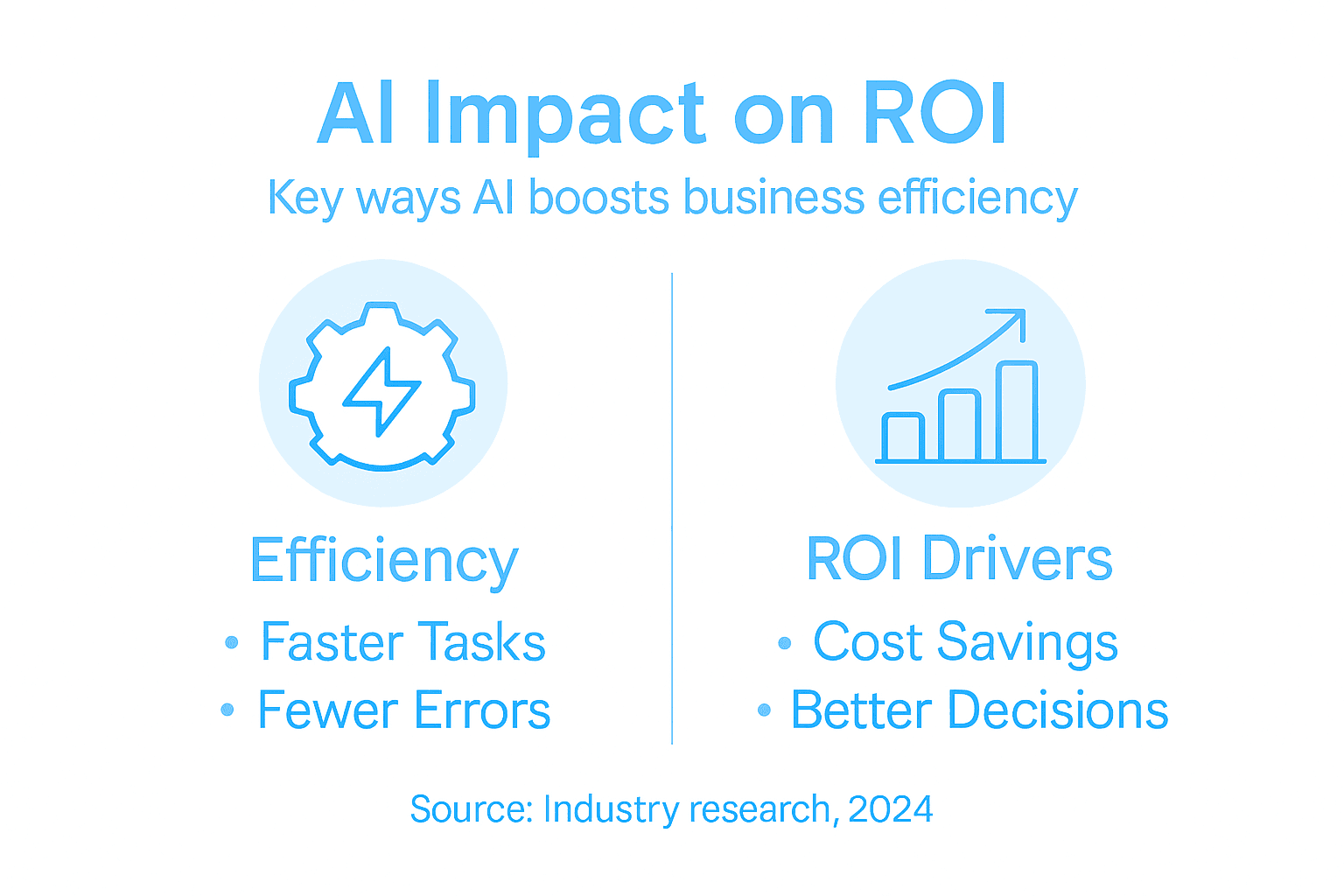
Strategic AI integration enhances productivity and competitive positioning by complementing existing business functions. But ROI requires honest measurement, not wishful thinking.
Consider a customer service operation. You deploy AI chatbots to handle routine inquiries. Real ROI factors include:
- Reduced labor costs: If AI handles 35% of inquiries, you save 35% of support staff capacity
- Faster resolution: Customers get answers immediately instead of waiting
- Escalation quality: Humans handle complex cases with better context, improving satisfaction
Measurable impact: 60% reduction in average resolution time, 40% drop in support headcount needs, 12% improvement in customer satisfaction scores. That’s ROI you can calculate.
Most AI projects generate ROI within 12-18 months if implemented strategically. This assumes clear metrics, realistic scope, and organizational alignment.
The Competitive Cost of Inaction
Global AI competition drives competitive advantage as organizations with advanced capabilities gain market positioning and operational edge. Delaying AI adoption isn’t cost-neutral. It’s a competitive liability.
Consider this: your competitor implements AI-driven pricing optimization. They adjust prices daily based on demand signals. You adjust quarterly. They capture margin improvements you never see. Over three years, they’ve gained sustainable competitive advantage that direct cost comparison can’t quantify.
Hidden Costs and How to Avoid Them
Most AI failures aren’t technical. They’re organizational. The hidden costs:
- Rework: Building systems disconnected from business workflows, then retrofitting them
- Data cleanup: Discovering data quality issues mid-project, pausing to fix them
- Team resistance: Deploying solutions teams don’t trust, resulting in non-adoption
- Integration delays: AI systems sitting idle while IT connects them to operational systems
These hidden costs often exceed the actual AI development cost. Prevention requires upfront organizational alignment and data readiness assessment.
To clarify the most common hidden costs of AI implementation, see this summary:
| Hidden Cost | Cause | Impact on ROI | Prevention Strategy |
|---|---|---|---|
| Rework | Poor workflow integration | Delayed value, added expense | Map business processes early |
| Data Cleanup | Low quality or incomplete data | Project pauses, resource drain | Conduct data audits beforehand |
| Team Resistance | Lack of user trust or buy-in | Non-adoption, wasted investment | Involve stakeholders throughout |
| Integration Delays | Legacy systems, complex pipelines | Idle systems, missed deadlines | Plan realistic timelines |
The costliest AI investment is one that works technically but fails organizationally.
Making the Investment Decision
Three metrics guide AI investment decisions:
-
Cost per unit of impact: Divide implementation cost by measurable improvement. Lower ratio wins.
-
Time to value: How quickly does ROI emerge? Faster payback reduces risk.
-
Competitive urgency: How critical is this to maintaining market position? Speed matters when competitors move.
Companies that weight all three make better decisions than those focused solely on upfront cost.
Pro tip: Build a detailed financial model for AI projects that includes infrastructure costs, talent investment, integration timeline, and expected operational improvements—this transforms vague cost concerns into concrete decisions your CFO can defend.
Risks, Compliance, and Integration Challenges
AI adoption isn’t frictionless. Organizations that ignore risks, compliance requirements, and integration complexity often face expensive failures. CTOs must treat these as first-class concerns, not afterthoughts.
Data Privacy and Regulatory Compliance
AI systems consume data. That data frequently falls under regulatory frameworks—GDPR, HIPAA, SOX, CCPA. Building AI without understanding your compliance landscape is reckless.
Compliance challenges in AI infrastructures require integrated governance frameworks incorporating continuous monitoring and adaptive protocols. This is especially critical in healthcare and finance where regulatory violations carry substantial penalties.
Key compliance concerns:
- Data residency: Where does AI training data live? Which jurisdictions govern it?
- Algorithmic transparency: Can you explain why your AI made a specific decision?
- Data retention: How long do you keep training data? When must you delete it?
- Cross-border transfer: How do you move data across regulatory boundaries legally?
Ignoring these questions until after deployment guarantees remediation costs and potential legal exposure.
Cybersecurity and Model Vulnerabilities
AI systems introduce new attack surfaces. Models can be manipulated through poisoned training data. Inference systems can be reverse-engineered to extract proprietary logic.
AI risk disclosures among major corporations reveal critical cybersecurity concerns affecting reputation and operational security. Your AI infrastructure needs security hardening equivalent to your most sensitive systems.
Critical security priorities:
- Model access control: Who can run inference? Who can retrain models?
- Input validation: What prevents attackers from poisoning training data?
- Output monitoring: Do you detect when model performance degrades unexpectedly?
- Audit trails: Can you trace decisions back to specific model versions and data?
Integration Complexity and Organizational Friction
Most AI projects fail not from technical limitations but from integration chaos. Your AI system produces predictions. Your operational systems ignore them. Your teams bypass them. Value evaporates.
Realistic integration challenges:
- Workflow redesign: Changing how decisions flow through your organization takes months, not weeks
- Legacy system connection: Your 15-year-old ERP doesn’t have APIs for AI integration
- Data pipeline reliability: AI needs fresh, clean data. Most enterprises lack this
- Team trust: Your operations team doubts AI accuracy and prefers manual processes
These aren’t technology problems. They’re organizational problems wearing technology disguises.
Successful AI integration requires treating organizational change as seriously as technical development.
Reputational Risk and Model Bias
AI systems trained on historical data inherit historical biases. If your training data reflects discriminatory decisions, your AI will amplify them. This creates legal and reputational exposure.
Bias mitigation requires:
- Audit training data for demographic skew and historical discrimination
- Monitor model performance across demographic segments, not just aggregate accuracy
- Document decision rationale so you can explain why AI rejected applications
- Establish human review for high-stakes decisions before full automation
Organizations that move fast without addressing bias pay later in lawsuits and brand damage.
Pro tip: Create a pre-deployment checklist covering data compliance, cybersecurity requirements, integration readiness, bias testing, and stakeholder sign-off—this forces conversations about realistic risks before you commit resources.
Unlock Real Business Value with Strategic AI Integration
Understanding the challenges of deploying AI to enhance ROI and operational efficiency is the first step toward transformation. If you are facing hurdles such as data readiness, aligning AI solutions with your workflows, or realizing measurable impact from AI projects, you are not alone. The article highlights critical pain points like unclear metrics, integration complexity, and organizational adoption—issues that can quietly drain resources and stall innovation.
NULLBIT specializes in bridging these gaps with tailored AI and digital solutions designed for businesses ready to evolve. From developing custom AI models including chat-based and retrieval-augmented generation architectures to optimizing cloud infrastructure and seamless integration, NULLBIT acts as your strategic partner to turn AI from a pilot project into a core driver of value. Explore how our expertise in AI solutions and software development can help accelerate your digital transformation. Act now to stay ahead of rising competitive pressures and achieve the measurable efficiency gains discussed in the article.
Take the next step—visit NULLBIT and start turning your AI ambitions into operational realities that drive ROI and sustainable growth.
Frequently Asked Questions
What is the main purpose of using AI in business?
AI enhances operational efficiency, decision-making, and customer experience, ultimately leading to better ROI by automating tasks and providing insights derived from large datasets.
How does AI improve ROI in organizations?
AI improves ROI by reducing manual labor costs, increasing processing speeds for decision-making, and providing predictive analytics that help optimize operations and resource allocation.
What types of AI technologies can businesses implement for operational improvements?
Businesses can implement machine learning for predictive analytics, natural language processing for text analysis, generative AI for content creation, and computer vision for visual tasks, depending on their specific operational needs.
What are the key challenges in integrating AI into business processes?
Key challenges include ensuring data quality, aligning organizational structure for AI adoption, and addressing compliance and cybersecurity risks associated with AI implementations.
Recommended
- AI Solutions | Copilots, RAG Systems & AI Features | NULLBIT
- AI Automation Services | Workflow Automation & AI Agents | NULLBIT
- Digital Business DNA - ChatGPT & Gemini Ready | NULLBIT
- NULLBIT - Technology Partner for Digitalization | NULLBIT
- Dot Data Labs — High-Quality Data for Training AI Models — Providing datasets for AI training
- Balancing Innovation, Clarity, and Time in an AI-Driven World
- 7 Advantages of Dedicated Cloud for AI Researchers