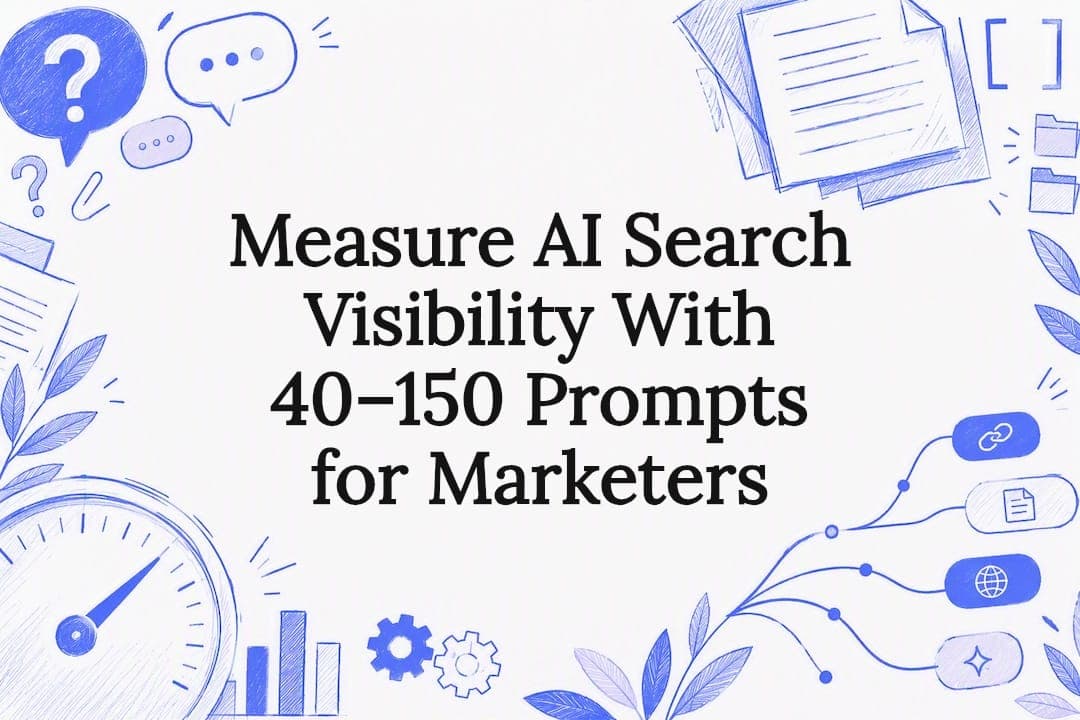
Measure AI Search Visibility With 40–150 Prompts for Marketers
AI search visibility is the rate at which AI answers name, cite, or recommend your brand when someone asks a relevant question. The immediate move is not a full rebrand of your content library. It’s picking three business-critical prompt groups (things like “best X for Y” or head-to-head comparisons) and running them, one model at a time, to find your current baseline. From there, three levers matter most: whether your pages can be crawled and parsed, whether your answers are written in a way that’s easy to quote, and whether you check each AI engine separately instead of averaging them together.
TL;DR:
- Measuring AI search visibility requires testing each engine separately with at least 40 to 150 prompts to ensure reliable data.
- Winning organic rank is necessary but not sufficient for AI citation; content structure, clarity, and third-party mentions also influence visibility.
- Technical issues like crawlability, indexing, and structured data availability are common barriers to AI recognition and should be addressed first.
- Short, clear, fact-based answers with embedded citations are more likely to be quoted by AI models, especially in comparison prompts.
- Ongoing audits and cycle-based testing help accurately diagnose gaps and track improvements, rather than relying on one-time, broad assessments.
Table of Contents
- Where AI Search Visibility Happens: Engines and Per-Model Divergence
- How to Measure AI Search Visibility Without Fooling Yourself
- What Actually Improves Your Odds of Being Cited
- The Weekly Workflow: Pick, Diagnose, Fix, Validate
- How Nullbit Approaches AI Visibility Work
- Why AI Visibility Deserves Its Own Line Item, Not a Footnote
- Get a Baseline Before You Guess at Fixes
- Sources
- FAQ
Where AI Search Visibility Happens: Engines and Per-Model Divergence
Not all AI surfaces work the same way, and that’s the first thing most marketing teams get wrong. ChatGPT and Claude lean heavily on training memory, meaning a fact baked into their training data can surface for months without any new content from you. Perplexity and Google’s AI Overviews behave more like live retrieval systems: they pull from indexed pages close to the moment of the query, so a page you publish today can show up in an answer this week.
That timing gap changes strategy. A win on a retrieval-grounded engine can happen fast. A win on a training-memory model often requires durable third-party coverage and waits for the next model update, according to Meev’s analysis of per-model brand visibility.
Layered on top of this is a pattern researchers call Citation-Ranking Divergence, or CRD. A study on generative search auditing found that AI citations partially diverge from organic SERP rankings, and exposure tends to re-concentrate around a narrower set of sources than what ranks on page one. Practically, that means:
- Ranking third on Google says nothing about whether ChatGPT will cite you at all.
- The sources an AI model quotes most often are usually a smaller, more consistent group than the ten blue links.
- Winning organic rank is necessary groundwork, but it doesn’t guarantee AI citation on its own.
How to Measure AI Search Visibility Without Fooling Yourself
Most dashboards blend every engine into one visibility score, and that’s the fastest way to make a wrong decision. A brand can look strong overall while quietly losing ground on the one model its buyers actually use. Measure per engine, every time.
Five KPIs cover the job:
- Prompt coverage — the percentage of your priority prompts where your brand appears anywhere in the answer.
- Recommendation rate — how often you’re named as a suggested option, not just mentioned in passing.
- Linked citation rate — how often the answer includes an actual link to your site versus a text-only mention.
- Comparative win rate — how you fare specifically in head-to-head or “versus” style prompts against named competitors.
- Representation accuracy — whether the facts the model states about you (pricing, services, location) are actually correct.
Statistic to know: platform outputs vary widely between runs, and reliable estimates typically require somewhere in the range of 40 to 150 prompts per platform depending on the engine, according to practical sampling guidance from Lantad. A single query run once tells you almost nothing.
Every report you produce should state four things plainly: the engine name, the date range of the test, the sample size, and some indication of uncertainty (even a simple “results from 3 runs, expect variance” note counts). Tools that skip this, per Lantad’s methodology guidance, are handing you numbers that can’t be reproduced or compared month over month.

What Actually Improves Your Odds of Being Cited
Getting cited by an AI model is a different skill than ranking on page one, and the tactics overlap only partly with classic SEO.
Start with snippability. AI systems tend to lift short, self-contained, factual sentences rather than paraphrasing a whole paragraph. Microsoft Advertising’s guidance on AI search inclusion frames this as selecting modular content pieces, not ranking a whole page. That means clear headers, direct answers in the first sentence under each one, and FAQ blocks that mirror how people actually phrase questions.
Technical health still matters; for e-commerce businesses especially, practical merchant-focused examples of AI search optimization can guide effective improvements. Google’s own generative AI guidance is blunt about this: generative features are grounded in core Search ranking systems, so a page has to be crawlable and indexable before it can be eligible for any AI feature at all. That checklist looks like:
- Confirm canonical tags aren’t accidentally pointing search engines away from your best page.
- Avoid burying key facts inside PDFs or content that only renders after a click or a script runs.
- Add structured data. Article, FAQ, and HowTo schema all help models parse what a page is actually saying.
- Keep the page reachable in two clicks or fewer from your site’s main navigation.
Content that includes specific statistics, named examples, and credible third-party mentions gets quoted more often than vague marketing copy. Adding a sourced number to a claim increases the odds a model treats that line as citable, per Microsoft’s own guidance on quotable content. Earned mentions in industry directories, comparison roundups, and reference sites do double duty here, feeding both the training data of memory-based models and the retrieval index of live-search engines.
Pro Tip: Check whether your best FAQ content is also embedded as FAQ schema. A page can read like a great answer to a human and still be invisible to a model that’s parsing structured data first.
The Weekly Workflow: Pick, Diagnose, Fix, Validate
Turning noisy AI outputs into a repeatable process comes down to four moves, run on a cycle rather than as a one-time project.
- Select 15 to 30 priority prompts across three groups: discovery (“best tools for X”), comparison (“X vs Y”), and transactional (“where to buy X near me” or “X pricing”).
- Run each prompt across every target engine, at minimum ChatGPT, Gemini, Perplexity, and Google AI Overviews, logging the full response text and any linked sources.
- Diagnose the gap type. A missing mention usually traces to one of four causes: thin content, a technical blocker, weak third-party credibility, or a page the model simply can’t access.
- Apply the matching fix, then re-run the same prompts after giving the engine time to re-index or re-train.
| Gap type | Likely cause | Fix to apply |
|---|---|---|
| Mentioned but not linked | Weak snippability | Rewrite the answer into shorter, quotable sentences |
| Absent entirely | Technical blocker | Fix crawlability, indexing, or hidden content |
| Present but inaccurate | Outdated or thin coverage | Update the page and pursue third-party mentions |
| Losing comparisons | Weak proof points | Add named examples, stats, and credible citations |
Validation is where most teams cut corners. Decide your sample size before you start, not after you see a favorable run. Re-test at least twice before declaring a fix worked, because a single good result on a retrieval-grounded engine can just be noise from that day’s crawl. Treat any single-digit sample as directional, not conclusive.
How Nullbit Approaches AI Visibility Work
Nullbit treats AI search visibility as its own measurement discipline rather than a footnote inside a traditional SEO retainer. That starts with preparing a client’s site architecture and content structure so AI assistants can parse it cleanly, an approach outlined in Nullbit’s Digital Business DNA service and reinforced across its broader AI solutions work.
Two projects in Nullbit’s portfolio show the range this work covers. One involved building an AI assistant integration for an automotive brand context, and another centered on a campaign built around cognitive recognition patterns in AI-driven discovery. Both are part of the broader portfolio of case studies documenting measurable outcomes across client engagements.
A typical engagement can follow this workflow:
- Conduct an initial audit to establish the per-model baseline across priority prompts.
- Run a proof-of-concept phase testing fixes on a limited content set before wider rollout.
- Sequence prioritized fixes by gap type, addressing technical issues first, then content and credibility work.
Why AI Visibility Deserves Its Own Line Item, Not a Footnote
Treating AI visibility as a subset of SEO undersells both the opportunity and the risk. The opportunity is real: a well-structured page with strong schema can win citations on retrieval-grounded engines within days, long before a traditional ranking campaign would show movement. The risk is just as real. Pew Research found six in ten U.S. adults now read AI summaries at the top of search results, which means a wrong fact in an AI answer reaches more people than a wrong fact buried on page four of Google ever would.
If you’re prioritizing where to spend first, put comparison and evaluation prompts ahead of pure discovery prompts. That’s where buying decisions get made, and where a missing or inaccurate mention costs you the most.
— Matija
Get a Baseline Before You Guess at Fixes
Most brands trying to improve their standing in AI answers are working blind: no per-model baseline, no prompt set, no idea whether last month’s content update actually moved anything. Nullbit runs this as a structured process instead of a guessing game, starting with proof-of-concept development to test fixes on a limited set of pages before committing to a larger rollout.
For teams that need the content and technical work done alongside the measurement, Nullbit’s SEO services and strategic management start from $1,500 per month and cover schema implementation, content restructuring for snippability, and ongoing per-model reporting. Smaller, well-defined fixes can also run as standalone projects starting at $15,000 through software development engagements when the work is mostly technical. If you want a concrete next step, request an AI visibility audit and get your current per-model baseline before deciding what to fix first.
Sources
- Optimizing for generative AI features on Google Search (Google Search Central)
- Optimizing your content for inclusion in AI search answers (Microsoft Advertising blog)
- Human‑Centric Auditing of AI‑Powered Generative Search: When Citations Diverge from Rankings (Information Systems Frontiers)
- How many prompts an AI visibility measurement needs (Lantad)
- Americans and AI, 2026 (Pew Research)
FAQ
What Is AI Search Visibility, Exactly?
AI search visibility measures how often AI systems like ChatGPT, Gemini, or Google AI Overviews mention, cite, or recommend your brand in response to relevant prompts. It’s tracked per engine rather than as one blended score, since engines diverge in what they cite.
How Is AI Search Visibility Different From SEO Rankings?
Ranking well on Google doesn’t guarantee an AI model will cite you, since citation patterns partially diverge from organic rankings. SEO fundamentals like crawlability still matter, but AI visibility also depends on how quotable and structured your content is.
How Many Prompts Should I Test Per Engine?
Reliable estimates generally need roughly 40 to 150 prompts per platform depending on the engine and how much variance it shows between runs. Testing a handful of prompts once gives you a snapshot, not a trend.
Does Nullbit Offer AI Visibility Audits?
Nullbit runs AI visibility work through its AI solutions and proof-of-concept services, starting with a baseline audit and moving into prioritized fixes. Pricing for smaller proof-of-concept projects starts from 5000 EUR one-off; current rates for other engagement types are available on the site.
What’s the Fastest Way to Improve My AI Citation Rate?
Rewrite key answers into short, self-contained sentences under clear headings, since AI systems tend to lift quotable, factual lines rather than paraphrase full paragraphs. Pairing that with schema markup and fixing any crawlability issues covers most of the fast wins.