
Why Integrate AI: 18% Growth Boosts Mid-Sized Efficiency

Mid-sized companies are adopting AI at an 18% annual rate, yet many still question whether integration truly delivers operational benefits or competitive advantage. This article cuts through misconceptions to explain why AI integration matters for mid-sized North American firms pursuing digital transformation. You’ll discover how AI enhances efficiency, creates lasting competitive advantages, and learn practical frameworks for successful implementation that accelerate ROI within 12 to 18 months.
Table of Contents
- Understanding AI Integration: What And Why
- How AI Enhances Operational Efficiency
- Why AI Creates Competitive Advantage
- Common Misconceptions About AI Integration
- Comparative Analysis Of AI Technologies And Integration Approaches
- AI Integration Strategies And Frameworks For Mid-Sized Companies
- Case Studies Illustrating AI Integration Benefits
- Conclusion: Bridging Understanding To Action
- Explore NULLBIT’s AI Integration Services
Key Takeaways
| Point | Details |
|---|---|
| Operational Efficiency | AI automation reduces errors and costs while analytics enables real-time decision making. |
| Competitive Advantage | Data-driven insights and faster innovation cycles differentiate mid-sized firms in crowded markets. |
| Strategic Alignment | 70% of AI projects fail without clear business goals and data governance. |
| Phased Integration | Pilot testing and incremental deployment reduce time to meaningful ROI. |
| Technology Selection | Rule-based AI suits simple tasks; machine learning delivers higher gains with quality data. |
Understanding AI Integration: What and Why
AI integration means embedding artificial intelligence technologies into your existing business processes to automate tasks, improve decision making, and gain competitive advantages. For mid-sized companies in North America, this isn’t about chasing trends. It’s about leveraging AI’s ability to process data faster and more accurately than humans while your team focuses on strategic work.
Why use AI in business? The primary objectives center on three areas:
- Automating repetitive tasks to free staff for higher-value work
- Enabling data-driven decisions through real-time analytics
- Creating sustainable competitive advantages in your market
Mid-sized firms occupy a sweet spot for AI adoption. You’re agile enough to implement quickly without enterprise bureaucracy, yet large enough to generate meaningful data for AI models. AI integration aligns with operational efficiency and competitive advantage goals specific to mid-sized North American companies navigating digital transformation. This foundation sets the stage for understanding exactly how AI delivers tangible operational improvements and strategic benefits that justify the investment.
How AI Enhances Operational Efficiency
AI transforms operations through three core mechanisms that directly impact your bottom line. AI automation reduces errors and costs significantly while analytics enables faster data-backed decisions. When you replace manual data entry with AI systems, human error rates drop dramatically, often by 80% or more. This accuracy improvement cascades through your operations, reducing costly mistakes in inventory management, order processing, and financial reporting.
Real-time analytics powered by AI give you decision-making speed that wasn’t possible five years ago. Your teams can spot trends, identify bottlenecks, and respond to market shifts within hours instead of weeks. Manufacturing firms see particularly striking results: predictive maintenance reduces industrial downtime by up to 40%. That’s production time reclaimed, delivery commitments met, and revenue protected.
Consider these proven efficiency improvements:
- Customer service chatbots handle 60 to 70% of routine inquiries, freeing human agents for complex issues
- Supply chain optimization reduces logistics costs by 15 to 25% through better route planning
- Quality control systems identify defects 99% accurately, eliminating rework expenses
Pro Tip: Prioritize AI use cases where you can measure efficiency impact directly, like processing time or error rates. Quick wins in measurable areas build organizational confidence and secure budget for broader AI workflow for enterprise efficiency initiatives. Start with the pain points costing you the most money or time, then expand as you prove ROI.
These operational gains compound over time. The hours saved, errors prevented, and resources optimized create cumulative value that separates high-performing mid-sized companies from competitors still relying on manual processes. But efficiency alone doesn’t tell the full story of why AI integration matters for your business strategy.
Why AI Creates Competitive Advantage
Operational efficiency keeps you in the game. Competitive advantage wins it. AI delivers strategic differentiation through capabilities that fundamentally change how you compete in your market. The data insights AI uncovers aren’t just faster versions of traditional analytics. They reveal patterns and opportunities invisible to human analysis, enabling smarter product development, pricing strategies, and customer targeting.
18% of mid-sized companies identify AI as a key competitive driver, and that number is climbing as more firms realize AI accelerates innovation cycles. Your product development teams can test concepts, analyze feedback, and iterate designs in weeks instead of quarters. This speed matters when market windows close quickly and customer preferences shift constantly.
AI enhances business scalability in ways that matter for mid-sized firms:
- Handle 300% more customer inquiries without proportional staff increases
- Enter new markets faster by automating localization and compliance checks
- Scale personalization across thousands of customers with AI-driven recommendations
“The companies seeing the strongest competitive advantages from AI aren’t necessarily the ones with the biggest budgets. They’re the ones using AI to unlock data assets that traditional analytics overlooked.”
Your competitors are testing AI right now. The question isn’t whether to integrate AI, but how quickly you can deploy it strategically. AI as a competitive driver works because it creates sustainable advantages that compound over time. Every month you collect more data, refine your models, and widen the gap between your capabilities and competitors still using legacy approaches.
Pro Tip: Use AI to analyze customer behavior data you’re already collecting but not fully exploiting. Most mid-sized companies sit on goldmines of transactional, behavioral, and feedback data that AI can transform into actionable competitive intelligence. This approach delivers insights without requiring new data infrastructure investments.
The firms winning with AI share a common trait: they view enhancing ROI and efficiency with AI as strategic imperatives, not IT projects. But success requires clearing misconceptions that derail many AI initiatives before they start.

Common Misconceptions About AI Integration
Three persistent myths prevent mid-sized companies from capturing AI’s full value. Understanding these misconceptions helps you avoid the pitfalls that sink most projects before they deliver results.
Misconception 1: AI Guarantees Success Without Strategy
70% of AI projects fail due to lack of strategic alignment and data quality. Technology alone solves nothing. You need clear business objectives, quality data, and organizational commitment. AI amplifies good strategies and exposes bad ones. Before deploying any AI solution, define exactly what business problem you’re solving and how you’ll measure success.
Misconception 2: AI Is Only Viable for Large Enterprises
This belief persists despite evidence showing AI adoption grows 18% yearly in mid-sized firms. Cloud-based AI services, pre-trained models, and no-code platforms have democratized access. You don’t need massive budgets or data science teams to start. Many mid-sized companies begin with focused AI applications in customer service, inventory management, or marketing automation, scaling gradually as they prove value.
Misconception 3: AI Benefits Are Immediate
Expecting instant results sets unrealistic expectations that doom projects. AI integration requires phased implementation: data preparation, model training, pilot testing, and refinement. Meaningful ROI typically appears within 12 to 18 months, not 12 weeks. Quick wins are possible in specific areas, but sustained competitive advantages develop through continuous improvement cycles.
The solution to these misconceptions is straightforward: adopt a phased, strategic approach. Set clear business goals before selecting technologies. Invest in data governance to ensure AI models have quality inputs. Start with pilot projects that test assumptions and build organizational capability. This methodical approach transforms AI from risky bet into calculated strategic investment that delivers predictable returns.
Comparative Analysis of AI Technologies and Integration Approaches
Choosing the right AI technology matters as much as the decision to integrate AI itself. Two primary categories dominate: rule-based systems and machine learning approaches. Each offers distinct trade-offs in complexity, cost, scalability, and potential efficiency gains.
| Technology Type | Initial Cost | Complexity | Scalability | Efficiency Gains | Best For |
|---|---|---|---|---|---|
| Rule-Based AI | Low | Simple | Limited | 15-25% | Predictable, structured tasks |
| Machine Learning | Medium to High | Moderate to High | High | 30-50% | Dynamic environments, pattern recognition |
| Hybrid Approach | Medium | Moderate | High | 25-40% | Mixed use cases, phased deployment |
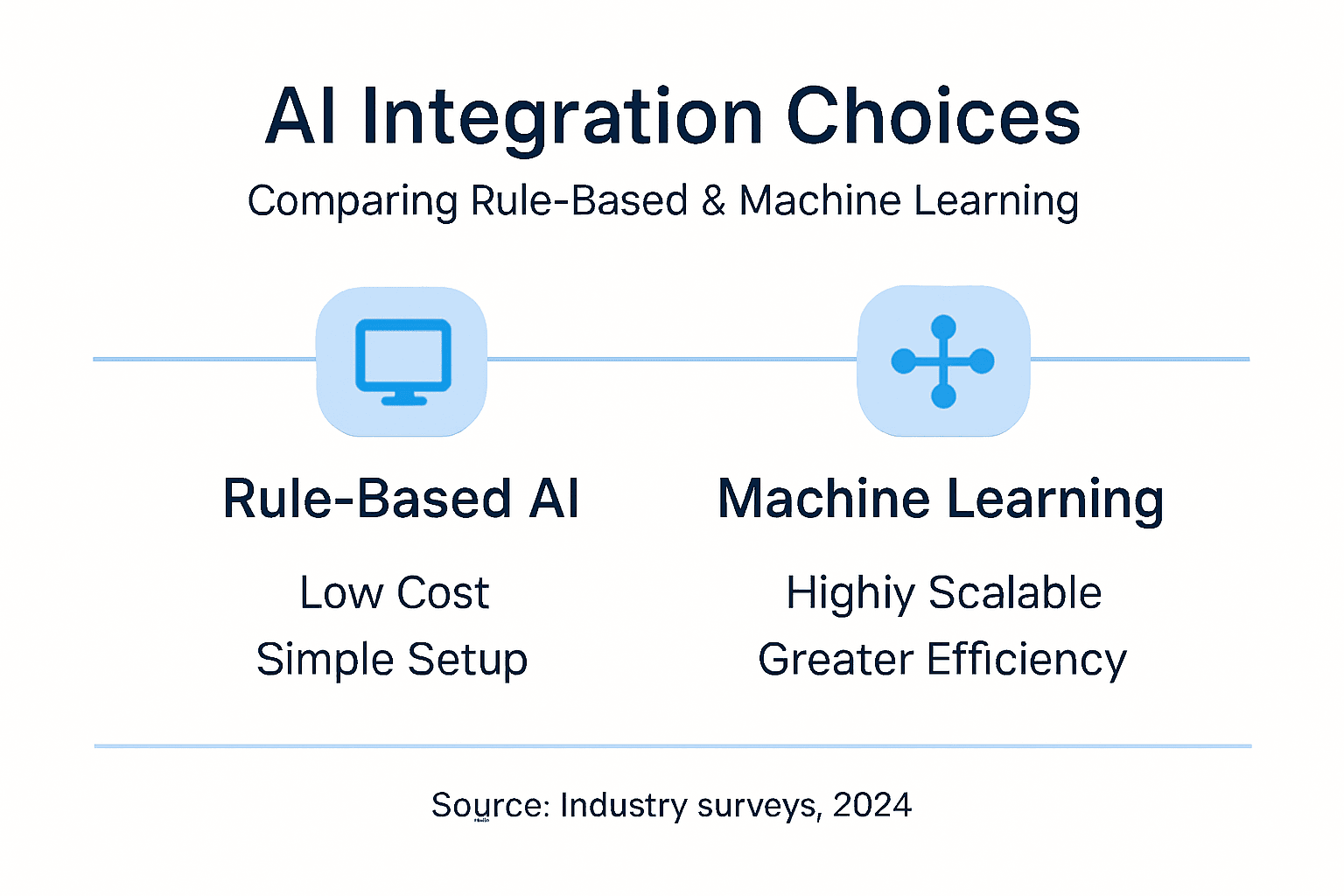
Rule-based AI is easier and cheaper but less adaptable; machine learning yields higher gains but requires quality data. Rule-based systems follow explicit instructions you program. They excel at repetitive tasks with clear decision trees: routing support tickets, flagging compliance issues, or scheduling appointments. Implementation is fast, costs are predictable, and maintenance is straightforward.
Machine learning systems learn from data patterns without explicit programming. They adapt to changing conditions and handle complexity that would overwhelm rule-based approaches. A logistics company might use ML to optimize delivery routes considering traffic, weather, weather patterns, and customer preferences simultaneously. Manufacturing operations deploy ML for predictive maintenance, analyzing sensor data to forecast equipment failures before they occur.
Consider these industry-specific applications:
- Logistics: ML-based route optimization reduces fuel costs by 20% while improving on-time delivery
- Manufacturing: Predictive maintenance powered by ML cuts unplanned downtime by 40%
- Professional Services: Rule-based chatbots handle 70% of routine client inquiries, freeing staff for complex work
Pro Tip: Start with simpler rule-based AI solutions for well-defined processes, then graduate to machine learning as you build data assets and organizational capability. This staged approach minimizes risk while accelerating time to initial ROI. Hybrid strategies combining both technologies often deliver the best results for AI integration types for enterprises with diverse operational needs.
The technology decision must align with your data readiness, budget constraints, and specific business requirements. Neither approach is universally superior. Success comes from matching the right AI technology to each use case within your broader integration strategy.
AI Integration Strategies and Frameworks for Mid-Sized Companies
Successful AI integration follows a structured, phased approach that minimizes risk while accelerating value delivery. This framework guides mid-sized companies from initial assessment through sustained operations:
-
Assess Current Operations: Identify processes with high error rates, excessive manual work, or decision-making bottlenecks. Prioritize areas where AI can deliver measurable improvements quickly.
-
Define Business Objectives: Set specific, quantifiable goals like reducing processing time by 30% or cutting customer service costs by $50,000 annually. Vague objectives doom AI projects.
-
Pilot Strategic AI Projects: Test AI solutions on limited scope before full deployment. A three-month pilot reveals implementation challenges, proves ROI, and builds organizational confidence.
-
Establish Data Governance: Ensure data quality, security, and compliance frameworks exist before scaling. AI models are only as good as the data feeding them.
-
Measure and Iterate Continuously: Track KPIs weekly, not quarterly. Rapid measurement cycles enable quick adjustments that maximize AI performance and business impact.
Phased approach reduces time to meaningful ROI from 24+ to 12-18 months. Why does this matter? Because executive patience and budget allocation depend on demonstrating value quickly. Front-loading wins through careful pilot selection builds momentum for broader AI initiatives.
Business objectives must drive every AI decision. Technology capabilities are seductive, but implementing AI because it’s cool wastes resources. Ask yourself: what specific business problem does this AI solution solve? How will we measure success? What happens if the AI project fails? These questions force strategic clarity that separates successful integrations from expensive distractions.
Risk mitigation happens through iterative testing. Pilot projects on non-critical processes let you identify data gaps, integration challenges, and user resistance before they derail major initiatives. You learn what works in your specific environment without betting the company.
Pro Tip: Engage cross-functional teams early in AI planning. IT, operations, finance, and business unit leaders all bring perspectives that strengthen implementation. Early buy-in prevents the resistance that kills AI projects during deployment. Create a steering committee with representatives from each affected area to guide decisions and champion adoption.
Continuous measurement enables sustained benefits. AI models drift over time as business conditions change. Weekly performance reviews catch degradation early. Monthly optimization cycles keep models aligned with current business needs. This ongoing commitment to scalable AI solutions guide ensures your initial investment continues delivering returns year after year.
The companies seeing the strongest AI results treat integration as an ongoing capability development program, not a one-time technology implementation. They build internal expertise, refine processes based on lessons learned, and scale successful pilots into enterprise-wide AI automation implementation for enterprise success that transforms operations fundamentally.
Case Studies Illustrating AI Integration Benefits
Real-world examples demonstrate how mid-sized companies across industries capture measurable value from strategic AI integration. These case studies reveal patterns worth emulating in your own AI journey.
A regional logistics firm with 200 employees struggled with rising fuel costs and inconsistent on-time delivery rates. They implemented ML-based route optimization that analyzed real-time traffic, weather, delivery windows, and vehicle capacity. Results appeared within six months: 22% reduction in fuel costs, 18% improvement in on-time deliveries, and $340,000 in annual savings. The system paid for itself in eight months.
A mid-sized manufacturing plant producing industrial components faced frequent unplanned equipment downtime that disrupted production schedules and inflated costs. They deployed predictive maintenance AI analyzing sensor data from critical machinery. The system forecast component failures 7 to 10 days in advance with 87% accuracy. Maintenance teams scheduled repairs during planned downtime windows, achieving 40% downtime reduction and increasing annual output by $1.2 million without capital equipment investments.
A professional services firm with 150 sales representatives struggled to prioritize leads effectively, resulting in wasted effort on low-probability prospects. AI-driven customer engagement scoring analyzed historical conversion patterns, company signals, and behavioral data to rank leads. Sales teams focused on high-probability opportunities, increasing conversion rates by 28% and shortening sales cycles from 90 to 65 days on average.
| Industry | AI Application | Key Results | ROI Timeline |
|---|---|---|---|
| Logistics | Route Optimization | 22% cost reduction, 18% delivery improvement | 8 months |
| Manufacturing | Predictive Maintenance | 40% less downtime, $1.2M output increase | 10 months |
| Professional Services | Lead Scoring | 28% higher conversion, 25-day cycle reduction | 6 months |
These cases share common success factors: clear business objectives defined upfront, quality data prepared before AI deployment, phased implementation that proved value quickly, and ongoing optimization that sustained benefits. The logistics firm didn’t try to optimize everything simultaneously. They started with their busiest routes, proved ROI, then expanded. The manufacturer piloted predictive maintenance on their most critical equipment line before rolling out facility-wide.
Lessons from these implementations emphasize the importance of tailored strategies. Off-the-shelf AI solutions provided the foundation, but customization to specific business contexts delivered superior results. Each company invested in data quality and governance before scaling, avoiding the pitfalls that doom generic AI deployments.
Conclusion: Bridging Understanding to Action
AI integration delivers measurable operational efficiency and competitive advantages for mid-sized North American companies ready to embrace digital transformation strategically. You’ve learned how automation reduces costs and errors, analytics accelerates decision making, and predictive capabilities prevent problems before they impact operations. The evidence is clear: AI adoption growing at 18% annually reflects recognition that AI isn’t optional for companies competing in 2026 markets.
Success requires strategic alignment, not technology for technology’s sake. Define business objectives first, select appropriate AI technologies second, and implement through phased pilots that prove value quickly while building organizational capability. The 70% failure rate for poorly planned AI projects warns against rushing implementation without addressing data quality, governance, and change management fundamentals.
Now is the time to start or accelerate your AI journey. The competitive advantages compound over time, meaning delays cost you market position as competitors pull ahead. Partner with experienced firms who understand mid-sized company constraints and opportunities to maximize your AI investment outcomes.
“The question isn’t whether mid-sized companies should integrate AI. It’s how quickly they can deploy AI strategically to capture efficiency gains and competitive advantages before market leaders establish insurmountable leads.”
Explore NULLBIT’s AI Integration Services
Ready to transform understanding into action? NULLBIT specializes in AI solutions tailored specifically for mid-sized firms navigating digital transformation. Our team delivers AI copilot systems, intelligent automation, and custom software development services that integrate seamlessly with your existing operations. We use agile development approaches that minimize risk through iterative pilots, proving ROI before scaling investment. Partnering with experts who understand both AI technology and mid-sized company realities ensures your integration aligns with business objectives and delivers measurable results within 12 to 18 months.
FAQ
What are the biggest challenges mid-sized companies face when integrating AI?
Common challenges include lack of clear strategy, insufficient data governance, and organizational resistance to change. Setting specific business goals, investing in data quality, and adopting phased implementation approaches mitigate these issues effectively. Success requires treating AI as a strategic capability development program, not just a technology project.
How long does it typically take for mid-sized companies to see ROI from AI integration?
Meaningful ROI generally appears within 12 to 18 months when using phased implementation approaches. Quick wins in specific areas like customer service automation may deliver value within 3 to 6 months. Sustained competitive advantages develop through continuous improvement cycles over multiple years.
Which AI technology is best suited for mid-sized companies?
Rule-based AI fits simple, rule-driven tasks with lower costs and faster implementation timelines. Machine learning suits dynamic environments requiring pattern recognition but demands quality data and larger investments. Start with simpler solutions for well-defined processes, then scale to ML as you build data assets and organizational capability.
How much does AI integration typically cost for mid-sized companies?
Costs vary widely based on scope, technology choice, and implementation approach. Pilot projects often range from $25,000 to $100,000, while enterprise-wide deployments can reach $250,000 to $500,000 over 18 months. Cloud-based AI services and phased approaches reduce upfront capital requirements significantly compared to legacy implementation models.
Can mid-sized companies implement AI without hiring data scientists?
Yes, through partnerships with AI solution providers, cloud-based AI platforms with pre-trained models, and no-code tools designed for business users. Many mid-sized firms successfully deploy AI by combining external expertise for initial implementation with internal training for ongoing operations and optimization.