
Revenue First B2B Content Strategy: One Goal Per Quarter
Pick one goal for the quarter, pipeline, authority, or retention, and build everything else around it. That means mapping a specific ideal customer profile to content stages, distributing through LinkedIn and email before ever paying to boost a post, and measuring influenced pipeline instead of pageviews. This is how a b2b content strategy stops being a publishing habit and starts working like a revenue channel, the way Sprout Social’s three-tier framework and Nullbit both approach it.
TL;DR:
- Focusing on one primary goal, such as pipeline generation or retention, ensures content efforts directly support revenue rather than general awareness.
- Building a detailed ideal customer profile with firmographics, technographics, and intent signals sharpens content relevance and improves conversion potential.
- Content must be mapped to distinct buyer stages with problem-aware, solution-aware, and vendor-aware assets to guide prospects effectively through the funnel.
- Using content to generate pipeline relies on metrics like influenced deals, content-assisted leads, and ICP-fit traffic, not pageviews or time-on-page.
- Effective distribution prioritizes email, LinkedIn organic posts, and targeted paid boosts on engaging organic content to maximize reach and pipeline impact.
Table of Contents
- What Is a B2B Content Strategy Built on Pipeline?
- How Should Content Map to the Buyer’s Journey?
- What Topics Actually Generate Pipeline?
- Which Content Formats Actually Move Deals?
- How Do You Distribute Content for Maximum Pipeline Reach?
- What KPIs Actually Prove Content Drives Revenue
- How Do You Run Content Operations at Scale?
- How Do You Turn One Asset Into Ten Pieces of Content?
- Proof Points: What Makes a Content Strategy Credible
- How Do You Connect Content Engagement to Sales-Ready Signals?
- How Should ABM and Content Strategy Work Together?
- How Do You Personalize Content Across Different Buyer Roles?
- How Do Marketing, Sales, and Product Collaborate on Content?
- What Legal and Compliance Issues Apply to B2B Content?
- How Are AI and Automation Changing B2B Content Strategy?
- How Do You Localize B2B Content for Global Audiences?
- Why Most B2B Teams Confuse Publishing With Strategy
- How Nullbit Helps You Build a Pipeline-Focused Content Strategy
- Sources
- FAQ
What Is a B2B Content Strategy Built on Pipeline?
A b2b content strategy built for revenue starts with a decision most teams skip: choosing exactly one primary objective before writing a single headline. Not three. One. Pipeline generation, authority building, or customer retention, and each demands different content, different formats, and different success metrics. High-performing teams pick one goal per period rather than chasing all three at once, because trying to optimize a case study for SEO authority and a bottom-funnel demo request at the same time usually produces content that does neither well.
Once the goal is locked, the next job is defining who the content actually needs to move. That means building an ideal customer profile, or ICP, that goes past job titles with CTA Systems I.T. Solutions Ltd’s IT support services. Combine three layers: firmographics (company size, industry, revenue band), technographics (what tools or platforms they already run), and intent signals (searches, content downloads, competitor page visits). Teams that define ICP this way, rather than relying on personas built from guesswork, consistently produce sharper topic decisions, according to DemandNexus’s pipeline-focused content guide.
Buyer-committee mapping matters just as much. A single B2B sale might involve a technical evaluator, a budget owner, and an end user, and each one asks a different question before they’ll sign off. A DevOps lead wants proof the tool works under load. A CFO wants proof it pays back within two quarters. If your content only speaks to one of them, deals stall in committee, not because the product is wrong but because half the room never got their question answered.
Here’s a fast way to check whether a topic idea is worth a writer’s time:
- Does it match a specific ICP segment’s actual search behavior or stated pain point?
- Does it move that segment one step closer to a sales conversation, not just a page view?
- Does it say something a competitor’s blog hasn’t already said?
- Can you tie it to a measurable action (download, demo request, reply to outbound)?
If a topic fails two or more of those checks, shelve it. Volume without ICP fit just inflates your content calendar without moving revenue.
Pro Tip: Run your ICP definition past your sales team before you finalize it. Marketing often defines “ideal” by firmographics alone; sales usually adds a disqualifier, like a buying committee that has no budget authority, that saves you from writing content for accounts that will never close.
How Should Content Map to the Buyer’s Journey?
Content strategy for B2B works best as a three-tier architecture: problem-aware, solution-aware, and vendor-aware content, each doing a distinct job in the funnel. This structure, widely used across top-performing B2B guides, gives every asset a clear reason to exist instead of a vague mandate to “raise awareness.”
Tier 1, problem-aware (ToFu), targets buyers who know they have a headache but haven’t named the cure. Blog posts, original research, and short-form social content live here. The job is education, not persuasion. They want someone to explain the mechanics of the problem.
Tier 2, solution-aware (MoFu), targets buyers who’ve identified a category of fix and are comparing approaches. Comparison guides, webinars, and buyer’s guides do the heavy lifting here. This is where you start naming trade-offs between build versus buy, or between platforms, without hard-selling a specific vendor yet.
Tier 3, vendor-aware (BoFu), targets buyers actively evaluating you specifically. Case studies, ROI calculators, and detailed technical documentation belong here, alongside white papers and interactive tools that industry guides consistently flag as high-impact for closing deals.
Sequencing matters more than most teams realize. A buying committee doesn’t move through these tiers as one person. The technical lead might jump straight into Tier 3 documentation while the budget owner is still reading a Tier 1 thought-leadership piece. Design your internal linking and email nurture sequences to catch both, rather than assuming a linear path.
For MoFu and BoFu assets specifically, build in qualification signals:
- Gate the asset behind a form that captures company size or role, not just an email address.
- Track which specific page or section a prospect spent time on, not just whether they downloaded.
- Note the asset in the CRM record so sales sees exactly what content triggered the interest.
- Time the follow-up to the content’s specificity, a generic guide gets a soft check-in, a pricing calculator gets a same-day call.
What Topics Actually Generate Pipeline?
Most editorial calendars die from having too many ideas and no filter to sort them. Use four questions to decide what makes the cut:
- Does it match a real ICP intent signal? Pull from actual search queries, support tickets, and sales call transcripts, not what sounds smart in a brainstorm.
- Does it move the buyer closer to a decision? A topic that entertains but doesn’t advance understanding of the problem or solution is a vanity piece.
- Does it carry a differentiated insight? If ten competitors have already written the same “5 tips” version, skip it or find the angle nobody else has.
- Does it tie back to a conversion path? Every piece should have a next step in mind, a related case study, a demo link, a newsletter signup, before it’s written.
The richest source of topic ideas isn’t a keyword tool. It’s your sales and support teams. Every objection an SDR hears on a call, every “how does this compare to X” question in a demo, is a content brief waiting to be written. Set up a lightweight monthly sync where sales flags the three questions they got asked most, and hand those directly to your editorial pillars.
Editorial pillars themselves should be built around the recurring problems your ICP faces, not around your product’s feature list. A cloud infrastructure company’s pillars might be cost visibility, security compliance, and scaling under load, each supporting a cluster of ToFu, MoFu, and BoFu content rather than one-off posts with no connective tissue.
Pro Tip: Before greenlighting a new pillar, run a gap analysis: search the topic yourself and read what ranks. If the top five results are thin, outdated, or written by non-experts, that’s your opening. If they’re already excellent, you need a genuinely different angle, not just a longer version.
Which Content Formats Actually Move Deals?
Format choice should follow funnel stage and available production time, not personal preference for one medium. Short-form social and blog posts work hardest at the top of the funnel, where the goal is reach and education. Comparison guides and webinars carry the middle. Case studies, technical white papers, and ROI tools do the closing work at the bottom, a pattern B2B research consistently supports.
Time investment doesn’t scale evenly with pipeline impact. A well-produced case study takes real coordination, pulling metrics from a client, getting legal sign-off, scheduling an interview, but it tends to punch far above its weight in bottom-funnel conversions because it answers the buyer’s real question: did this work for someone like me?
Video sits in an odd middle spot. A polished explainer video takes significant production time for uncertain payoff, while a raw, unscripted executive video shot on a phone often performs better on LinkedIn precisely because it doesn’t look like an ad.
A few practical notes on production:
- Case studies convert best when they lead with the client’s specific numbers before explaining the how, readers skim for the outcome first.
- Executive LinkedIn posts outperform brand-page posts for reach because the platform’s algorithm favors personal profiles over company pages.
- Short-form social should repurpose insights from long-form assets rather than being written from scratch, it’s faster and keeps messaging consistent.
- White papers only justify their production cost when they contain original data or a framework nobody else has published.
How Do You Distribute Content for Maximum Pipeline Reach?
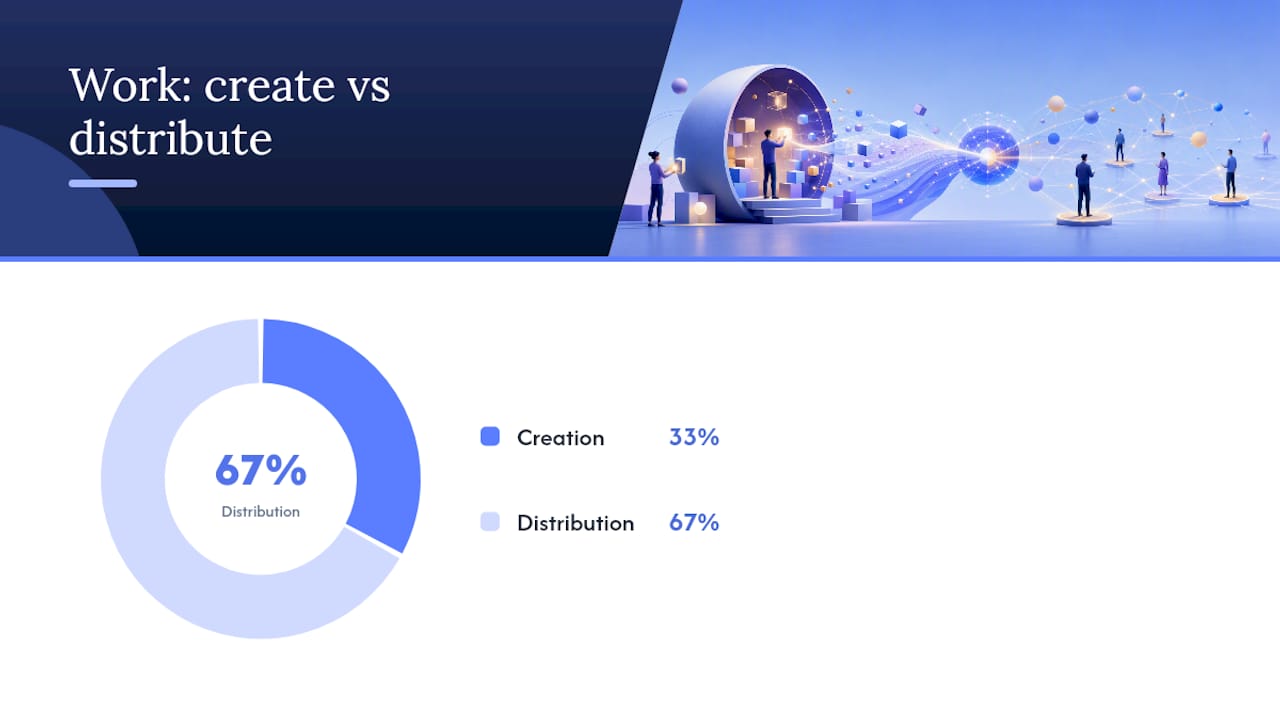
Creating an asset is maybe a third of the work. The rest is getting it in front of the right people, and B2B marketers overwhelmingly point to one channel for that job.
Mailchimp’s research on B2B content marketers shows most identify LinkedIn as the platform producing the best results, and Statista’s data on platform usage supports that B2B marketers prioritize their distribution effort there. If your distribution checklist doesn’t put LinkedIn first, you’re fighting the data.
A working distribution sequence looks like this:
- Email first. Send the asset to your existing list segmented by ICP fit, this is your warmest audience and the fastest signal on whether the content resonates.
- Executive LinkedIn post. Have a founder or subject-matter expert post a personal take on the asset’s core insight, linking out or inviting comments, rather than a company-page announcement.
- Native LinkedIn company post. Run a shorter version on the brand page for reach among followers who don’t see the executive’s personal feed.
- Repurpose within 48 hours. Break the asset into three to five smaller posts, a stat, a quote, a framework graphic, spaced over the following two weeks.
- Paid boost for top performers only. Don’t boost everything. Identify the organic post with the strongest engagement in the first 24 hours and put a modest budget behind it rather than spreading spend evenly across every piece.
A reasonable rule of thumb: reserve paid amplification budget for the most engaging content by organic engagement, and target by job function and company size rather than broad industry categories, since distribution checklists that combine repurposing with paid amplification consistently outperform single-channel pushes.
Outbound teams should treat content as ammunition, not an afterthought. When a prospect downloads a guide or watches a webinar, that action belongs in the SDR’s opening line, not buried in a CRM field nobody reads. “I noticed you downloaded our guide on X” converts better than a cold, generic opener because it proves you’re paying attention to what they actually care about.
What KPIs Actually Prove Content Drives Revenue
Pageviews and time-on-page tell you almost nothing about whether content is generating revenue. DemandNexus’s guide on pipeline-driven content makes the case plainly: influenced pipeline and content-assisted MQLs are far better indicators of ROI than traffic metrics, because they connect content directly to money in motion.
Four metrics deserve a permanent spot on your dashboard:
- Influenced pipeline. The dollar value of open deals where the prospect touched at least one content asset before or during the sales cycle.
- Content-assisted MQLs. Marketing-qualified leads where a specific piece of content was part of the conversion path, not just the last-touch form fill.
- Download-to-conversation rate. The percentage of gated-asset downloads that turn into an actual sales conversation within a set window, this exposes whether your gating and follow-up process is working.
- ICP-fit organic traffic. Not total traffic, traffic from companies and roles that actually match your ICP criteria, which you can approximate through firmographic enrichment tools on your form fills.
Instrumentation is where most of this falls apart in practice. Set a consistent UTM convention across every channel before you launch a single campaign, tag content by funnel tier and pillar in your CMS, and make sure your CRM records which asset a lead engaged with, not just that they filled out a form. Without that tagging discipline, none of the four metrics above are calculable six months from now when you actually need the report.
Review the numbers monthly, not quarterly. A quarterly cadence means you’ve already burned three months of budget before you notice a pillar isn’t converting.
Pro Tip: Set up a simple monthly experiment: pick one variable, headline format, gating position, CTA wording, and test it on your two highest-traffic pillar pages. Small conversion-rate gains compound faster across an existing content library than most teams expect from new production.
How Do You Run Content Operations at Scale?
A content calendar without operational discipline behind it turns into a graveyard of half-finished drafts. Running content like a system, not a scramble, starts with a regular audit.
- Audit your existing library quarterly. Pull every published asset into a spreadsheet with traffic, conversion data, and publish date, then sort into three buckets: refresh (still relevant but outdated), merge (overlapping thin pieces that should become one strong asset), and retire (no traffic, no ranking, no pipeline contribution).
- Assign a RACI for every piece. Someone is Responsible for drafting, someone Accountable for final approval (often a content lead or CMO), Consulted parties like sales or product for accuracy, and Informed parties like leadership who just need visibility. Skipping this step is how a case study ends up published with a client quote that legal never approved.
- Run production in two-week sprints. Assign a fixed set of assets per sprint tied to the quarter’s single primary goal, review what shipped, and carry over anything incomplete rather than letting it silently vanish from the calendar.
Lightweight governance matters more than heavy process. One rule that consistently helps: no asset ships without a named distribution owner attached at the brief stage, not after publication. If nobody’s job is to distribute it, it won’t get distributed, no matter how good the writing is.
How Do You Turn One Asset Into Ten Pieces of Content?
Topical authority compounds when content clusters link to each other around a shared pillar topic, rather than existing as isolated posts competing with your own pages for the same keywords. Build a pillar page, link supporting posts back to it, and link those posts to each other where the topics genuinely overlap. Search engines and readers both reward that structure over scattered, unconnected posts.
Repurposing is the fastest way to multiply reach without multiplying production time, and Salesforce’s guide on distribution treats it as equally important as creation itself. A reliable recipe: one long-form asset becomes five LinkedIn posts (a stat, a quote, a contrarian take, a framework, a client result), one short video pulled from a webinar or interview clip, and one email sequence that walks a segment through the asset’s core argument over three touches.
Original research and interactive tools, calculators, benchmarking quizzes, cost estimators, deserve investment only when you have proprietary data or a genuine expertise gap to fill. If you’re just summarizing what five other companies have already published, derivative content is faster and nearly as effective. Save the original research budget for topics where being first actually earns you citations and backlinks from other publishers, which is where the compounding return shows up months later.
Proof Points: What Makes a Content Strategy Credible
A revenue-driven b2b content strategy only earns trust when the people building it can show their work. That’s true for Matija, this article’s author, and it’s true for any technology partner claiming to run content and pipeline together.
Nullbit approaches content strategy the way it approaches software: as a system integrated with AI-driven analytics and automation rather than a standalone marketing function bolted on afterward. That’s consistent with its broader Digital Business DNA approach to digital transformation, where measurable business outcomes, not just publishing cadence, define success.
A persuasive client case study, in content strategy or anywhere else, needs three things: a specific before-and-after metric (not “increased engagement” but a number tied to pipeline or conversion), a clear timeline showing how long the result took, and an honest account of what role content actually played versus other factors like sales process changes or pricing shifts. Vague success stories erode trust faster than admitting a result took longer than expected.
How Do You Connect Content Engagement to Sales-Ready Signals?
Content only earns its keep when engagement triggers a human follow-up, not when it sits in a dashboard as an isolated metric. The strongest B2B teams treat every meaningful content interaction, a webinar attendance, a pricing page visit after a case study download, as an intent signal that feeds directly into sales qualification frameworks like BANT.
The mechanism matters more than the intention. DemandNexus’s research points to a specific detail that most teams miss: outbound follow-up that references the exact content a prospect consumed, sent within roughly 24 hours of the engagement, converts meaningfully better than a delayed or generic touch. Wait three days and the prospect has forgotten what they read, let alone why it mattered.
Build a simple scoring layer into your CRM. Weight BoFu content engagement (a pricing calculator, a technical spec sheet) higher than ToFu engagement (a blog post visit). Combine that content score with firmographic fit, and route only the combination, high content engagement plus strong ICP match, to a live SDR conversation. Everything else stays in nurture.
This requires sales and marketing to agree in advance on what counts as “sales-ready,” not argue about it after a bad lead gets passed. A shared scoring rubric, reviewed quarterly as your content library grows, keeps both teams honest about what a signal actually means.
How Should ABM and Content Strategy Work Together?
Account-based marketing and content strategy aren’t separate motions, they’re the same motion at different resolutions. Traditional content targets a segment; ABM targets a named list of accounts, and the content needs to get specific enough to feel relevant to each one.
For your highest-value target accounts, generic pillar content isn’t enough. Build account-specific variations: a case study featuring a client in the same industry as the target account, a LinkedIn post from an executive that name-checks a challenge specific to that account’s public earnings call or product roadmap, or a personalized landing page that swaps generic copy for language pulled from the account’s own job postings or press releases.
The content tiers still apply, but the audience shrinks. Instead of writing one MoFu comparison guide for an entire market segment, an ABM program might produce a tighter version aimed at the three to five accounts currently in active evaluation, distributed directly through a named-account LinkedIn ad campaign rather than broad organic reach.
Measurement shifts too. ABM success isn’t about traffic volume, it’s about engagement depth within a small, defined account list. Track which specific target accounts engaged with which asset, and feed that directly to the account owner rather than folding it into aggregate content metrics where it gets lost.
How Do You Personalize Content Across Different Buyer Roles?
A single ICP definition still contains multiple humans with different priorities, and treating them identically wastes the specificity you worked to build. The technical evaluator, the economic buyer, and the end user each need the same core message translated into what they personally care about.
Practical personalization doesn’t require building ten versions of every asset. It requires tagging content by role at the planning stage and directing distribution accordingly. A white paper on infrastructure cost reduction might get one executive summary emphasizing budget impact for the CFO, and one technical appendix emphasizing implementation detail for the engineering lead, packaged as the same asset with role-specific entry points.
Email nurture sequences are the easiest place to apply this without heavy production cost. Segment your list by the role data captured at form-fill, and send the same underlying insight through a different lens, ROI framing for finance contacts, technical proof for engineering contacts, ease-of-adoption framing for end users who’ll actually use the product day to day.
Landing pages deserve the same treatment for your highest-traffic pillar topics. Dynamic content blocks that shift headline and proof points based on a visitor’s referral source or firmographic data, when your tech stack supports it, close more of the gap between generic messaging and what each buyer-committee member actually needs to see before they’ll advocate internally for the purchase.
How Do Marketing, Sales, and Product Collaborate on Content?
Content built in a marketing silo, without input from the people actually talking to customers, tends to sound smart and convert poorly. The strongest B2B content operations treat sales and product as ongoing sources, not occasional reviewers brought in at the last minute.
A monthly or biweekly sync between content and sales should surface real objections, real questions, and real language customers use, the kind of raw material no keyword tool will ever generate. Product teams add a different layer: accuracy on what the tool actually does, upcoming features worth teasing, and technical nuance that keeps a case study or white paper from overstating a capability.
Formalize the handoff points rather than leaving collaboration to chance encounters in Slack. Sales should have a standing channel to flag content gaps the moment they lose a deal to a competitor’s better-explained feature. Product should review any technical claim before it publishes, not after a customer points out an inaccuracy. Marketing owns the calendar and the final call on what ships, but the inputs need to flow constantly, not in a single kickoff meeting at the start of the quarter.
The biggest collaboration failure isn’t lack of goodwill, it’s lack of a defined process for who reviews what, by when. Build that into your RACI at the operations level, and cross-team friction drops considerably.
What Legal and Compliance Issues Apply to B2B Content?
B2B content carries legal exposure that’s easy to underestimate because it feels less regulated than consumer marketing, but the risks are real and often industry-specific. Client case studies need explicit written approval before publishing any name, logo, metric, or quote, not a verbal “sure, go ahead” from a contact who may not have authority to approve external use of their company’s data.
Data privacy regulations, including GDPR for European contacts and similar frameworks in other jurisdictions, govern how you collect, store, and use information from gated content forms. If your content operation spans multiple regions, your privacy policy and consent language need to reflect the strictest applicable standard, not the most lenient one your legal team can find.
Claims made in content, especially around performance metrics, competitive comparisons, or regulatory compliance, need a factual basis your legal team can defend if challenged. This applies to specific industries with heightened restrictions, financial services, healthcare, and legal technology among them, where certain claims require specific disclosures or are restricted outright. When in doubt, route comparative or superlative claims through legal review before publication rather than after a competitor sends a cease-and-desist.
How Are AI and Automation Changing B2B Content Strategy?
AI has moved from a drafting shortcut to something closer to infrastructure inside content operations, and the shift changes what “good” content strategy looks like. Draft generation, topic research, and first-pass editing are increasingly automated, which frees writers to spend more time on the parts AI still can’t do well: original insight, client interviews, and judgment calls about what’s actually worth publishing.
Automation is also reshaping distribution and measurement. Tools that auto-tag content by funnel stage, route qualified leads based on engagement scoring, and trigger outbound sequences the moment a prospect hits a defined intent threshold are turning what used to be manual CRM hygiene into something closer to real-time pipeline instrumentation.
The risk running alongside the opportunity is sameness. As more teams lean on AI for first drafts, the market fills up with content that sounds competent but says nothing distinctive, and that undercuts the differentiation checklist covered earlier in this piece. The teams that win aren’t the ones avoiding AI, they’re the ones using it to handle volume and speed while protecting the original insight, proprietary data, and genuine point of view that AI can’t manufacture on its own. Nullbit’s own approach treats AI as embedded in the core workflow, not an add-on bolted onto existing processes, which is closer to where the discipline is heading than treating it as a novelty tool.
How Do You Localize B2B Content for Global Audiences?
Translating content word-for-word rarely works for B2B audiences, because buying behavior, formality norms, and even what counts as convincing proof vary by market. A case study format that leans on a bold, results-first headline might read as credible in one market and as overselling in another where buyers expect more measured, data-first framing before they trust a claim.
Start localization decisions with your highest-revenue markets rather than trying to cover every region at once. Prioritize translating and adapting your bottom-funnel assets, case studies, ROI tools, technical documentation, before spending budget on top-funnel blog content, since BoFu assets have the most direct line to closed revenue in each new market.
Currency, regulatory references, and compliance claims need market-specific accuracy, not just translated labels. A statistic or legal claim that’s accurate in the United States might be flatly wrong, or require different framing, in the European Union or Asia-Pacific markets. Build a review step with in-market legal or sales input before publishing localized versions of any asset that makes a regulatory or financial claim.
Distribution channels shift by region too. LinkedIn’s dominance in B2B distribution, well established in North America and much of Europe, doesn’t translate identically everywhere, some markets favor different platforms or rely more heavily on email and industry-specific communities. Research the actual channel behavior in each target market rather than assuming your home-market playbook transfers directly.
Why Most B2B Teams Confuse Publishing With Strategy
The most common mistake is mistaking a full calendar for a real strategy. Teams publish constantly and still can’t say which piece moved a deal forward. Two trade-offs consistently pay off: fewer, better assets beat volume, and doubling down on distributing what already works beats constantly creating something new. One SaaS company I’ve seen referenced in industry discussions cut its output by half and grew pipeline by focusing entirely on repurposing its three strongest case studies. Quality distributed relentlessly outperforms quantity distributed once.
— Matija
How Nullbit Helps You Build a Pipeline-Focused Content Strategy
If you’ve read this far, you already know the hard part isn’t writing more content, it’s building the system underneath it: ICP definition that actually holds up, distribution that doesn’t stop at “we posted it,” and measurement that ties back to revenue instead of vanity metrics. That’s the gap Nullbit is built to close, treating content strategy as one piece of a larger digital operation rather than a standalone marketing task handed to a single writer.
Nullbit’s digital marketing and SEO services start with the same groundwork this article covers: ICP mapping, content architecture, and attribution instrumentation, then execute the distribution and reporting cadence so your team isn’t rebuilding the wheel every quarter. For teams that want to pair content operations with AI-driven analytics on top, a proof-of-concept engagement is a low-risk way to test whether automated lead scoring and content tagging actually move your pipeline numbers before committing to a larger build.
Engagement models are flexible: agile monthly partnerships or fixed-price project scopes both work depending on how much of the operation you want built and handed off versus run alongside your existing team. Start with a content audit conversation, bring your current calendar and analytics, and Nullbit will show you where the pipeline leaks actually are before recommending anything.
Sources
- B2B content marketing: Ultimate strategy guide for 2026 | Sprout Social
- B2B content marketing guide | Salesforce
- B2B content marketing | Mailchimp
- Social media platforms used by B2B and B2C marketers worldwide | Statista
FAQ
What Is a B2B Content Strategy?
A B2B content strategy is a plan that aligns a single business goal, pipeline, authority, or retention, with a defined ideal customer profile, funnel-stage content mapping, distribution channels, and pipeline-tied measurement. It differs from a content calendar because every asset ties back to a specific buyer-committee need and a measurable business outcome, not just a publishing schedule.
What Makes B2B Content Effective?
Effective B2B content matches a specific ICP intent signal, moves the buyer measurably closer to a decision, and offers an insight competitors haven’t already published. Content built around three-tier funnel mapping, problem-aware, solution-aware, and vendor-aware, tends to outperform generic content because each piece has one clear job.
What Are the 4 C’s of B2B Marketing?
Definitions of the “4 C’s” vary across sources, and no single canonical version dominates B2B marketing literature the way the traditional 4 P’s do for general marketing. Rather than force-fitting an unclear framework, focus on what consistently drives results: a clear customer profile, credible content, consistent distribution, and conversion-tied measurement.
What Are Some Effective B2B Content Strategies?
Strong B2B strategies include mapping content to a three-tier funnel architecture, distributing through LinkedIn-first channels before paid amplification, and measuring influenced pipeline and content-assisted MQLs instead of traffic alone. Repurposing one long-form asset into multiple social posts, an email sequence, and a short video also compounds reach without linear production costs, a pattern Salesforce’s B2B guide backs consistently.
How Much Does It Cost to Get Content Strategy Support?
Nullbit’s SEO and content marketing services start from €1,500 per month, while smaller, targeted projects like a proof-of-concept build start from €5,000 one-off. Exact scope and pricing depend on the engagement model chosen, agile monthly or fixed-price project, and current rates are available directly on the site.