


90 Day Paydown: Technical Debt Reduction for Engineering Leaders

Technical debt reduction means treating the recurring cost of past shortcuts, called interest, as seriously as the one-time fix called principal, and funding the fix with dedicated engineering time instead of hoping a slow quarter shows up. The single highest-leverage move is to inventory every known debt item, protect a standing percentage of sprint capacity for paydown, and attack the highest-interest items first. Skip the full rewrite. Incremental, behavior-preserving fixes almost always beat a ground-up rebuild.
TL;DR:
- Regularly prioritize fixing the highest-interest technical debt items to maximize the reduction of recurring costs and prevent escalating maintenance burdens.
- Allocate 10 to 30 percent of engineering capacity consistently to debt paydown instead of sporadic refactoring sprints, ensuring steady progress.
- Use a comprehensive debt register that includes evidence, costs, owner, risk, and ROI to enable targeted and measurable debt management efforts.
- Automate mechanical cleanup tasks like dependency updates and code duplication detection, leveraging AI tools and batch-change workflows for scale.
- Maintain visibility through fixed-schedule reporting and documented decisions to secure ongoing funding and sustain a debt reduction culture.
Table of Contents
- What Reduces Technical Debt Most Effectively?
- How Do You Measure and Inventory Technical Debt?
- How Should You Prioritize and Fund Debt Paydown?
- What’s the Safest Way to Execute Debt Paydown?
- How Do You Automate Debt Reduction at Scale?
- How Do You Build a Culture That Sustains Debt Reduction?
- What Does a 90-Day Technical Debt Reduction Plan Look Like?
- Lessons Learned From Watching Debt Programs Fail
- Let Nullbit Run Your Debt Reduction Playbook
- Sources
- FAQ
What Reduces Technical Debt Most Effectively?
Some tactics move the needle far more than others, and the order you tackle them in matters almost as much as the tactics themselves. Here’s the sequence that actually works, ranked by leverage.
- Stand up a debt budget first. Before you fix anything, carve out a standing allocation of engineering time, and defend it in every planning meeting the way you’d defend a security fix. Teams that treat this as optional watch it evaporate the first time a deadline slips.
- Inventory before you act. You cannot prioritize what you haven’t written down. Build a register of every known debt item with its cost and location before assigning anyone to fix anything.
- Pay down the highest-interest items first. A small fraction of your codebase usually generates most of the pain: the module everyone fears touching, the flaky test suite that eats an hour a day. Practitioner guides consistently point to this 80/20 pattern as the fastest way to cut recurring costs, so target those hotspots before anything cosmetic.
- Attach fixes to feature work. Pairing a refactor with the feature that touches that code cuts the context-switch tax and makes the paydown feel like progress instead of a detour.
- Run the mechanical cleanup in parallel. Delete dead code, write characterization tests around anything you’re about to touch, automate dependency upgrades, and use codemods for repetitive syntax changes across the codebase.
Pro Tip: Track paydown items in the same backlog and sprint board as features, not a separate “someday” list. Debt that lives outside the normal workflow gets deprioritized by default.
A standing allocation beats sporadic “refactoring sprints” because it compounds. Teams that only clean up when things break end up doing the work under duress, at the worst possible time, with the least context. A predictable slice of capacity, protected every sprint, lets you chip away at the backlog before it becomes an emergency.
How Do You Measure and Inventory Technical Debt?
You can’t fund what you can’t name. A debt register turns vague complaints (“this code is a mess”) into line items with an owner, a cost, and a plan. Each entry should capture:
- Evidence: the specific symptom (a flaky test, a recurring incident, a slow build step)
- Recurring charge (interest): engineering hours lost per sprint or per incident
- Principal: the estimated effort to fix it once
- Owner: a named person or team accountable for tracking status
- Risk multiplier: how bad it gets if left untouched (security exposure, compliance gap, scaling ceiling)
- Payback estimate: interest saved divided by principal cost, giving you a rough ROI
- Code link: a direct pointer to the file, module, or repository
Measurement doesn’t require exotic tooling. Look at engineering days lost to workarounds, tag incidents by root cause and see which modules keep recurring, and watch CI and deploy friction: a pipeline that takes 40 minutes when it should take 8 is telling you something. Some teams calculate a debt-to-code ratio by running automated queries across repositories to flag duplicated logic, dead branches, and modules with no test coverage.
Debt hides in three places most teams never check: static analysis flags (complexity scores, unused code), self-admitted debt (comments like “TODO: fix this properly” and PR descriptions that say “quick hack for now”), and dependency audits that surface libraries three major versions behind. Research on debt management explicitly calls for cost models that translate these signals into business terms that a non-engineer can act on. Skip that translation step and your register becomes a spreadsheet nobody outside engineering reads.
How Should You Prioritize and Fund Debt Paydown?
Score each register item on two axes: risk and impact. Plot them into four quadrants, and the response follows naturally.
- High risk, high impact: pay immediately, even if it means pulling someone off a feature
- High risk, low impact: plan it into the next sprint or two, don’t let it linger
- Low risk, high impact: schedule it deliberately, usually paired with related feature work
- Low risk, low impact: monitor and revisit quarterly, but don’t let it consume a sprint
Funding is where most programs stall, not scoring. Leaders need a number they can defend against a roadmap fight, and “trust me, it’s bad” doesn’t survive a budget meeting. A standing allocation somewhere in the 10 to 30 percent range of engineering capacity is the common pattern across practitioner guides, with many organizations converging closer to 15 percent as a sustainable baseline. Accenture’s research on debt management frames roughly 15 percent of IT budget as a reasonable programmatic reference point, while cautioning that returns diminish past a certain threshold, so this isn’t a number to chase past diminishing returns.
Pro Tip: Convert interest into a dollar figure stakeholders understand: “This module costs us six engineering days a month in workarounds” lands better in a budget review than “the code quality here is poor.”
What’s the Safest Way to Execute Debt Paydown?
Engineers reach for a rewrite instinctively when code feels unmanageable. Resist that instinct. The safer, faster path almost always runs through small, reversible steps.
- Make the change easy, then make the easy change. Martin Fowler’s refactoring guidance frames this as the default move: restructure the code first, without altering behavior, so the actual feature change becomes trivial afterward.
- Use branch by abstraction for anything load-bearing. Introduce an abstraction layer over the old implementation, build the new one behind it, then flip the switch once you trust the new path. Nobody notices the transition happening underneath them.
- Apply the strangler-fig pattern for legacy systems. Route new functionality through a new component while the old system keeps running, then migrate piece by piece until the legacy code has nothing left to do.
- Write characterization tests before touching anything. Capture what the code actually does today, bugs included, so you have a safety net that catches regressions the moment you introduce them. Sourcegraph’s paydown guidance treats this as a non-negotiable prerequisite for legacy code.
- Keep refactors separate from behavior changes. Mixing “I restructured this” with “I also fixed this bug” in one pull request makes it impossible to tell which change caused a regression.
- Ship behind feature flags with a rollback plan. Small pull requests, active monitoring, and a flag you can flip off in seconds reduce the blast radius of every change to almost nothing.
How Do You Automate Debt Reduction at Scale?
Mechanical debt doesn’t need a human touch for every instance. Once you’ve identified a pattern, automating it across dozens or hundreds of repositories is faster and safer than doing it by hand.
- Batch-change tooling for dependency and API updates. Search-and-replace tools that generate tracked pull requests across every affected repository can clear a mechanical fix that would otherwise take weeks of manual grinding. Sourcegraph documents this pattern applied to fast, wide-scale remediation of dependency vulnerabilities.
- AI-assisted detection for pattern recognition. AI tools are increasingly capable of flagging duplicated logic, dead code paths, and complexity hotspots across a codebase faster than a human reviewer could scan them manually.
- Guardrails before you trust any AI-generated fix. Every suggestion needs validation against your actual test suite, and teams should watch for AI training data that reflects outdated patterns or introduces subtly wrong assumptions about your architecture. Research on debt management tooling notes this shift will move engineering effort away from mechanical fixes toward higher-value architectural decisions, but only if the outputs get checked.
- CI gates that block new debt at the door. Linting rules, complexity thresholds, and test coverage requirements enforced in the pipeline stop tomorrow’s debt from accumulating while you’re busy paying down today’s. A tool like Nullbit’s AI automation work can help set up this kind of end-to-end pipeline without requiring a full internal platform team.
- Auditability matters more as automation scales. Before you hand detection work to any AI system, confirm it can actually see and parse your full codebase; tools like BabyLoveGrowth’s crawlability audit illustrate the same principle applied to web content: automated systems are only as good as what they can actually access and verify.
How Do You Build a Culture That Sustains Debt Reduction?
Technical debt reduction fails quietly when it’s nobody’s job. The organizations that sustain it treat governance as a recurring habit, not a one-time cleanup sprint.
- Set a triage cadence. Review the debt register on a fixed schedule, monthly works for most teams, and assign a named owner to every item so nothing sits unclaimed.
- Track debt like a feature, not a favor. If it lives in the same backlog, gets the same story-point estimate, and shows up in the same sprint review as feature work, it survives prioritization fights that a separate “tech debt list” never does.
- Use Architecture Decision Records to stop the bleeding. Document why a design choice was made, and require a lightweight review gate before merging anything that deviates from established patterns. This keeps yesterday’s fixed debt from quietly returning next quarter.
- Report metrics to stakeholders on a rhythm. A quarterly dashboard showing interest trending down and payback delivered keeps funding alive; a system engineering review can help formalize what gets tracked and how it’s presented to leadership.
Debt visibility dies the moment it stops appearing in a meeting someone outside engineering attends.
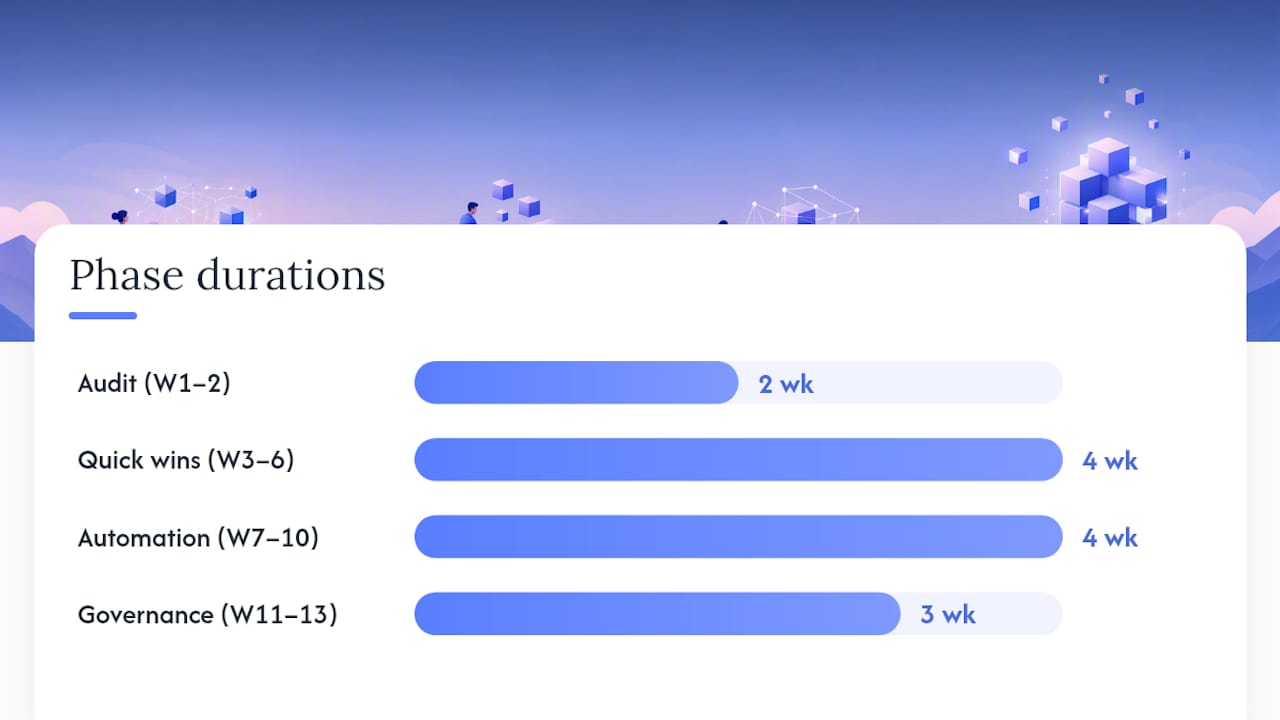
What Does a 90-Day Technical Debt Reduction Plan Look Like?
Momentum beats perfection in the first quarter. Here’s a runnable sequence.
- Weeks 1 to 2: Audit. Build the initial debt register, run static analysis across the codebase, mine self-admitted debt from comments and pull request history, and score the first batch of items on risk and impact.
- Weeks 3 to 6: Quick wins. Fix two or three high-interest, low-risk items to prove the model works. Delete dead code, patch the flakiest tests, and clear the dependency updates sitting furthest behind.
- Weeks 7 to 10: Automation and pilots. Run one codemod across affected repositories, pilot AI-assisted detection on a contained module, and measure the time saved against a manual equivalent.
- Weeks 11 to 13: Governance and reporting. Lock in the standing sprint allocation, publish the first metrics dashboard, and present results to stakeholders in business terms.
Nullbit has run this exact sequence on large, high-complexity systems, including work on a country-scale labor platform where system-level debt had to be untangled without disrupting live operations, and on infrastructure monitoring work built around catching failures before they became incidents.
By day 90, you should have a live debt register, one working dashboard, at least one completed codemod, and a written sprint allocation policy that survives the next roadmap review.
Lessons Learned From Watching Debt Programs Fail
Big-bang rewrites fail more often than they succeed, mostly because they ask an organization to freeze feature delivery for months while betting everything on a single cutover. They’re occasionally justified: a platform genuinely built on an unsupported, unpatchable stack, or a security posture nobody can fix underneath. Outside that narrow case, incremental paydown wins.

Three failure modes account for most dead programs. No visibility means nobody outside engineering knows debt exists, so it loses every funding fight. No dedicated funding means the standing allocation gets raided the first time a deadline slips. No test safety net means every refactor attempt introduces new bugs, which kills leadership’s appetite for the next one.
The programs that survive share one habit: they report small, measurable wins on a fixed schedule, in language a non-engineer can act on.
— Matija
Let Nullbit Run Your Debt Reduction Playbook
Running this playbook internally takes dedicated capacity most teams are already stretched too thin to spare, and that’s exactly where a technology partner earns its keep. Custom software development, AI automation projects, and system engineering work can be provided for organizations that need the audit, the codemods, and the governance structure built without pulling their own engineers off feature work for a quarter.

If you’re carrying a codebase nobody wants to touch, start with a scoped engagement rather than an open-ended commitment. Nullbit’s Agile Engagement model runs on a time-and-materials basis, so you can start with an audit and expand into paydown work as the register takes shape. For a narrower first step, a proof-of-concept engagement can validate one codemod or one AI-assisted detection pilot before you commit further. Reach out through the cooperation page to scope what a 90-day pilot would look like for your codebase.
Sources
- How to Manage Technical Debt Without Killing Velocity (Capgo)
- How to reduce technical debt (Sourcegraph blog)
- Technical Debt Management: The Road Ahead for Successful Software Delivery (research paper)
- Martin Fowler — Refactoring and changing structure without changing behavior
FAQ
What Is Technical Debt Reduction?
Technical debt reduction is the practice of identifying shortcuts made in code or architecture, measuring their ongoing cost, and systematically fixing them through funded, prioritized work. It treats remediation as a recurring budget line rather than an occasional cleanup, with interest costs tracked in engineering days rather than vague complaints about code quality.
How Do You Eliminate Technical Debt?
You don’t eliminate it entirely. Every codebase accumulates some debt as it evolves, so the realistic goal is keeping it below a manageable threshold through a standing allocation, a maintained debt register, and incremental fixes applied to the highest-interest items first, rather than chasing a debt-free state that doesn’t exist in practice.
How Much Technical Debt Is Acceptable?
There’s no universal number, since acceptable debt depends on your system’s risk profile and growth stage. Most practitioner guidance points to protecting a standing allocation somewhere in the 10 to 30 percent range of engineering capacity for paydown, which keeps debt from compounding faster than the team can address it.
What Is an Example of Technical Debt?
A common example is a shared authentication module patched repeatedly under deadline pressure until nobody fully understands its edge cases, forcing every related feature to route around it rather than through it. Another is a dependency left unpatched for years because upgrading it risks breaking undocumented integrations, creating security exposure that grows every quarter it’s ignored.