
Per App Legacy Modernization: Cut Risk with a €5,000 PoC
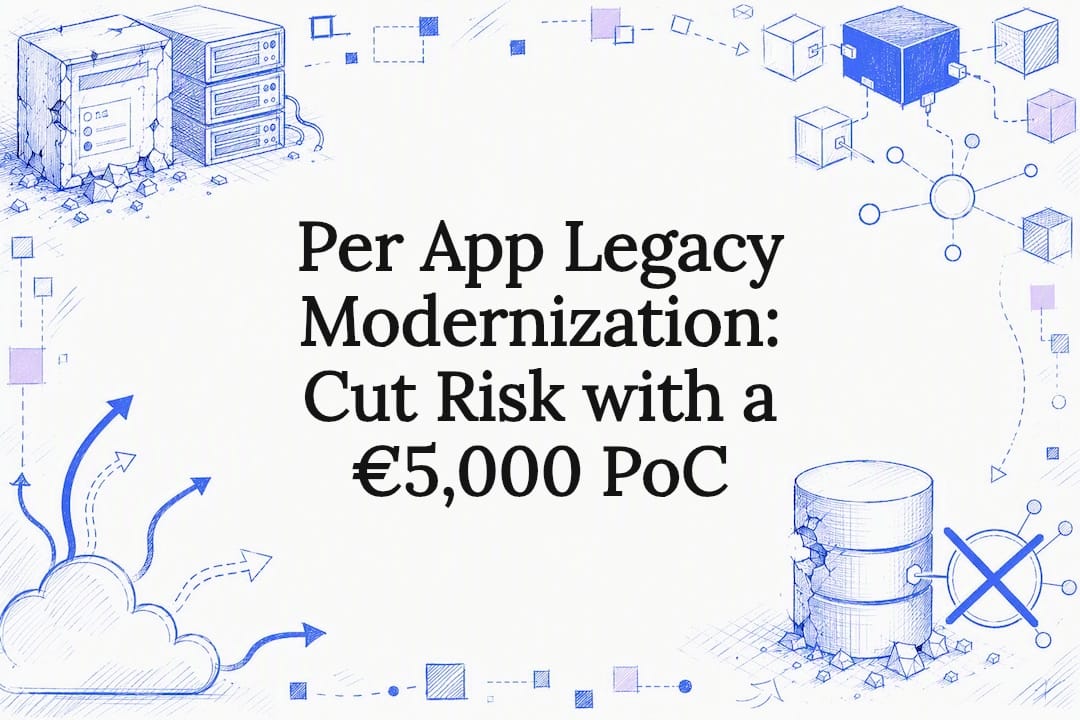
Legacy system modernization is a portfolio-led effort to change where and how applications deliver business capability, retaining, replacing, or rebuilding each workload to reduce risk and unlock agility. It is broader than a lift-and-shift cloud migration. Done right, the outcome is measurable: faster feature delivery, a stronger security posture, and a cost model you can actually forecast, one application decision at a time.
TL;DR:
- Modernization strategies must be tailored to each system’s business impact, technical complexity, and integration dependencies, rather than applying a blanket approach.
- A comprehensive inventory and scoring process is essential before starting, with pilots chosen for low dependency and clear value to build credibility.
- Successful projects require strong governance, explicit milestones, and clear retirement plans, with decision gates focused on measurable KPIs.
- Security and compliance should be integrated from the beginning, emphasizing auditability, supply-chain risk, and early identification of gaps.
- Costs vary widely based on code complexity, scope, and undocumented behaviors, so modeling current spending and phased pilots help control budgets.
Table of Contents
- What Counts as a Legacy System, and What Modernization Actually Means
- Why Modernizing Legacy Systems Pays Off
- The Modernization Challenges That Sink Otherwise Good Plans
- Choosing a Modernization Strategy: The 6 Rs Explained
- How to Assess Your Application Portfolio Before You Start
- Building Governance That Keeps a Modernization Program Alive
- Securing a Modernization Program Without Late-Stage Surprises
- Execution Patterns That Keep Migrations From Breaking Production
- Budgeting for Modernization Without a Fixed Price Tag
- What Real Modernization Delivery Looks Like in Practice
- Why the Business-First Approach Still Gets Ignored
- How Nullbit Supports a Modernization Program From Discovery to Scale
- Sources
- FAQ
What Counts as a Legacy System, and What Modernization Actually Means
A legacy system is not simply “old software.” It’s an application that has become a business risk because the people, documentation, or vendor support that once made it maintainable have thinned out. Three traits show up again and again:
- Unsupported or scarce-skill technology, where the last engineer who understood the batch job retired years ago
- Brittle point-to-point interfaces that break silently when an upstream schema changes
- Business workarounds bolted onto the system, like a shadow spreadsheet that reconciles what the software gets wrong
None of that requires a mainframe. A five-year-old monolith with no tests and one person who understands the deployment script qualifies just as easily as a COBOL application from 1987. The category matters more than the vendor or the decade.
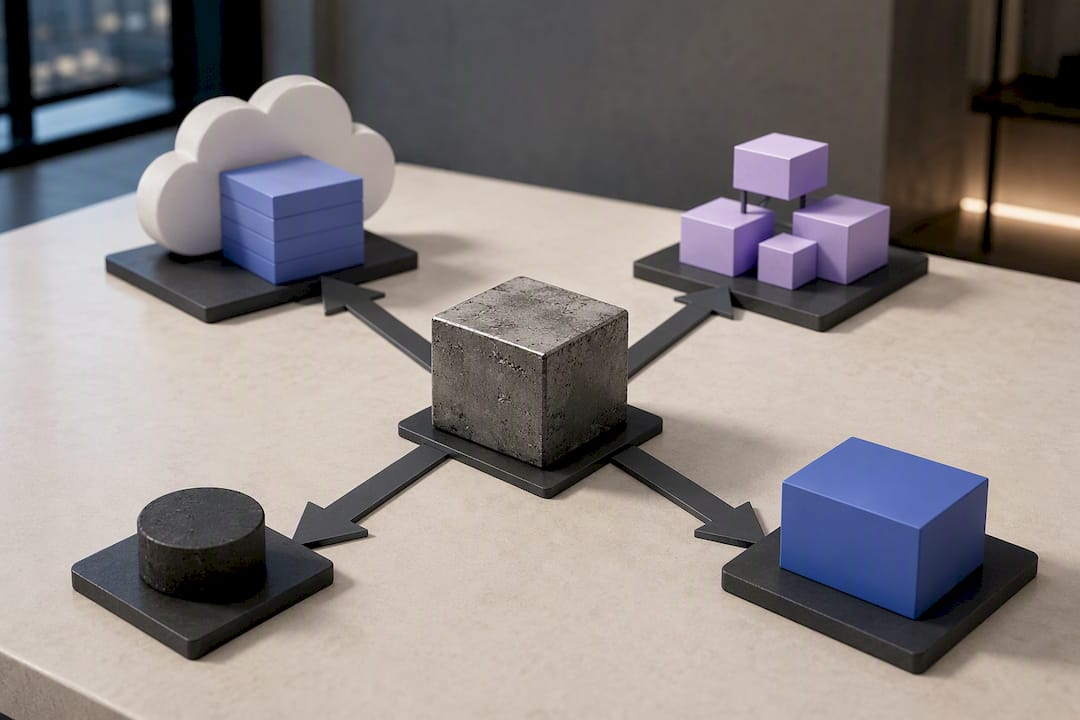
Modernization gets confused with migration constantly, and the distinction matters for planning. Migration usually means moving a workload from one environment to another, on-premises to cloud, one database engine to another, with the application’s behavior left mostly untouched. Modernization is the umbrella term: it includes migration as one possible tactic, but it also covers rewriting business logic, replacing a system outright, or retiring it because the business no longer needs it. Legacy application modernization decisions get made per system, not once for the whole estate.
Why Modernizing Legacy Systems Pays Off
The business case rests on four pillars, and leadership tends to care about them in this order: speed, cost, security, and data access.
Faster delivery is usually the first thing engineering teams notice. A codebase with automated tests and a sane deployment pipeline lets a team ship a change in days instead of the multi-week cycle a tangled legacy release process demands. Developer velocity improves because engineers spend less time reverse-engineering undocumented logic and more time building.
Cost improvement is real but needs a caution attached: vendor case studies love round numbers, and most of them aren’t independently verifiable. What you can say with confidence is that legacy systems typically accumulate maintenance overhead, specialized contractor rates, workarounds that need their own support, licensing for platforms nobody wants to renew, that a modern, well-architected system avoids by design.
Security and compliance readiness improve almost automatically once a system moves off unsupported platforms, because patching, identity integration, and audit logging become part of the platform instead of a custom afterthought.
Data access is the quiet win. Legacy systems often trap data in formats that are hard to query, which blocks analytics and any AI-driven decision support downstream. Modernized systems expose that data through APIs or modern schemas, which is usually the precondition for any AI initiative leadership has already promised the board.
Pro Tip: Before promising a cost reduction number to your CFO, model your current maintenance spend for 12 months first. Most teams underestimate it because it’s scattered across contractor invoices, licensing renewals, and unplanned firefighting hours.
The Modernization Challenges That Sink Otherwise Good Plans
Most failed modernization projects don’t fail on technology. They fail on the things nobody wrote down.
- Hidden business behavior. Legacy systems accumulate edge cases that live in nobody’s head and no document. A batch job that skips processing on the last Friday of the fiscal quarter, because someone discovered a bug in 2011 and worked around it instead of fixing it, is exactly the kind of thing that gets missed until it breaks production.
- Integration dependencies. A system rarely lives alone. Downstream consumers, reporting tools, partner feeds, other internal apps, depend on outputs nobody fully mapped, and replacing the source without mapping every consumer creates outages that show up weeks later.
- Skill shortages. The people who understand the old system are retiring or have moved on, and the people who understand the new stack don’t know the business rules yet. That gap is where knowledge gets lost permanently.
- Coexistence risk. Parallel running two systems is a valid safety net, but it becomes a liability when “temporary” coexistence drifts past its planned end date and nobody owns the decision to cut over.
- Governance gaps. Plans that skip milestones, ownership, and a clear retirement date for the old system correlate with higher odds of delay and cost overrun, according to a GAO review of federal legacy modernization programs.
Pro Tip: Interview the people who operate the legacy system, not just the ones who built it. Operators know the workarounds that never made it into any specification.
Choosing a Modernization Strategy: The 6 Rs Explained
There is no universal modernization strategy, because the right move for a payroll system is rarely the right move for an internal reporting dashboard. Microsoft’s application modernization guidance frames the decision as a set of seven options applied per application, not once across an entire estate.
- Retain. Leave the system as is, usually because it works, carries low risk, and the cost of changing it exceeds the benefit right now.
- Retire. Shut it down because the business capability it provides is no longer needed or has been absorbed elsewhere. This is the most underused option; retiring a system is often cheaper and safer than modernizing it.
- Rehost. Move the application to new infrastructure, often cloud virtual machines, with minimal code change. Fast, lower risk, but it doesn’t fix underlying architecture problems.
- Replatform. Make targeted changes, swap a database engine, adopt a managed service, without a full rewrite. A middle ground between speed and structural improvement.
- Refactor. Restructure the existing code to improve maintainability without changing external behavior. This is legacy code refactoring in its purest form: same outputs, cleaner internals.
- Rearchitect or rebuild. Redesign the application’s structure, sometimes rewriting it from scratch, to unlock capabilities the old architecture couldn’t support. Highest cost and risk, but sometimes the only path to real agility.
- Repurchase. Replace the custom system with a commercial product, when the business logic is generic enough that building it yourself no longer makes sense.
The decision criteria come down to four questions for each application: how much business impact does it have, how ready is it for cloud infrastructure, how tangled are its integration dependencies, and does the cost of change actually beat the cost of leaving it alone? A single portfolio typically ends up using four or five of these strategies simultaneously. That’s normal, and it’s the entire point of a rewrite vs refactor decision made per workload instead of as a blanket policy.
How to Assess Your Application Portfolio Before You Start
Before any strategy gets picked, you need an honest inventory. Skipping this step is the single most common reason modernization programs stall six months in.
- Collect the raw data. Code repositories, data flow diagrams, batch schedules, system owners, downstream consumers, and any compliance exposure tied to the data the system touches.
- Score business criticality against technical condition. A simple two-axis matrix, how much the business depends on this system versus how fragile or outdated its technical state is, sorts your portfolio into obvious buckets fast.
- Interview operators, not just architects. Behavioral discovery, the undocumented workarounds and manual processes that keep a system running, is often harder to uncover than reading the code itself, and it’s where the real risk hides.
- Pick pilots that are bounded, not just visible. A good pilot has a contained scope, clear business value, manageable dependencies, and a recoverable failure mode if something goes wrong.
Resist the urge to modernize the oldest system first just because it’s the scariest one. The oldest system is often the most entangled, which makes it a terrible pilot candidate. Pick something with real business value but few downstream dependencies instead, prove the approach works, and use that credibility to tackle the harder systems next.
Pro Tip: A pilot that succeeds quietly is more valuable than a flagship project that takes eighteen months to prove anything. Speed to a believable result buys you the political capital for the harder migrations later.
Building Governance That Keeps a Modernization Program Alive
Every modernization program needs an accountable owner, someone who can say yes or no to scope changes and who answers for the outcome. Without that single point of accountability, decisions drift, and drift is expensive.
A credible plan separates cost and timeline into distinct phases instead of quoting one lump figure: discovery, remediation, engineering, testing, dual running, training, and decommissioning each carry different risk profiles and should be budgeted separately. The GAO’s review of federal modernization programs found that incomplete plans, ones missing milestones, a clear description of work, or a disposition plan for the legacy system, correlate with a higher risk of delays and cost overruns. That finding applies just as directly to private-sector programs as it does to government ones.
Decision gates matter as much as milestones. Before a workload moves from pilot to broader rollout, someone with authority should confirm the pilot actually met its KPIs, not just that time passed. And every legacy system entering the program needs an explicit retirement plan from day one, what happens to it, and when, once its replacement goes live. Leadership dashboards should track a small number of metrics that actually mean something: cycle time for shipping a change, defect rate post-cutover, percentage of the portfolio still on unsupported platforms, and cost per supported application. Skip the vanity metrics; track what tells you whether the program is actually reducing risk.
Securing a Modernization Program Without Late-Stage Surprises
Security bolted on after a system goes live is security done wrong. The NIST Cybersecurity Framework 2.0 recommends building security, governance, and supply-chain review into planning from the start, not as a pre-launch checklist.
- Build an Organizational Profile early that maps your current cybersecurity posture against where you need to be once modernization completes, using the NIST CSF taxonomy as a common language between security and engineering teams.
- Treat third-party APIs and cloud services as supply-chain risk, not just integration work. A modernized system usually depends on more external vendors than the legacy system it replaces, which widens the attack surface even as it improves individual components.
- Maintain a Plan of Action and Milestones (POA&M) for every known gap that won’t be closed before launch, so nothing gets quietly forgotten once the project moves to the next phase.
- Keep the modernized system auditable from day one. Logging, access controls, and change history need to exist before go-live, not get added after an incident forces the issue.
Systems engineering teams that already handle architecture and integration work tend to catch these gaps earlier, because they’re already thinking about how components talk to each other across the whole stack.
Execution Patterns That Keep Migrations From Breaking Production
The single biggest tactical decision in any migration project is whether to replace a system all at once or incrementally. The strangler fig pattern, routing traffic gradually from the old system to the new one, service by service, until the legacy application has nothing left to do, consistently reduces risk compared with a big-bang cutover, according to Sourcegraph’s guidance on legacy code modernization. A big-bang rewrite might look faster on a slide, but it concentrates all your risk into one weekend.
- Write characterization tests before touching the code. These tests capture what the system actually does today, bugs and all, so you know immediately if the new version changes behavior nobody meant to change.
- Use golden-file testing for complex outputs. Compare the new system’s output against a known-good reference file for the same input, catching subtle formatting or calculation drift automated tests might miss.
- Let AI tools accelerate code reading, not replace domain judgment. AI-assisted analysis speeds up understanding a tangled codebase, but it cannot substitute for a human who knows why the finance team needs that odd rounding rule. MIT Technology Review’s reporting on AI-assisted modernization makes the same point: preserving business behavior means reverse-engineering the edge cases deliberately, not assuming the new system will just work.
- Reconcile data at the field level. Field-by-field mapping, reconciliation totals, and an exception queue for records that don’t match catch silent data loss before it reaches a customer or an auditor.
- Run systems in parallel and watch cutover metrics leadership can actually read. Error rate, latency, reconciliation mismatch count, and transaction volume side by side tell you whether the new system is ready, better than a status update that just says “on track.”
Budgeting for Modernization Without a Fixed Price Tag
There is no standard price for legacy system migration, and any table promising one number for “enterprise modernization” should be treated skeptically. Cost and timeline depend on the size of the codebase, how much behavior needs preserving, how many downstream integrations exist, and how much of the discovery work is still undocumented.
A credible business case models these line items separately instead of quoting one number:
- Discovery and behavioral analysis (interviews, tracing, schedule capture)
- Engineering and remediation work itself
- Testing, including characterization and reconciliation testing
- Dual-running costs while old and new systems operate in parallel
- Training for staff who’ll operate the new system
- Ongoing operations once the new system is live
- Contingency for the edge cases discovery didn’t catch
- Decommissioning the legacy system, including data archival
You can reduce cost meaningfully by retiring more of the portfolio than you think you need to, trimming scope to the capabilities the business actually uses, and running phased pilots instead of committing the whole budget upfront. A single-application pilot might run a few months; a full program touching multiple interconnected systems is more realistically a long-term effort with distinct phases, not one continuous project.
What Real Modernization Delivery Looks Like in Practice
Portfolio decisions only matter if execution follows through, and that’s where a delivery partner earns its place. Nullbit works through the same sequence most successful modernization programs converge on: discovery to map the real behavior and dependencies, a proof of concept to validate the riskiest assumption cheaply, a bounded pilot to prove business value, then a scaled rollout once the pilot’s KPIs hold up.
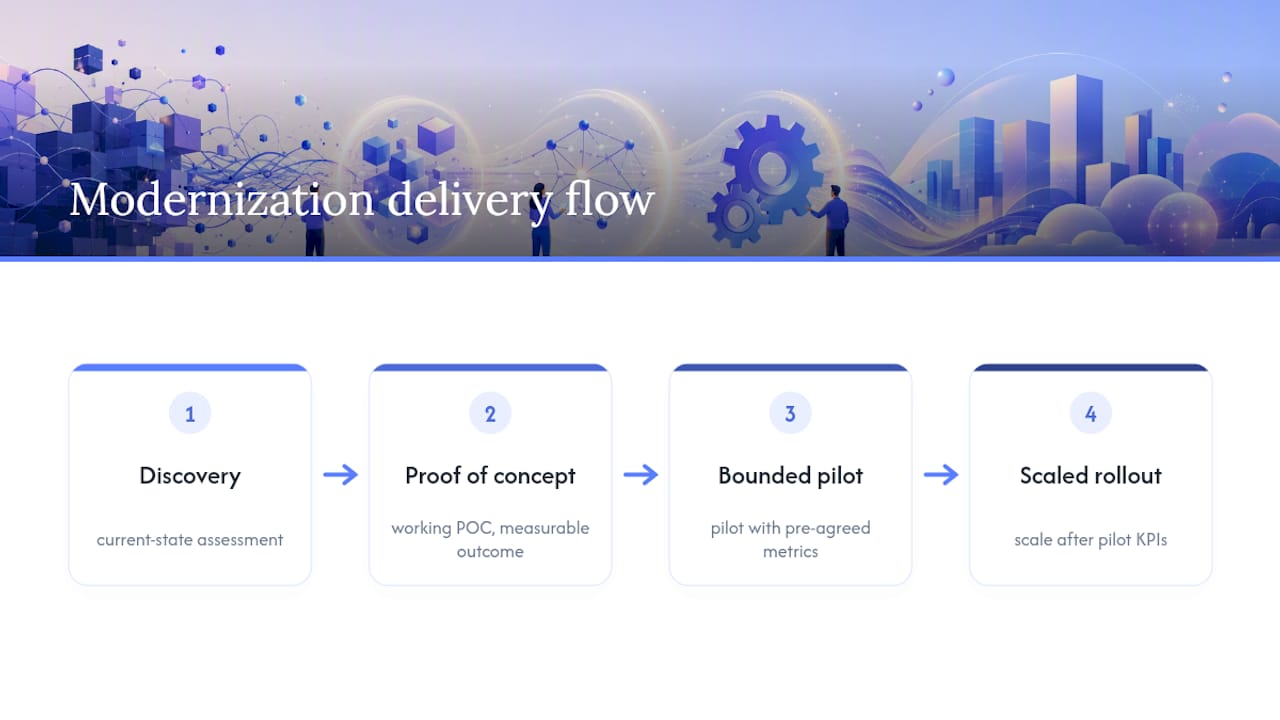
Clients working through this model should expect concrete deliverables at each gate, not vague progress updates: a documented current-state assessment, a working proof of concept tied to one measurable business outcome, and a pilot with defined success metrics agreed before work starts. Nullbit’s engagements pair system engineering with process optimization work, since modernization projects usually surface operational workarounds worth fixing alongside the technical debt. Case examples in Nullbit’s portfolio show this pattern applied to infrastructure monitoring and civic platforms alike, where the win was measurable operational improvement, not just a technology swap.
Why the Business-First Approach Still Gets Ignored
Most modernization advice defaults to a technology-first framing: pick a cloud provider, pick an architecture pattern, then figure out what to do with the applications. That order is backwards. The applications and the business capabilities they support should drive every choice, including the choice to leave a system alone.
Governance gets treated as bureaucratic overhead when it’s actually the cheapest risk mitigation available. An accountable owner and a real decision gate cost almost nothing compared to a failed six-figure rewrite. If there’s one thing worth arguing for loudly, it’s this: run pilots small enough to fail safely, measure them against KPIs you agreed on before you started, and let that evidence, not a vendor’s roadmap, decide what happens next.
— Matija
How Nullbit Supports a Modernization Program From Discovery to Scale
Nullbit works as a technology partner for exactly the model this article describes: per-application decisions backed by governance, not a one-size-fits-all rebuild. Core services map directly onto a modernization roadmap, portfolio management for the inventory and scoring work, system engineering for integration and architecture decisions, and cloud infrastructure support for rehosting or replatforming workloads that need new ground to stand on.
If your estate needs AI woven into decision-making rather than bolted on afterward, Nullbit builds that in from the proof-of-concept stage rather than treating it as a later add-on. A scoped proof-of-concept engagement starting at €5,000 is a low-risk way to validate the riskiest assumption in your modernization plan before committing to a full program. For teams ready to structure a bigger engagement, Nullbit’s Agile Engagement and Fixed-Price Project models cover everything from a single discovery sprint to a full turnkey rebuild. Start with a discovery conversation about the systems keeping your team up at night, and find out which of them actually need rebuilding, and which just need to be retired.
Sources
The recommendations in this article draw on a small set of documents worth reading directly if you’re building a modernization business case.
- The 6 Rs of application modernization - App Modernization Guidance | Microsoft Learn
- Information Technology: Agencies Need to Plan for Modernizing Critical Decades-Old Legacy Systems | U.S. GAO
- The NIST Cybersecurity Framework (CSF) 2.0
FAQ
Which is an example of legacy system modernization?
Replacing a mainframe payroll system with a cloud-based service while preserving its exact calculation logic is a common example, and so is refactoring an untested monolith into modules with automated tests without changing what it outputs. The common thread is a deliberate, per-application decision, not a blanket “move everything to the cloud” mandate.
What is an example of a legacy system?
A COBOL application is the classic example, but a five-year-old internal tool with no documentation and one engineer who understands it qualifies just as easily. The defining trait is fragility and risk, not age alone.
How do you modernize a legacy application?
Start with a portfolio inventory that scores each application on business criticality and technical condition, then apply the 6 R framework, retain, retire, rehost, replatform, refactor, rearchitect, or repurchase, to each one individually. Pilot the approach on a bounded, low-dependency system first, validate it against agreed KPIs, then scale to the rest of the estate.
What is the difference between legacy modernization and digital transformation?
Legacy modernization focuses on specific applications and infrastructure, deciding what to retain, replace, or retire to remove technical risk. Digital transformation is the broader business shift, new processes, new customer experiences, new ways of using data, and modernization is usually one of the technical enablers that makes that broader shift possible.
How much does legacy system modernization typically cost?
There is no fixed price, since cost depends on codebase size, integration complexity, and how much undocumented behavior needs preserving. A scoped starting point, like a proof-of-concept engagement from €5,000, lets you validate the riskiest part of a plan before committing to a full program budget.