Cut DSO in Weeks: Finance First Quote to Cash Automation
Quote to cash automation replaces the manual handoffs between sales, legal, billing, and accounting with a connected, largely self-executing workflow. The core outcome: revenue leakage drops and cash gets collected faster because contract terms move from quote to invoice as structured data instead of being retyped at every stage. The technical hinge that makes this possible is simple to name and hard to build: a shared, machine-readable data model that both sales and finance systems can read without a human translating a PDF in between.
TL;DR:
- Automating quote to cash reduces revenue leakage by ensuring contract terms move seamlessly from quote to invoice through a shared, structured data model.
- Success relies on a single, finance-owned product catalog, structured contract fields, and reliable system integration, not on choosing a specific software tool.
- Pilot projects focused on high-volume manual processes like order entry can demonstrate measurable savings in hours and DSO within weeks.
- A unified data model prevents errors during mid-contract amendments and simplifies compliance with ASC 606 standards.
- Proper governance of product catalogs, contract structuring, and phased implementation are crucial to avoid common pitfalls and ensure scalable automation.
Table of Contents
- What Is Quote to Cash and Where Does the Workflow Start and End?
- Which Components and Data Elements Actually Need to Be Automated?
- What Business Benefits and KPIs Prove Automation Is Working?
- Should You Build a Unified Data Model or Keep Systems Separated?
- How Do You Roll Out Q2C Automation From Pilot to Enterprise Scale?
- What Pitfalls Derail Most Q2C Automation Projects?
- Nullbit’s Experience Building Automated Financial Systems
- How Do You Keep Q2C Automation Secure and Compliant?
- How Do You Get Sales and Finance Teams to Actually Adopt the New System?
- What Do Successful Q2C Automation Rollouts Actually Look Like?
- How Does Automation Change the Sales and Customer Experience?
- The Real Lesson Buried in Most Q2C Advice
- Ready to Scope a Quote to Cash Automation Pilot?
- Sources
- FAQ
What Is Quote to Cash and Where Does the Workflow Start and End?
Quote to cash (Q2C) is the end-to-end process bridging sales and accounting. It starts the moment a sales rep configures a price and ends when revenue is recognized on the books. Zuora defines it as the workflow that begins with a mathematically billable quote and ends with compliant revenue recognition, which is a useful boundary because it forces a discipline most sales teams skip: a quote isn’t done when the customer signs it, it’s done when finance can bill against it without guessing.
People often confuse Q2C with two narrower terms. CPQ (configure, price, quote) is just the front end. It handles product configuration and pricing logic, but stops once the quote goes out. Order to cash (O2C) is the back half, covering order fulfillment through collections. Q2C is the whole arc that contains both, plus the contract and provisioning steps that sit between them.
The canonical steps look like this:
- Quote: sales configures pricing, discounts, and terms.
- Contract: legal and the customer finalize terms; the agreement is signed.
- Order: the signed terms convert into a sales order or subscription record.
- Fulfillment: the product or service is provisioned or delivered.
- Billing: an invoice is generated against the agreed schedule.
- Payment: the customer pays, and cash is applied against the invoice.
- Revenue recognition: finance recognizes revenue according to ASC 606 or equivalent standards.
Every one of these steps can happen manually. Automation targets the handoffs between them, because that’s where data gets lost, retyped, or misread.
Which Components and Data Elements Actually Need to Be Automated?
Automating Q2C isn’t one project, it’s a set of interlocking systems that all need to agree on the same facts. Getting the components right matters more than picking a specific tool, because a fragmented setup will leak revenue no matter how polished any single piece looks.
The building blocks that need to work together:
- A single product and financial catalog: pricing rules, SKUs, and discount logic live in one place, not in three spreadsheets owned by three teams.
- Structured contract fields inside CPQ: billing schedule, ramp terms, usage-based pricing tiers, and renewal logic captured as data fields, not paragraphs of legal prose.
- A billing engine that reads those structured fields directly and generates invoices without a human re-keying line items.
- Subscription or order management that tracks mid-term changes, like upgrades, downgrades, and proration, without breaking the link back to the original contract.
- Payment gateways and a revenue subledger that reconcile cash received against recognized revenue automatically.
- An integration layer, usually APIs or event-driven middleware, that keeps CRM, CPQ, ERP, and billing systems synchronized in near real time.
Master data hygiene underpins all of it. If two systems disagree on what a “seat” or a “unit” means, automation just moves the error faster. That’s why a finance-led Q2C strategy that controls pricing, proration rules, and the product catalog prevents what practitioners call “dirty deals”, quotes that look approved but aren’t actually billable once they hit finance systems.
What Business Benefits and KPIs Prove Automation Is Working?
The business case for quote to cash automation rests on four measurable outcomes: fewer billing disputes, lower days sales outstanding (DSO), reduced revenue leakage, and faster quote turnaround. Each one is trackable, which matters because RevOps and finance leaders need numbers to justify the investment, not just a smoother-sounding process.
Pro Tip: Track quote turnaround time (QTT) from the first pilot week onward. It’s the leading indicator that shows up before DSO or leakage numbers move, and it’s the easiest metric to explain to an executive sponsor.
The KPIs worth building a dashboard around:
- Days sales outstanding (DSO): how long it takes to collect cash after invoicing.
- Revenue leakage rate: the percentage of billable revenue that never gets invoiced due to pricing errors, missed renewals, or unbilled usage.
- Quote turnaround time (QTT): how long it takes from quote request to signed, billable quote.
- Time to first invoice: the gap between contract signature and the first invoice going out.
- Collections efficiency: the ratio of cash collected to cash billed in a given period.
Order to cash platforms that apply AI to accounts receivable tasks can meaningfully cut DSO while improving cash application and dispute resolution, largely because automated matching catches discrepancies a human reviewer would miss during a manual reconciliation pass. Pilots that focus narrowly on order entry or RFQ intake tend to show the clearest early wins, both in hours saved and in DSO movement, which is exactly why finance teams should expect a pilot to prove itself in weeks, not quarters, before scaling further.
Should You Build a Unified Data Model or Keep Systems Separated?
This is the single most consequential decision in any Q2C automation project, and it’s usually made by default rather than on purpose.
A separated stack keeps CPQ, contract management, and billing as distinct systems connected by exports, emails, or manual re-entry. It’s faster to stand up because each tool can be best-in-class for its own job, and legacy ERP constraints often make a full replacement impractical in the short term. The cost shows up later: every handoff between systems is a place where a human retypes a number, and that’s where revenue leakage actually happens. When contract terms sit in a PDF instead of a structured field, downstream teams have to re-enter them manually, and that re-entry is the single biggest driver of billing errors.
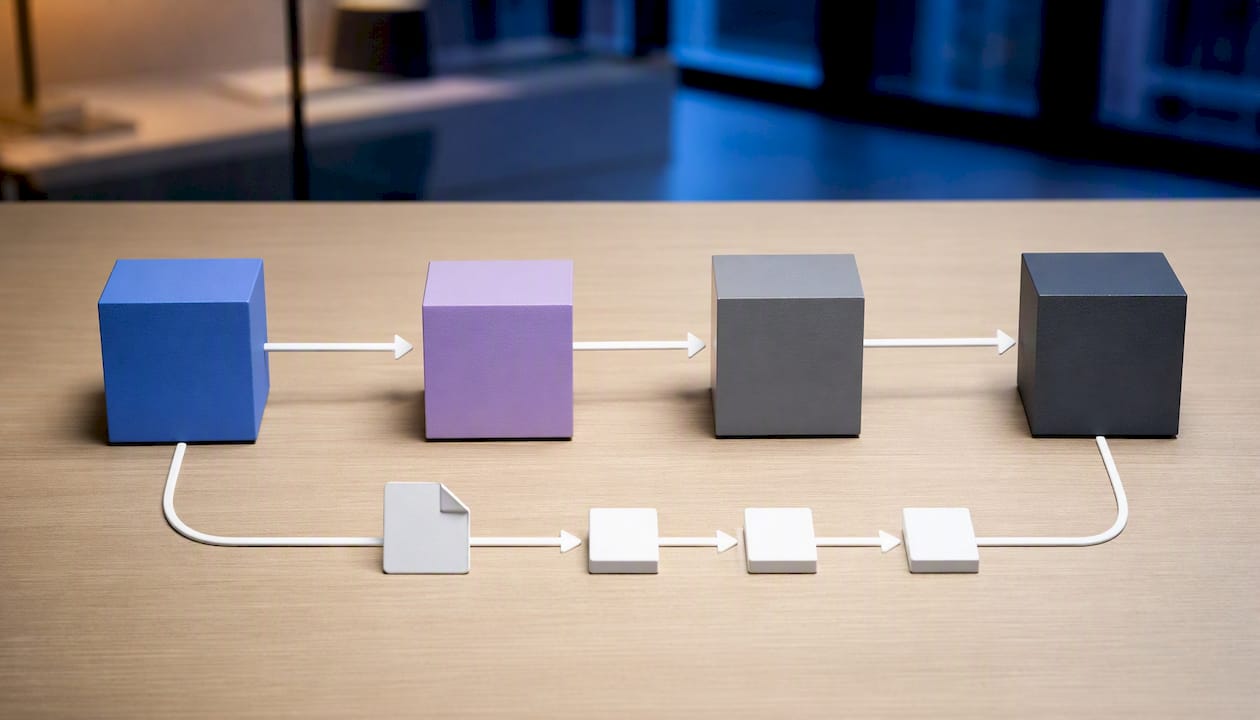
A unified data model keeps quoting and billing on the same underlying data, so a signed contract updates the billing schedule directly with no document handoff in between. This structure also prevents the reconciliation errors that show up during mid-contract amendments and proration, which is where separated stacks tend to break down worst, because a single upgrade or downgrade can touch three systems that don’t automatically agree on the new number.
Trade-offs to weigh honestly:
- Speed of deployment: separated stacks deploy faster; unified models take longer to configure correctly.
- Legacy constraints: an entrenched ERP or CRM can make a unified model a multi-year migration.
- Technical debt: bolting connectors onto a separated stack accumulates debt that compounds with every new product line.
- Migration cost: moving from separated to unified mid-flight is expensive and disruptive if done without a phased plan.
Pro Tip: Before choosing an architecture, count your contract amendment volume per month. If mid-term changes are rare, a separated stack with good integration testing may be fine. If amendments are constant, the unified model pays for itself within a year through fewer reconciliation errors alone.
Run this checklist before committing: What’s your monthly quote volume and how complex is the pricing (flat fee versus usage-based versus tiered)? Do you have audit trail and ASC 606 compliance requirements that demand traceability from quote to recognized revenue? How much integration risk can your IT team absorb in year one?
How Do You Roll Out Q2C Automation From Pilot to Enterprise Scale?
A staged rollout beats a big-bang implementation almost every time, because it lets finance prove value before asking for a bigger budget.
- Phase 0, discovery: map every system involved in the current quote-to-cash flow and identify where handoffs break down, usually contract signature to billing, or order entry to fulfillment.
- Phase 1, pilot: pick one high-volume, painful process, order entry or RFQ intake are the usual candidates, and automate it end to end. These receive phases combine high manual effort with clear, measurable ROI, which makes them the fastest way to build credibility for the rest of the project.
- Phase 2, catalog governance: standardize the product and financial catalog under finance ownership, with version control so sales can’t quote off a stale price sheet.
- Phase 3, integration: connect CPQ to billing to the revenue subledger, and build reconciliation tests that flag mismatches before they become disputes.
- Phase 4, scale: add dispute automation, dunning workflows, and automated cash application, then iterate based on the KPI dashboard.
Pilots that start with order entry and show measurable savings in manual effort and DSO tend to earn the executive sponsorship needed to fund the rest of the Q2C cycle. That sequencing matters more than most roadmaps admit: a finance team that asks for full-cycle automation before proving a narrow win usually gets a smaller budget than one that shows results first. For teams handling custom integration work across CRM, CPQ, and ERP, a structured approach to enterprise automation can shorten the discovery phase considerably.
What Pitfalls Derail Most Q2C Automation Projects?
Three failure modes account for most stalled or abandoned Q2C projects, and all three are preventable with governance decisions made before the first line of integration code gets written.
- Contract terms trapped in unstructured PDFs. If billing schedules and pricing terms live only in prose, someone has to manually transcribe them downstream. The fix: require structured fields at quote time, so billing schedule, proration rules, and renewal terms are captured as data, not paragraphs.
- An inconsistent product catalog across teams. When sales, finance, and billing each keep their own version of the price book, automation just propagates the mismatch faster. The fix: freeze a single, finance-owned catalog with version control, and require every quote to draw from it.
- Insufficient integration testing. Systems that pass data silently can fail silently too. The fix: build reconciliation tests and exception queues that flag mismatches for human review rather than letting them post to the ledger unchecked.
Pro Tip: Keep a human in the loop for exceptions, not for every transaction. Automating 95% of standard quotes while routing the unusual 5% to a reviewer is safer, and cheaper, than trying to automate every edge case on day one.
Reconciliation tests, exception handling queues, and audit logs are the practical controls that keep ASC 606-compliant revenue recognition auditable once automation is live, and they’re far cheaper to build during implementation than to retrofit after an audit finding.
Nullbit’s Experience Building Automated Financial Systems
Nullbit works as a technology partner for companies digitizing operations, including the kind of custom integration and AI-driven decision systems that quote to cash automation depends on. The practical work looks like this:
- Custom software and AI solutions built around each client’s existing systems rather than a one-size-fits-all platform, addressing the operational inefficiency that fragmented Q2C stacks create.
- AI integrated into core workflows, not bolted on as an add-on, so automated decisions (like flagging a mismatched invoice) happen in real time rather than in a nightly batch job.
- A cloud-based fiscal cash register built for a client, demonstrating direct experience with cloud-native billing and compliance systems, the same category of problem that Q2C billing engines solve.
- A track record of completed projects and repeat client relationships across industries, rather than one-off engagements.
Engagements typically move from a proof-of-concept scoped around one painful workflow, through a pilot that proves measurable results, to a scaled rollout once the data model and integrations hold up under real volume.
How Do You Keep Q2C Automation Secure and Compliant?
Automating quote to cash means automating access to pricing, contract terms, and payment data, which raises the stakes on both security and compliance. Every integration point, CRM to CPQ, CPQ to billing, billing to the revenue subledger, is a place where sensitive financial data moves, and each one needs its own access controls rather than a single perimeter defense.
Role-based access matters more here than in most business systems, because sales reps, finance approvers, and billing administrators each need different levels of visibility into contract terms and pricing overrides. A rep who can approve a discount shouldn’t automatically be able to alter a billing schedule after the fact.
Audit trails aren’t optional. Every automated decision, an approved discount, an auto-generated invoice, a revenue recognition entry, needs a traceable log showing what triggered it and who (or what system) approved it. This is what makes automated revenue recognition defensible under ASC 606 during an audit, and it’s the same control that catches an automation bug before it compounds across a thousand invoices.
Data residency and payment card handling add another layer, particularly for companies operating across multiple regulatory jurisdictions. Payment gateways typically carry their own PCI DSS compliance, but the integration layer connecting them to your billing engine needs to be built so it never stores raw card data outside that gateway’s compliant environment. Getting this wrong doesn’t just create a compliance gap, it creates a specific, auditable liability that’s expensive to unwind after the fact.
How Do You Get Sales and Finance Teams to Actually Adopt the New System?
The best-architected Q2C system fails if sales reps route around it because the old spreadsheet felt faster. Adoption, not technology, is usually the real bottleneck in these projects.
Start with the team that has the most to gain and the least patience for friction: sales reps drowning in manual quote approvals. If the new system cuts quote turnaround time visibly in week one, reps adopt it without being told to. If it adds steps without an obvious payoff, they’ll find workarounds no policy can fully stop.
Finance teams need a different pitch. They care about auditability and control, not speed, so show them the reconciliation reports and exception queues before asking them to trust the automated billing engine with live contracts. A finance team that helped design the exception-handling rules is far more likely to trust the system’s output than one that had rules imposed on it.
Training should be role-specific, not a single all-hands demo. A rep needs to know how to configure a quote correctly; a billing administrator needs to know how to interpret an exception queue. Mixing those into one generic session usually means neither group retains what they need.
Run the old and new process in parallel for one billing cycle before fully cutting over. It costs a little extra effort, but it catches the edge cases that would otherwise surface as a customer dispute rather than an internal test failure.
What Do Successful Q2C Automation Rollouts Actually Look Like?
The pattern across successful implementations is consistent: start narrow, prove the metric, then expand. A company that tries to automate the entire quote-to-cash cycle at once, catalog, CPQ, billing, and revenue recognition simultaneously, usually stalls somewhere in the middle because too many teams have to agree on too many changes at the same time.
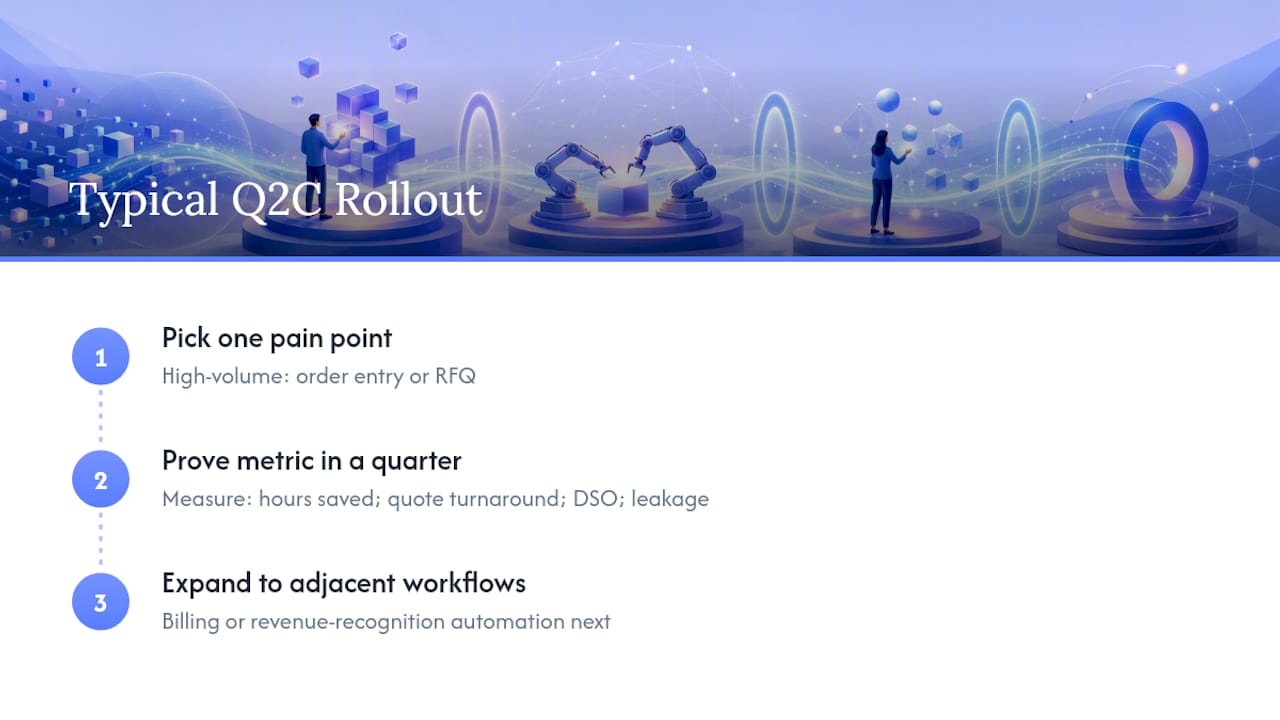
The more durable pattern looks like this: a company picks its highest-volume pain point, usually manual order entry or RFQ processing, and automates just that step first. Within a single quarter, the team can point to a specific number, hours saved per week, or a measurable drop in quote turnaround time, and use that number to justify expanding into billing automation next.
Subscription businesses with usage-based or tiered pricing tend to see the clearest gains, because manual proration calculations are exactly the kind of repetitive, rule-based work automation handles well. Companies with simpler, flat-fee pricing see smaller relative gains from the billing side, but often find their biggest win further upstream, in contract-to-order conversion, where manual re-entry was quietly consuming hours every week.
The common thread isn’t the industry or the pricing model. It’s the decision to measure one metric, hours saved, DSO improvement, or leakage reduction, before expanding the automation footprint further.
How Does Automation Change the Sales and Customer Experience?
Faster quote turnaround doesn’t just help finance, it changes how customers experience the sales process itself. A prospect who gets a billable, accurate quote in hours instead of days is less likely to shop around during the wait, and a customer whose invoice matches their contract on the first try never has to open a dispute ticket.
For sales teams, the productivity gain is less about speed and more about focus. Reps who aren’t manually re-keying contract terms into a billing request spend that time on the next deal instead. That shift compounds over a sales cycle: fewer administrative tasks per deal means more deals a rep can carry at once without adding headcount.
Disputes drop for a specific reason: most billing disputes trace back to a mismatch between what was verbally or contractually agreed and what got invoiced. When contract terms flow through as structured data rather than getting reinterpreted at each handoff, that mismatch has fewer places to occur. Customers notice consistency more than they notice speed, oddly enough. An invoice that always matches expectations builds more trust over a multi-year contract than one that’s merely fast but occasionally wrong.
The Real Lesson Buried in Most Q2C Advice
Most quote to cash content reads like a vendor feature list, comparing dashboards and integration counts as if the software itself were the hard part. It isn’t. Vendor roundups tend to show remarkably similar capabilities across platforms, which tells you the differentiator isn’t the tool, it’s whether your contract data is structured enough for any tool to use.
The conventional advice, “pick the right platform,” puts the decision in the wrong order. The right sequence is: fix your product catalog governance, structure your contract fields, and only then evaluate which system can execute against that clean data. Skip that order and even the best billing engine on the market will just automate the same manual re-entry errors, faster.
If there’s one place to spend disproportionate effort, it’s finance ownership of the catalog and contract schema, not the integration layer. IT can connect almost anything given enough time. What IT can’t fix is a sales team that quotes off three different price sheets. That’s a governance problem, not a technology gap, and no amount of automation budget solves it if the underlying data stays messy.
Start there. Everything downstream, DSO, leakage, quote turnaround, gets easier once the data itself is trustworthy.
*— Matija
Ready to Scope a Quote to Cash Automation Pilot?
If your quote to cash process still depends on someone manually retyping contract terms into a billing system, Nullbit builds the connective layer that removes that step, custom-built around the systems you already run instead of forcing a rip-and-replace.
A typical starting engagement is a proof-of-concept build focused on one painful handoff, often order entry or RFQ intake, priced from €5,000 as a one-off project so you can prove the model before committing further. From there, work can continue as an agile engagement billed monthly, or as a fixed-price turnkey project once the scope is defined.
To get a useful scoping conversation started, bring three things: a sample export of your current product and pricing catalog, a handful of signed contracts representing your typical deal complexity, and a list of the CRM, CPQ, and ERP systems currently in play. From there, Nullbit’s AI automation services team can map the fastest path from your current manual handoffs to a working pilot.
Sources
- Quote-to-cash automation turns signed contract terms into billing with no re-entry
- What Is Quote-to-Cash (Q2C)? Process & Definition
FAQ
How can I automate the quote-to-cash process?
Start with the highest-volume manual bottleneck, usually order entry or RFQ intake, and connect it directly to a structured product catalog before automating billing or revenue recognition. Expanding phase by phase, as outlined in the implementation roadmap above, avoids the stalled rollouts that come from trying to automate everything simultaneously.
What is the best quote-to-cash software?
There’s no single best platform. The right choice depends on your pricing complexity, contract amendment volume, and whether you need a unified data model or can work with a well-integrated separated stack. Evaluate architecture fit and catalog maturity before comparing feature lists, since most vendors offer similar core capabilities.
What is a quote-to-cash workflow?
A quote-to-cash workflow is the sequence of steps a business runs from generating a sales quote through to collecting payment and recognizing revenue: quote, contract, order, fulfillment, billing, payment, and revenue recognition. Zuora frames the endpoint specifically as compliant revenue recognition, not just cash collection, which is why finance teams treat it as their process, not just sales’.
What is automated quotation?
Automated quotation is the use of software, typically a CPQ system, to generate accurate, billable price quotes automatically based on predefined pricing rules, discount logic, and product configurations, without a rep manually calculating each line item. Nullbit’s automation work often connects this quoting layer directly to billing so the quote’s terms carry through without re-entry.