
Size ABM With AI: Account Based Marketing Strategy for B2B Teams
Account-based marketing is a revenue-first B2B strategy that concentrates sales and marketing on a short list of high-value accounts to generate larger deals and faster pipeline. It works by flipping the usual funnel: instead of casting wide and qualifying down, teams pick the accounts worth winning first, then build coordinated campaigns around each one. B2B teams selling into named accounts see the payoff in bigger deal sizes and tighter sales cycles. This guide walks through the exact framework, from ICP to orchestration to measurement, with real case examples along the way.
TL;DR:
- ABM programs should focus on a small, well-researched target list of 10 to 25 accounts for one-to-one efforts, or 50 to 100 for more scalable tiers.
- Prioritize accounts based on firmographic, technographic, and behavioral fit, using intent data only as a timing signal, not a replacement for fit assessment.
- Success metrics include account engagement scores, buying-group coverage, account progression rate, pipeline from target accounts, and win-rate uplift, which take several quarters to fully materialize.
- Effective ABM campaigns rely on coordinated multi-channel sequencing with personalized offers, retargeting, web personalization, and offline touches like direct mail.
- Set clear goals, align definitions with sales, and run pilots on high-stakes accounts for at least one quarter before scaling to ensure reliable results.
Table of Contents
- What Is an Account-Based Marketing Strategy?
- What Business Results Does ABM Actually Deliver?
- What Framework Should You Follow to Build ABM?
- How Do You Build an ABM Strategy Step by Step?
- How Do You Choose the Right Target Accounts?
- How Do Sales and Marketing Stay Aligned in ABM?
- What Tactics and Channels Work Best for ABM?
- How Do You Measure ABM Success?
- What Do Successful ABM Programs Look Like in Practice?
- What Should You Budget for an ABM Program?
- What Legal and Privacy Rules Apply to ABM Data?
- Author’s Perspective: Discipline Beats Cleverness
- How Nullbit Supports Your ABM Program
- Sources
- FAQ
What Is an Account-Based Marketing Strategy?
An account based marketing strategy flips the traditional funnel on its head. Instead of generating leads and hoping the right companies show up, you pick the companies first and build campaigns designed for them specifically. HubSpot’s definition frames ABM as concentrating resources on a defined set of target accounts to create personalized buying experiences, and that framing matters because it forces marketing and sales to agree on the same list before a single email goes out.
Demand generation optimizes for volume: more traffic, more forms, more marketing qualified leads flowing into a pipeline that sales sorts through later. ABM optimizes for fit: a smaller number of accounts get disproportionate attention, often including named contacts, custom content, and direct outreach from day one. The mindset shift is the entire point. You are not fishing with a net and hoping for the right catch. You are spearfishing.
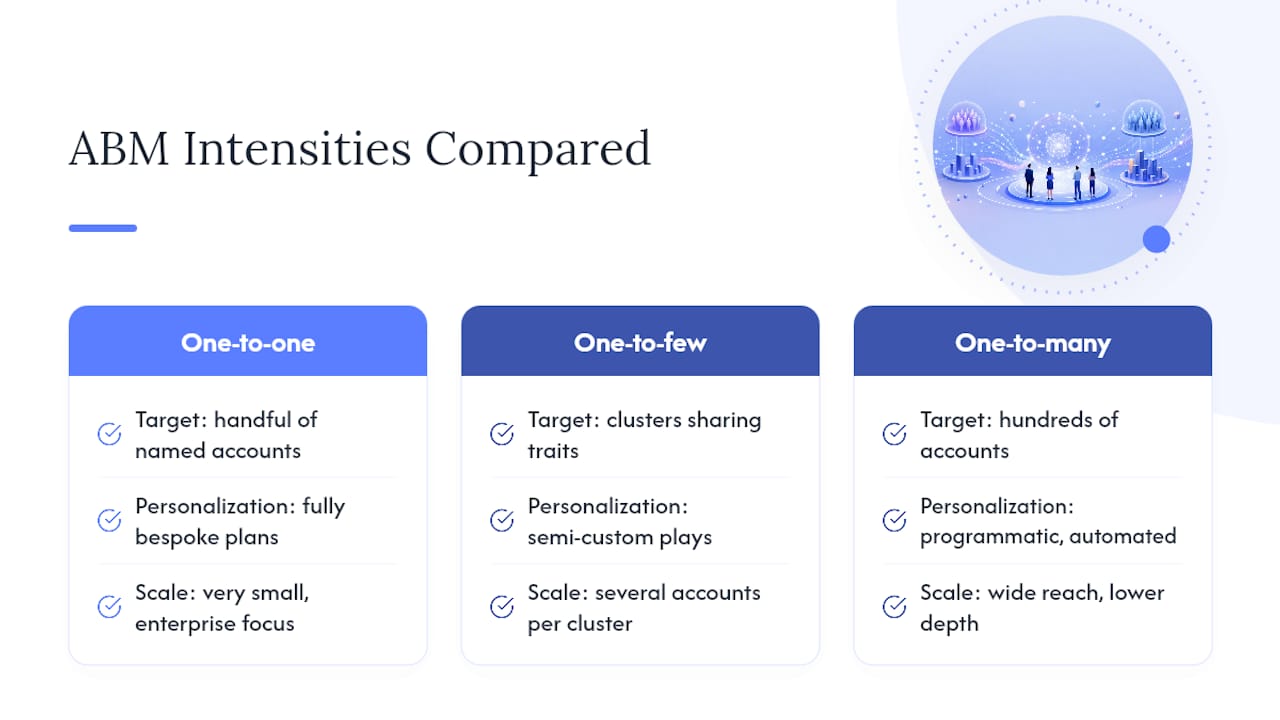
Most ABM programs operate at one of three intensities. One-to-one ABM targets a handful of named enterprise accounts, usually a small number, with fully bespoke plans, dedicated content, and executive-level outreach. One-to-few groups accounts by shared traits, like industry vertical or tech stack, and builds semi-custom plays for clusters of several companies at a time. One-to-many, sometimes called programmatic ABM, uses automation and intent data to personalize at scale across hundreds of accounts, trading bespoke depth for reach. 6sense’s ABM framework treats these three intensities as different tools for different resourcing levels, not a maturity ladder every company must climb.
Few companies run pure ABM. Most blend it with inbound: demand generation fills the top of the funnel and nurtures unknown accounts, while ABM accelerates the accounts you already know are worth winning. HubSpot’s own guidance frames inbound and ABM as complementary rather than competing strategies, which is closer to how most B2B teams actually operate.
What Business Results Does ABM Actually Deliver?
The case for ABM comes down to concentration. When you stop spreading budget across thousands of unqualified leads and put it behind accounts that already fit your ideal customer profile, the return shows up in a few predictable places.
- Higher ROI and larger deal sizes. Mature ABM programs consistently report stronger returns than broad-based campaigns, largely because the spend follows accounts with real budget and real buying intent rather than accounts that merely filled out a form.
- Tighter sales and marketing alignment. ABM forces both teams onto a shared account list with shared definitions of success, which eliminates the usual argument over whether a lead was “sales qualified.”
- Faster deal velocity. Coordinated multi-channel outreach to a known buying committee shortens the research phase buyers usually spend alone, because you are already answering their questions before they ask.
- Stronger expansion and retention. The same account intelligence that wins a deal helps you spot expansion opportunities and renewal risk long after the contract is signed.
None of this is automatic. ABM requires more upfront research per account than a demand-gen campaign requires per lead, and the payoff takes longer to show up in a dashboard. But for companies whose average deal size justifies the effort, the math tends to work in ABM’s favor within two to three quarters of disciplined execution.
What Framework Should You Follow to Build ABM?
Every durable ABM program answers five questions before launch: who is the ideal customer, which specific accounts fit that profile, how are those accounts tiered, what does the plan look like per tier, and how will progress be measured. Skip any one of these and the program drifts into a loosely branded demand-gen campaign wearing an ABM label.
The discipline lives in the details. Keep the initial target list short. A practitioner playbook from Leadriver stresses that short, well-researched lists consistently outperform sprawling ones, because a team that tries to personalize for 200 accounts ends up personalizing for none of them. Size each tier to what your headcount can realistically support: a small dedicated team can typically run bespoke plans for 10 to 25 one-to-one accounts, or manage 50 to 100 one-to-few accounts if the content requirements are lighter, according to operator guidance on ABM execution. Beyond that, you need programmatic tooling to keep personalization from collapsing under its own weight.
Account plans should scale in complexity with the tier. A one-to-one plan needs named stakeholders mapped to the buying committee, a custom value narrative, and an executive sponsor on your side. A one-to-few plan needs shared messaging themes across the cluster with light customization per account. A one-to-many plan needs strong segmentation logic and enough automation to personalize the top layer, like the company name and industry pain point, without hand-building every asset.
How Do You Build an ABM Strategy Step by Step?
Building an account based marketing strategy from scratch follows a sequence. Skip a step and you end up retrofitting alignment problems after the campaign has already launched.
- Set goals and get executive alignment first. Define what success looks like in revenue terms, not just engagement terms, and get sign-off from sales leadership on the investment and timeline before marketing builds a single asset.
- Derive your ideal customer profile from your best existing customers. Pull firmographic and behavioral data from your highest-value, longest-retained accounts rather than guessing at a profile from market research alone.
- Select and tier your target accounts. Score each candidate account against your ICP criteria and sort into one-to-one, one-to-few, or one-to-many based on deal potential and available resourcing.
- Build account plans and tailored assets per tier. One-to-one accounts get named stakeholder maps and custom decks; one-to-many accounts get segmented ad creative and templated but personalized email sequences.
- Orchestrate multi-channel plays with clear escalation sequences. Coordinate the order of touches, email, then a LinkedIn engagement, then a targeted ad, then a sales call, so the account experiences a coherent story instead of disconnected noise.
- Pilot with a small number of accounts, watch leading indicators, then scale. Run the first cohort for one full quarter, track engagement and account progression before expecting closed revenue, then expand tier by tier based on what worked.
Pro Tip: Run your pilot on accounts you’d be genuinely disappointed to lose, not a random sample. A pilot on low-stakes accounts tells you nothing about whether the program can handle real deal complexity.
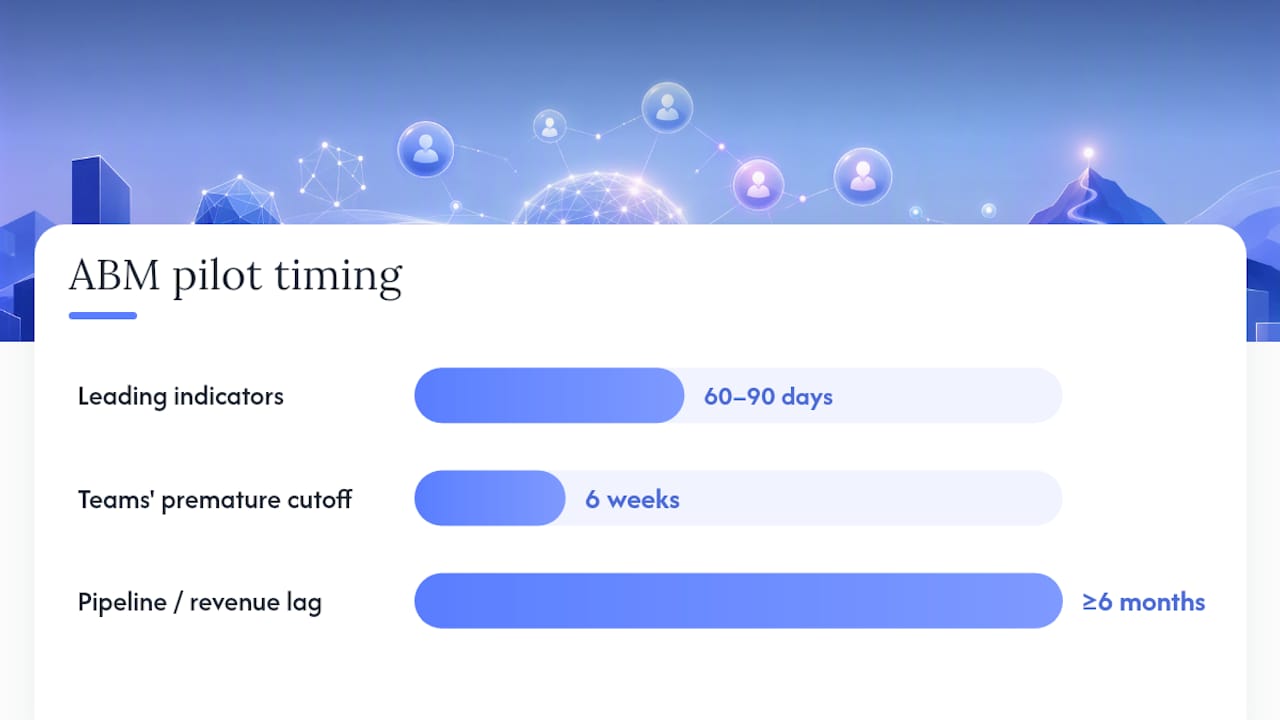
The pilot phase deserves more patience than most teams give it. Leading indicators like buying-group engagement and account progression typically show up within 60 to 90 days, but pipeline influence and closed revenue often lag six months or more behind that, especially for enterprise deal cycles. Teams that kill a pilot after six weeks because pipeline hasn’t moved yet are judging a marathon by its first mile.
Scaling should be gradual and signal-driven rather than a single big-bang rollout. Move accounts between tiers as engagement and opportunity size become clearer instead of locking the original list in place, an approach operator-level ABM guidance recommends specifically because static lists waste resources on accounts that have gone cold and starve accounts that have heated up.
How Do You Choose the Right Target Accounts?
Account selection is where most ABM programs quietly fail before they ever launch a campaign. The instinct is to chase recognizable logos, but a big-name account with poor product fit will drain your team’s time and never convert. Build your ICP from data instead of aspiration.
Start with your existing customer base. Pull the accounts with the highest lifetime value, the fastest time-to-close, and the lowest churn, then look for what they have in common: company size, industry, tech stack, org structure, and the trigger events that preceded their purchase. That pattern becomes your firmographic and technographic baseline.
- Firmographic fit: company size, industry, revenue band, geography.
- Technographic fit: the tools and platforms an account already uses that signal compatibility with your product.
- Behavioral fit: engagement history, content consumption, and prior touchpoints with your brand.
- Intent signals: third-party research activity or search behavior suggesting active buying research.
Intent data deserves a specific caveat: treat it as a signal that sharpens timing, not a substitute for fit. 6sense’s guidance on ABM frameworks makes this distinction directly, warning teams against chasing high-intent accounts that don’t match the ICP, since intent without fit just produces fast-moving deals that stall or churn. A simple scoring model weights firmographic and technographic fit most heavily, uses behavioral history as a secondary factor, and reserves intent data as a tiebreaker or timing trigger, drawing on intent data types Gartner outlines for what signals are worth tracking. CRM data, product usage logs, and an intent-data provider typically cover the sourcing you need.
How Do Sales and Marketing Stay Aligned in ABM?
ABM collapses without a shared operating model, because personalization at the account level only works if sales and marketing are looking at the same list and agreeing on what each stage means.
Start with shared definitions. What counts as “engaged”? What counts as “sales-ready”? What counts as an actual “opportunity”? Write these down and get both teams to sign off, because vague definitions are where alignment quietly breaks down weeks after a kickoff meeting everyone thought went well.
Build a cadence around it. Weekly or biweekly account reviews, with both marketing and sales in the room looking at the same dashboard, keep the program from splintering into two disconnected efforts running in parallel. A practitioner-focused ABM playbook puts shared account intelligence and a consistent review cadence at the center of what separates programs that scale from ones that stall after the first quarter.
Assign clear roles. Marketing typically owns content, campaign orchestration, and account research; sales typically owns direct outreach, relationship depth, and deal navigation. Someone, often a dedicated ABM manager or a growth marketing lead, needs to own the shared dashboard and the SLA between the two functions, or the cadence meetings turn into status updates instead of decisions.
What Tactics and Channels Work Best for ABM?
Channel mix should match tier intensity. One-to-one accounts justify bespoke events, executive briefings, and direct mail with real production value, because the deal size supports the cost per account. One-to-few accounts work well with vertical-specific workshops, cluster webinars, and content built around a shared industry pain point. One-to-many accounts need programmatic ads, scaled personalization tokens, and automated nurture sequences that still feel relevant without hand-crafting every touch.
Sequencing is what separates orchestration from a scattershot campaign. A typical sequence: a personalized email opens the account, a LinkedIn engagement from the rep follows within days, a targeted display ad reinforces the message across the account’s browsing, then a direct sales outreach lands once engagement signals suggest the account has actually seen the content.
- Prospect-specific offers: tailor the value proposition to the account’s specific situation rather than a generic pitch, a tactic Gartner’s ABM guidance lists among the most effective plays for accelerating engagement.
- Retargeting: keep the account’s buying committee seeing relevant ads across the sites they already visit, reinforcing the message without repeated cold outreach.
- Web personalization: dynamically swap headlines or case studies on your site based on which account is visiting, so a self-service visit still feels tailored.
- Offline touches: direct mail, event invitations, and executive dinners remain effective for one-to-one tiers precisely because so few competitors bother with them anymore.
Orchestration across these channels, not any single tactic, is what actually moves accounts through the funnel. Coordinated sequencing produces a compounding effect that isolated email blasts or standalone ad campaigns rarely match on their own.
How Do You Measure ABM Success?
ABM metrics look different from lead-based marketing metrics, because a single account has multiple people involved, and a single touch rarely tells you much on its own.
Five metrics matter most: account engagement score (a composite of content consumption, email opens, and web visits across everyone at the account), buying-group coverage (how many of the actual decision-makers you’ve reached, not just one champion), account progression rate (how many target accounts move from one funnel stage to the next per period), pipeline generated from target accounts versus non-target accounts, and win rate uplift compared to a similar cohort of accounts that never entered the ABM program.
A small dedicated ABM team can realistically run bespoke plans for a limited number of one-to-one accounts, or a larger but still constrained number of one-to-few accounts, depending on how much custom content each account demands, according to operator-level execution guidance.
That capacity ceiling matters for measurement too, because a team overextended past those numbers usually sees engagement scores flatten across the board rather than concentrating where it counts. Track pipeline from target accounts separately from your overall pipeline dashboard. Leadfeeder’s ABM guidance recommends this separation specifically because blending the two hides whether ABM is actually driving incremental results or just riding on demand generation’s coattails. Expect leading indicators like engagement and coverage within the first quarter; expect win-rate uplift and revenue influence to take two to three quarters to show clearly.
What Do Successful ABM Programs Look Like in Practice?
Nullbit’s strategic recruitment marketing case shows account-level thinking applied outside a typical enterprise SaaS context. The objective was building persona-aligned messaging that spoke directly to the specific hiring challenges of the target organization, rather than running generic recruitment ads, and the resulting campaign structure mapped closely to how one-to-few ABM plans get built: shared themes, targeted execution, measurable engagement per segment.
A second example comes from a forecasting model integration project that consolidated a dozen disconnected data sources into a single predictive model. That kind of consolidation is exactly what account selection and scoring depend on: without unified data, an ICP model is guesswork dressed up as strategy.
Some providers apply AI and data engineering to speed up both halves of ABM, account research and multi-channel orchestration, so teams spend less time stitching data together and more time acting on it.
What Should You Budget for an ABM Program?
Budget for ABM differently than you budget for demand generation, because the cost structure runs per account rather than per lead. A one-to-one program with a limited number of target accounts might justify higher spend per account annually when you include custom content, executive events, and dedicated sales enablement time, while a one-to-many program spreading automation across a larger number of accounts might run lower spend per account once the platform and creative investment is amortized.
Resource allocation should follow the 70/20/10 rule loosely: the majority of budget and headcount goes to the tier with the highest average deal value, a smaller portion supports the middle tier, and the smallest share funds the broadest programmatic layer, since that layer leans on automation rather than manual effort.
Don’t forget the cost centers that rarely show up in the initial budget conversation. Data enrichment and intent-data subscriptions carry ongoing licensing fees. Content production for one-to-one accounts, custom decks, tailored case studies, executive briefing documents, takes real creative hours that add up quickly across even a short list. And orchestration platforms that sync CRM, marketing automation, and ad platforms together carry both licensing costs and the implementation time to configure them properly.
Headcount matters as much as software spend. A single ABM manager can typically oversee a one-to-few program of modest size, but a serious one-to-one program for enterprise accounts usually needs a dedicated account marketer working in lockstep with the assigned sales rep, not a shared resource split across a dozen initiatives. Underinvesting in headcount is the most common way well-funded ABM programs still underperform.
What Legal and Privacy Rules Apply to ABM Data?
ABM depends on collecting and combining data about specific companies and the individuals inside them, which puts privacy compliance squarely in scope, not as an afterthought.
Regulations like GDPR in the European Union and CCPA in California govern how personal data, including business email addresses and behavioral tracking data, can be collected, stored, and used for marketing. B2B teams sometimes assume business contact data falls outside these rules; it generally does not, since a named individual’s work email is still personal data under most privacy frameworks. Consent requirements, data retention limits, and the right to be forgotten all apply to your ABM contact database the same way they apply to a consumer marketing list.
Third-party intent data introduces its own layer of risk. When you buy intent signals from a data provider, verify how that provider sourced and obtained consent for the underlying data, because liability for improperly sourced data can extend to the buyer, not just the original collector. Retargeting and ad personalization also increasingly require explicit cookie consent under regional rules, which affects how precisely you can target individual accounts through paid channels.
Practical compliance steps include auditing your data vendors for their consent practices, documenting a lawful basis for processing contact data in your CRM, and building data retention schedules that actually get enforced rather than left as a policy document nobody follows. None of this should be treated as a compliance afterthought bolted onto a launched program. Build it into the account selection and data-sourcing steps from the start, since retrofitting compliance into an already-running ABM database is far more disruptive than designing it in from day one.
Author’s Perspective: Discipline Beats Cleverness
Three failure modes kill more ABM programs than bad tactics ever do: lists too long for the team’s actual capacity, intent data mistaken for fit, and pilots abandoned before leading indicators had time to move. None of these are strategy problems. They’re pacing problems. Size your first tier conservatively, resist the urge to add “just a few more” accounts, and give a pilot a full quarter before judging it. The case studies above hold up because the discipline came first, not the tools.
— Matija
How Nullbit Supports Your ABM Program
Running ABM well means synchronizing data across your CRM, ad platforms, and content systems, and that’s exactly the kind of integration problem some providers solve for B2B teams. Rather than bolting another point solution onto an already fragmented stack, they build data pipelines and AI-assisted research tools that let a lean team cover the account research and orchestration work a much larger team would otherwise need.
If your account scoring still lives in a spreadsheet, AI solutions can turn scattered firmographic and intent signals into a working model your sales team actually trusts. If your bottleneck is campaign execution across channels, digital marketing services cover the orchestration layer, from paid media sequencing to content production for one-to-one tiers. And where the real gap is custom internal tooling, like an account dashboard your CRM doesn’t natively support, custom software development builds it around your actual workflow instead of forcing you into a rigid platform.
Start with a discovery conversation about where your ABM program is bottlenecked today, data, orchestration, or measurement, and a technology partner can scope the specific piece worth fixing first.
Sources
- 8 steps to build your account-based marketing strategy + recommended tools
- Account Based Marketing Strategy: A 2026 Playbook for B2B Teams | Leadriver
FAQ
What Is the Difference Between ABM and Demand Generation?
Demand generation casts wide and qualifies leads down after the fact; ABM picks specific high-value accounts first and builds campaigns around them from the start.
How Many Accounts Should a Small ABM Team Target?
A small dedicated team can typically support 10 to 25 one-to-one accounts or 50 to 100 one-to-few accounts, depending on how much custom content each requires.
Should You Use Intent Data to Choose ABM Accounts?
Use intent data as a timing signal that sharpens which in-market accounts to prioritize, not as a substitute for firmographic and technographic fit against your ICP.
How Long Does It Take to See ABM Results?
Leading indicators like engagement and account progression typically appear within 60 to 90 days, while pipeline influence and win-rate uplift usually take two to three quarters to show clearly.
Can ABM and Inbound Marketing Work Together?
Yes. Inbound marketing discovers and nurtures unknown accounts at scale, while ABM accelerates conversion on the specific high-value accounts you’ve already identified.
What Tools Support an ABM Tech Stack?
A working ABM tech stack typically combines a CRM, an intent-data provider, an orchestration or ad-personalization platform, and increasingly AI-assisted research tools like those Nullbit builds to speed account scoring and campaign coordination.