
AI Readiness Assessment: Nullbit’s 90 Day Fix for Your Weakest Pillar
An AI readiness assessment measures how prepared your organization is to deploy artificial intelligence across strategy, data, infrastructure, governance, talent, and culture. Run it right, and the deliverable is a scored breakdown of gaps plus a prioritized roadmap, not a vague impression. The CEO, CIO, COO, and CDO should own the process together, because no single function sees the whole picture alone.
TL;DR:
- Infrastructure gaps such as network bandwidth can significantly delay AI deployment and should be honestly assessed before other pillars.
- Governance policies, data quality, and compliance requirements are often low-cost fixes that prevent costly failures if addressed early.
- Scoring should be based on evidence like data catalogs and policies, with thresholds guiding whether to pause, pilot, or scale AI initiatives.
- Prioritizing high-value, low-effort fixes and small-scale pilots ensures organizational capability develops alongside AI technologies.
- Combining a detailed assessment with a quick, focused proof-of-concept accelerates progress and reduces the risk of stalled AI projects.
Table of Contents
- What Are the Core Pillars of an AI Readiness Assessment?
- How Do You Structure and Run an AI Readiness Assessment?
- How Do You Measure and Interpret AI Readiness Scores?
- How Do You Turn Assessment Results Into a Roadmap?
- Integrating Readiness Findings Into Existing Systems
- Managing Change During AI Adoption
- Assessing Risk Before AI Deployment
- Legal and Ethical Compliance Factors in AI Readiness
- What Do Real AI Readiness Assessments Look Like in Practice?
- Turning a Score Into Actual Projects
- How Nullbit Turns Your Readiness Score Into a Working System
- Frameworks Worth Consulting Next
- Sources
- FAQ
What Are the Core Pillars of an AI Readiness Assessment?
Most credible frameworks break readiness into six areas. Forrester’s AI Maturity Assessment evaluates strategy, governance, operating model, talent, technology, and activation, then turns the results into a prioritized path from pilot projects to measurable return. MITRE’s AI Maturity Model covers similar ground across 20 dimensions and outputs a visual maturity score with evidence notes attached to each rating.
Here’s what evidence collection actually looks like for each pillar:
- Strategy: A documented AI use-case pipeline tied to business goals, not a slide deck of buzzwords.
- Data: A working data catalog, known data quality issues, and clarity on who owns what.
- Infrastructure: Bandwidth capacity, centralized monitoring, and cloud or on-prem readiness for model workloads.
- Governance: A written AI policy covering approval workflows, risk tiers, and accountability.
- Talent: Named owners for AI projects and a realistic inventory of in-house technical skill.
- Culture: Evidence that teams have tested AI tools voluntarily, not just tolerated a mandate.
The weakest-link effect matters more than any average score. An organization with brilliant data infrastructure but no governance policy is not “mostly ready.” It’s one leaked prompt or one compliance violation away from a shutdown order. Treat each pillar as a gate, not a grade to be averaged out.
Pro Tip: Score infrastructure honestly before you score anything else. Enterprise AI workloads routinely expose network gaps around bandwidth and policy management that teams didn’t know existed until a pilot stalled.
How Do You Structure and Run an AI Readiness Assessment?
Running the assessment well matters as much as the framework you choose. A comprehensive evaluation needs a cross-functional leadership team because business operations, data hygiene, and cultural readiness live in different departments, and no single executive sees all three clearly.
- Assemble the team. Pull in the CEO, CIO, COO, and CDO (or equivalents) so financial, technical, operational, and data perspectives all show up in the room.
- Pick your format. A short checklist run in a single two-hour session works for a first pass. A full maturity model, like MITRE’s or Forrester’s, takes multiple sessions across two to four weeks and produces deeper benchmarking.
- Define scope up front. Decide whether you’re assessing one business unit or the whole company. Mixing scopes muddies the score.
- Assign a neutral facilitator. Someone without a stake in the outcome keeps departments honest about their own weak spots.
- Collect real evidence, not opinions. Ask for the data catalog, the AI policy document, or the infrastructure diagram. Don’t accept “we’re working on it” as proof.
How Do You Measure and Interpret AI Readiness Scores?
A simple scoring method works better than an elaborate one. Score each question 0 to 2 (0 = not started, 1 = in progress, 2 = established), then total by pillar and again for the full assessment. Elevates.AI’s 15-question checklist across five dimensions uses exactly this approach, and it’s simple enough to run without outside facilitation.
Thresholds give the score meaning:
- Low readiness (under 40% of possible points): Pause major AI investments. Fix foundational gaps, especially data and governance, before spending on tools.
- Medium readiness (40 to 70%): Proceed with a narrow, well-defined pilot. Expand only after the pilot proves value.
- High readiness (above 70%): Scale confidently, but keep reassessing individual pillars as you expand scope.
The threshold matters less than what you do with it. Analysts at Forrester have flagged that organizations frequently mistake buying tools for actually being ready, when true readiness depends on organizational capability for secure design, implementation, and governance, not on a vendor contract.
Interpret results by hunting for high-impact, low-effort fixes first. A missing data catalog is expensive to build but cheap to document as a gap. A missing AI policy costs almost nothing to draft and removes a governance blocker overnight. Fix the cheap blockers before touching the expensive ones.
How Do You Turn Assessment Results Into a Roadmap?
Score in hand, the next move is prioritization. Not everything gets fixed at once, and trying to fix everything simultaneously is how AI initiatives stall before they start.
- Rank gaps by value and effort. Plot each identified gap on a simple grid: high value and low effort goes first, low value and high effort goes last or gets dropped entirely.
- Pick one pilot use case. Choose the initiative with the clearest business metric attached, whether that’s ticket resolution time, forecast accuracy, or manual hours saved.
- Set a 90-day action list. Typical first moves include cataloging your top three data sources, drafting a baseline AI governance policy, and launching one pilot with a defined KPI target.
- Track progress against the original score. Rerun the same questions in 90 days and check whether the pilot pillar moved.
- Set your reassessment cadence. Quarterly works for fast-moving teams; every six months suits organizations with slower change cycles. Readiness shifts as fast as your data infrastructure and staffing do, so don’t treat the first score as permanent.
Pro Tip: Resist the urge to pick your most ambitious use case as the pilot. The goal of the first 90 days is proving the model works end to end, not proving it can handle your hardest problem.
Gartner’s guidance on maturity planning backs this staged approach: target maturity levels should align with specific business goals rather than chasing uniform excellence across every pillar. A logistics company doesn’t need governance maturity as deep as that of a healthcare provider. Match the target to the actual risk profile of your use cases.
Integrating Readiness Findings Into Existing Systems
An assessment score is only useful if it changes how existing systems actually work. Bolting a new AI tool onto processes that weren’t built to receive it usually produces shadow workflows, where staff quietly revert to spreadsheets because the new system doesn’t talk to the old one.
Start by mapping which existing systems the pilot use case touches: your CRM, your ERP, your ticketing platform, whatever holds the data the model needs. Readiness findings around data quality and infrastructure should feed directly into that integration plan rather than sitting in a separate report. If your data pillar score flagged inconsistent customer records, that gap needs fixing before the AI tool goes live against that same data, not after.

Governance findings integrate differently. A documented AI policy should plug into existing approval workflows, whatever your organization already uses for procurement or IT change control, rather than creating a parallel process nobody follows. Duplicate systems for the same decision type are how governance policies die quietly within a year.
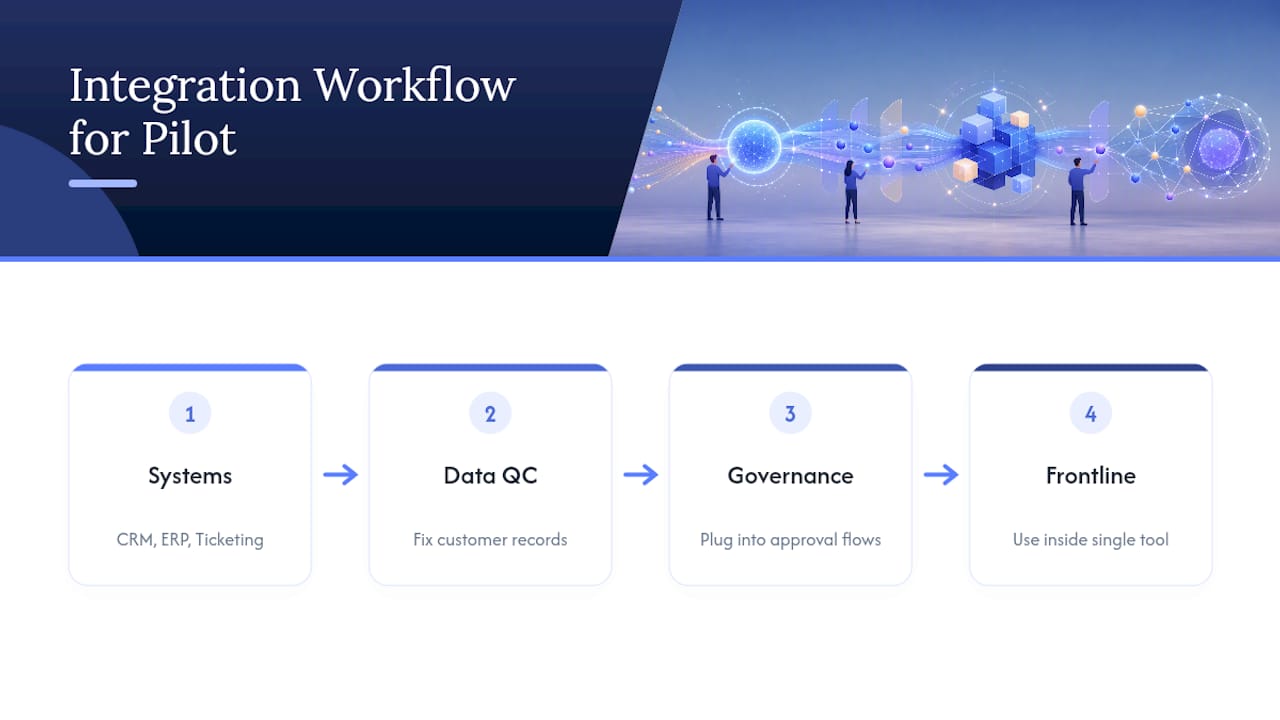
The practical test: can a frontline employee use the new AI capability inside the tool they already open every morning, or does it require a second login and a separate habit? Readiness assessments that ignore this question tend to produce technically sound pilots that never scale, because integration was treated as a phase-two problem instead of a scoring criterion from day one.
Managing Change During AI Adoption
Readiness scores measure capability, but adoption depends on whether people actually change their behavior once the tool is live. That’s a separate problem, and skipping it is the most common reason a technically sound pilot fails to scale.
Communicate early and specifically. Tell affected teams what the AI tool will and won’t do, and be honest about which tasks shift or disappear. Vague reassurance breeds more resistance than a direct answer, even an uncomfortable one.
Build in a feedback loop from the first week of the pilot. Frontline staff notice friction points executives never see, and their input during the pilot phase prevents the same mistakes from repeating at scale. Treat early complaints as data, not resistance to manage away.

Assign change champions inside each affected team, not just inside IT. A peer who can answer “why are we doing this” carries more weight than a memo from leadership. Pair that with visible executive sponsorship. Culture pillar scores in the original assessment often predict how much of this work you’ll need. A low culture score means budget more time for this phase, not less.
Assessing Risk Before AI Deployment
Every AI readiness assessment should surface risk exposure alongside capability gaps, because a high strategy score doesn’t offset a governance gap that could trigger a compliance failure. The two need separate scrutiny.
Operational risk centers on model reliability: what happens when the AI system produces a wrong answer, and who catches it before it reaches a customer or a regulator? Assessments that skip this question tend to discover the answer the hard way, during an actual incident rather than a planning session.
Data risk covers exposure of sensitive information, whether through training data, prompts sent to third-party models, or outputs that leak proprietary details. OWASP’s AI Maturity Assessment treats secure, responsible integration as a core domain rather than an afterthought, with specific criteria for how AI systems handle design, operations, and governance together.
Vendor risk deserves its own line item too. Third-party AI tools carry dependency risk: pricing changes, model deprecations, and data handling terms that shift without much warning. Build vendor review into your governance pillar rather than treating procurement as a one-time decision. Score this the same way you score internal gaps, because an unreviewed vendor contract is exactly the kind of low-effort, high-impact fix that belongs early on your roadmap.
Legal and Ethical Compliance Factors in AI Readiness
Compliance readiness gets treated as a legal department problem, but it belongs in the assessment itself, scored alongside strategy and data. Waiting until deployment to ask “is this legal” is backwards.
Data privacy regulations vary by jurisdiction and by sector, and an assessment needs to reflect the specific rules governing your organization’s data, not a generic checklist. What’s permitted for an internal analytics tool may not be permitted for a customer-facing model trained on personal data. Loop in legal counsel during the assessment phase, not after the pilot launches.
Bias and fairness testing belongs in the governance pillar’s evidence requirements. Documented testing for disparate outcomes across protected groups isn’t optional for anything touching hiring, lending, or healthcare decisions, and increasingly isn’t optional anywhere customer-facing AI operates.
Transparency obligations are tightening globally, and requirements differ by region and industry, so verify the specific rules that apply to your sector before committing to a deployment timeline. Build a documentation habit now: what data trained the model, what decisions it influences, and how a person can contest an outcome. That documentation is cheaper to build during the assessment phase than to reconstruct after a regulator asks for it.
What Do Real AI Readiness Assessments Look Like in Practice?
Higher education offers one of the clearer public examples of structured assessment. EDUCAUSE’s generative AI readiness framework divides evaluation into strategy, governance, technology, workforce, and teaching sections, which helps cross-functional committees at universities focus discussion instead of debating everything at once. That sectioning approach translates directly to corporate settings: a retail chain assessing AI readiness might split evaluation into merchandising, store operations, IT, and customer service, mirroring how EDUCAUSE separates academic and administrative concerns.
The pattern across working assessments is consistent regardless of industry: teams that score each area separately, rather than producing one blended number, make better prioritization decisions. A logistics company might score high on infrastructure (existing IoT sensor networks, cloud contracts already in place) but low on governance (no documented policy for automated routing decisions). That split score tells the leadership team exactly where to spend the next quarter, instead of leaving them with a single ambiguous number that hides the real bottleneck.
Enterprise infrastructure assessments consistently turn up the same surprise: teams underestimate network and system engineering gaps until an AI workload actually hits production bandwidth limits. That’s a recurring finding across sectors, not an isolated case, which is why infrastructure deserves its own dedicated scoring rather than getting folded into a general “technology” bucket.
Turning a Score Into Actual Projects
Most assessments stop at the scorecard. That’s the gap Nullbit sees most often: leadership teams with a clear, well-documented readiness report and no clear next move to convert findings into working systems.
The useful move after scoring is picking the one pilot with the clearest business metric and building it fast enough to prove or disprove the case within a quarter. That means scoping a proof-of-concept narrowly, wiring it into existing systems rather than building around them, and defining the KPI before the first line of code gets written. Teams that skip this sequencing tend to build technically impressive pilots that never get budget approval for phase two, because nobody defined success in advance.
A scalable architecture matters here too. A pilot built on infrastructure that can’t handle production volume just moves the readiness gap downstream instead of closing it.
— Matija
How Nullbit Turns Your Readiness Score Into a Working System
Nullbit is the option for organizations that want their assessment results built, not just discussed further in another workshop. Where a generic consultancy hands you a report and leaves, Nullbit treats the scorecard as a build spec: strategy findings become a scoped proof-of-concept, infrastructure gaps get addressed through cloud and system engineering, and governance gaps get folded into the automation work itself rather than bolted on afterward.
Proof-of-concept development starts from a competitive price, scoped directly against whichever pilot your assessment flagged as highest value with lowest effort, leveraging expertise from an AI Automation agency to operationalize AI workloads effectively. For teams ready to move past a single pilot into AI automation across multiple workflows, engagements run as either agile time-and-materials work or fixed-price turnkey projects, detailed on the cooperation page. Every engagement ends with a working deliverable and measurable KPIs tied back to the numbers your assessment produced, not a second report. Reach out with your scorecard and Nullbit will map it to a concrete 90-day build plan.
Frameworks Worth Consulting Next
For deeper benchmarking, Forrester’s AI Maturity Assessment and MITRE’s AI Maturity Model offer the most rigorous scoring structures. OWASP’s AIMA covers governance and security in more depth, while Microsoft’s AI Readiness wizard offers a faster, practical questionnaire format.
Sources
- Assess Your AI Maturity | Forrester
- MITRE AI Maturity Model
- Assessments | AI Readiness Assessment — Microsoft Learn
- OWASP AI Maturity Assessment (AIMA)
FAQ
What Is an AI Readiness Assessment?
It’s a structured evaluation of an organization’s capability to adopt AI across strategy, data, infrastructure, governance, talent, and culture, producing a scored breakdown and prioritized roadmap rather than a general impression.
How Do You Evaluate AI Readiness Across Departments?
Use a cross-functional team, typically the CEO, CIO, COO, and CDO, so business strategy, technical infrastructure, operations, and data ownership all get evaluated by the people who actually own those functions.
What Is an AI-Ready Test, and Who Should Run It?
An AI-ready test is a short checklist or formal maturity model that scores your organization’s gaps; run it with a neutral facilitator and cross-functional leadership rather than a single department acting alone.
Can Nullbit Help After We Complete an Assessment?
Yes. Nullbit builds proof-of-concept pilots and automation systems directly from assessment findings, starting with scoped engagements detailed on its services page.