

What is AI voice translation? A 2026 business guide

Global business still struggles with language barriers despite decades of digital connectivity. Real-time AI voice translation systems now achieve 1.5 to 2.5 seconds latency and 90 to 95% accuracy, enabling near seamless multilingual communication. This guide explains how AI voice translation works, what performance you can expect, where current systems fall short, and how to apply this technology in your enterprise.
Table of Contents
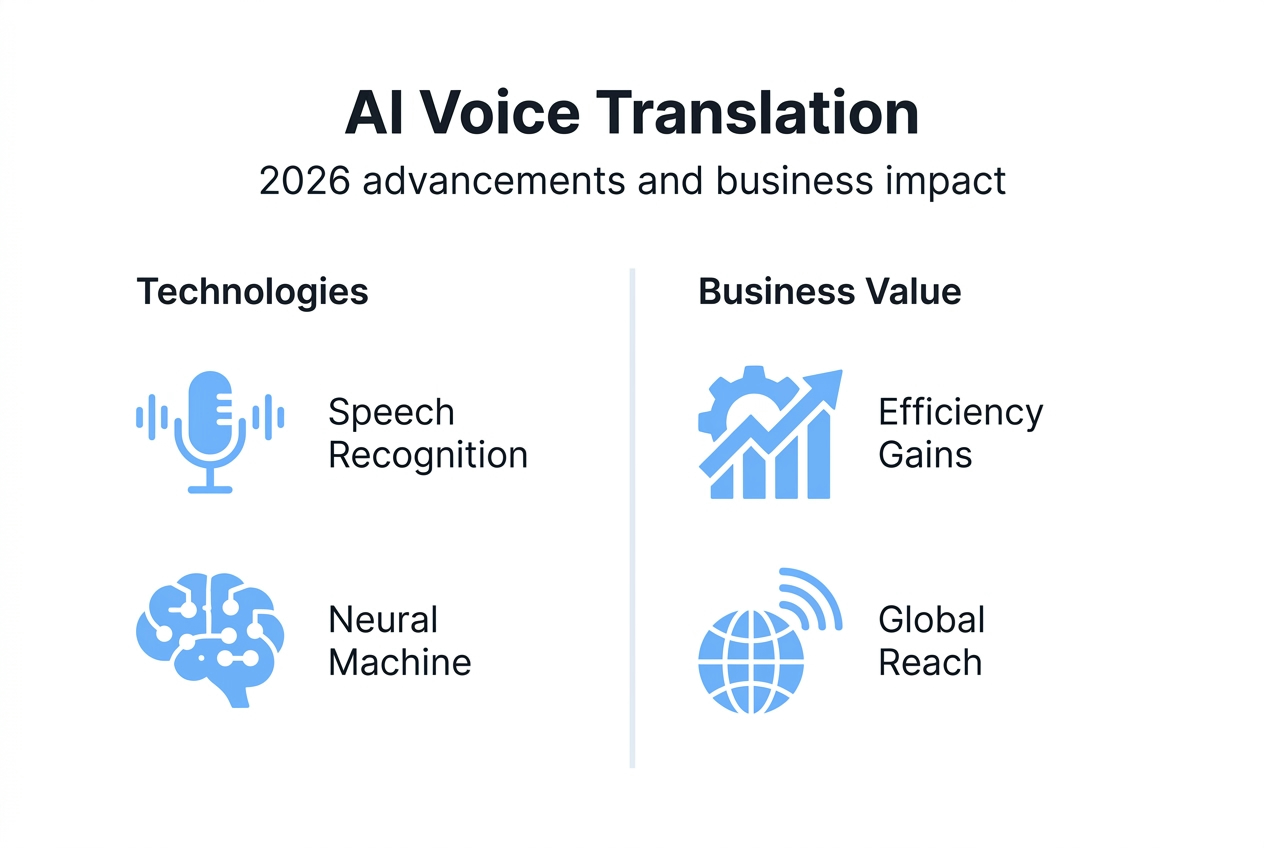
- How AI Voice Translation Works: Core Technologies And Architecture
- Performance Metrics And Technical Challenges In Real-Time AI Voice Translation
- Evolving Solutions And Advancements In AI Voice Translation
- Implementing AI Voice Translation In Business: Practical Tips And Considerations
- Discover Enterprise AI Solutions With NULLBIT
- Frequently Asked Questions
Key takeaways
| Point | Details |
|---|---|
| Core architecture | AI voice translation integrates speech recognition, neural machine translation, and speech synthesis subsystems for low latency streaming. |
| Performance metrics | Commercial systems deliver 1.5 to 2.5 seconds latency with 90 to 95% accuracy, though accents and overlapping speech reduce precision. |
| Recent advances | Frameworks like TransLinguist and Google Meet AI translation support 62+ languages with measurable ROI and cross-task training benefits. |
| Business implementation | Pilot with cross-functional teams, design quiet environments, and maintain human oversight for compliance-sensitive sectors. |
How AI voice translation works: core technologies and architecture
AI voice translation architecture combines three main subsystems. The input layer captures speech through acoustic sensors and converts audio to text using automatic speech recognition (ASR). The processing layer applies neural machine translation (NMT) to convert source language text into target language equivalents. The output layer synthesizes translated text into natural speech, sometimes with spatial audio positioning to maintain speaker identity in multi-person conversations.
Each subsystem operates under strict latency constraints. Real-time communication requires continuous streaming rather than waiting for complete sentences. Voice agent systems must convert spoken words into understanding, then generate speech responses within the conversational flow. This means ASR models predict words before speakers finish, NMT engines translate partial phrases, and speech synthesizers start output before translation completes.
Acoustic modeling forms the foundation of speech recognition. Deep learning models analyze audio waveforms to identify phonemes, the smallest sound units in language. Statistical language models predict likely word sequences based on context, allowing the system to resolve ambiguous sounds. NMT engines use transformer architectures trained on millions of parallel sentences to map meaning across languages while preserving context and tone.
The continuous audio-text flow creates unique challenges. Speakers pause mid-sentence, correct themselves, or overlap with others. Translation systems must handle these interruptions gracefully, sometimes revising earlier output as new context arrives. For example, German sentence structure often places verbs at the end, forcing the system to buffer or restructure English output dynamically.
Pro Tip: When evaluating AI voice translation systems, test them with your actual business conversations rather than scripted demos. Real-world speech patterns reveal limitations that polished demonstrations often hide.
For enterprises planning broader AI workflow implementation, voice translation represents one component in a larger automation ecosystem. Integration with meeting platforms, CRM systems, and knowledge bases amplifies value beyond standalone translation.
Performance metrics and technical challenges in real-time AI voice translation
Empirical evaluation shows 1.5 to 2.5 seconds latency and 90 to 95% ASR accuracy in production systems. These numbers represent controlled environments with clear audio, single speakers, and standard accents. Real-world performance varies significantly based on several factors.
Accent variability creates the largest accuracy gap. ASR models trained primarily on North American English struggle with Scottish, Indian, or Nigerian accents. Even within a single language, regional pronunciation differences cause recognition errors that cascade through translation and synthesis. A 5% ASR error rate might seem minor, but it compounds when translation models encounter unexpected words or phrases.
Overlapping speech poses a fundamental challenge for consumer AI earbuds due to single-speaker assumptions. Beamforming microphones help isolate individual voices in controlled settings, but close proximity conversations with rapid turn-taking overwhelm most systems. Structured speaker turns improve accuracy by up to 65% compared to natural overlapping discussion.
Performance factors affecting accuracy:
- Background noise level and type (steady hum vs. intermittent sounds)
- Speaker distance from microphone (optimal 30 to 60 cm)
- Speech rate and clarity (fast speech reduces accuracy 10 to 20%)
- Domain-specific vocabulary (medical, legal, technical terms)
- Audio codec quality in VoIP or streaming contexts
| Metric | Optimal conditions | Challenging conditions |
|---|---|---|
| Latency | 1.5 to 2.0 seconds | 3.0 to 5.0 seconds |
| ASR accuracy | 93 to 95% | 75 to 85% |
| Translation accuracy | 90 to 93% | 70 to 80% |
| Speaker separation | 95%+ (single speaker) | 60 to 75% (overlapping) |
Real-time call translation prioritizes conversational fluency over perfect accuracy. This design choice means systems sometimes smooth over uncertainties rather than flagging them. In low-stakes conversations, this approach works well. For compliance-sensitive discussions, it creates risk.
“The trade-off between latency and accuracy remains the central challenge in real-time translation. Buffering improves precision but breaks conversational flow. Instant output maintains engagement but increases error rates.” Industry research consensus, 2026
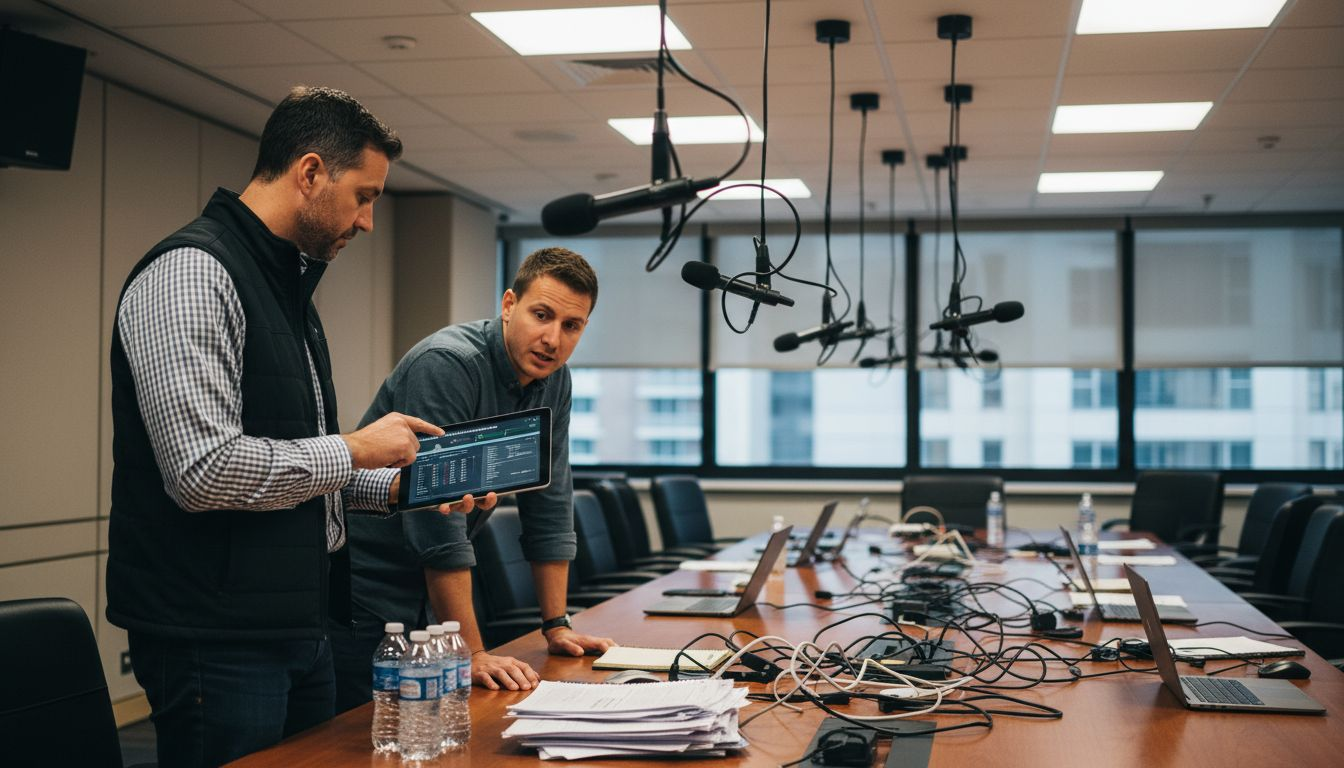
Pro Tip: Install translation systems in quiet conference rooms with ceiling-mounted microphone arrays. This controlled environment minimizes the acoustic challenges that degrade performance in open office spaces.
NULLBIT’s live AI translation case study demonstrates how proper environment design and system tuning can push accuracy above 92% even in multi-speaker scenarios. The key is matching technology capabilities to specific use case requirements rather than expecting one-size-fits-all solutions.
Evolving solutions and advancements in AI voice translation
Recent frameworks push beyond basic translation to multi-modal experiences. TransLinguist supports 62 languages with real-time translation, subtitles, voice-over, and sign language integration, delivering 2x ROI in 2 years for enterprises that previously relied on human interpreters. The system combines visual and audio channels to improve comprehension, especially in noisy environments where speech alone proves insufficient.
Google Meet’s AI translation enables near real-time speech conversion across major European languages, developed through collaboration between DeepMind and Research teams. The system integrates directly into the meeting platform, eliminating separate apps or devices. Users hear translated audio in their preferred language while maintaining natural conversation flow.
Cross-task training improves translation quality by exposing models to diverse language tasks during development. Whisper-UT framework enables seamless multi-modal machine translation without requiring 3-way parallel data, reducing the training data burden that previously limited language coverage. This approach allows systems to leverage subtitle data, dubbing corpora, and text translation pairs simultaneously.
| System | Languages | Latency | Unique features | Enterprise ROI |
|---|---|---|---|---|
| TransLinguist | 62 | 1.8 to 2.2 sec | Sign language, voice-over, subtitles | 2x in 2 years |
| Google Meet AI | 15+ | 2.0 to 2.5 sec | Native platform integration | 40% meeting efficiency gain |
| Whisper-UT | 100+ | 1.5 to 3.0 sec | Multi-modal training, high accuracy | Varies by implementation |
Production-ready systems demonstrate clear efficiency gains. International sales teams using AI voice translation report 30 to 40% faster deal cycles by eliminating interpreter scheduling delays. Customer support organizations handle 25% more non-English inquiries without adding multilingual staff. These metrics translate directly to competitive advantage in global markets.
Multi-modal translation advantages extend beyond voice. Combining speech with visual text or sign language supports diverse accessibility needs. Hearing-impaired participants access real-time sign language interpretation. Non-native speakers read translated subtitles while hearing original audio. This flexibility increases meeting inclusivity and information retention.
NULLBIT’s AI solutions integrate voice translation with broader automation frameworks. Combining translation with transcription, sentiment analysis, and knowledge extraction creates compound value. Meeting recordings become searchable multilingual knowledge bases. Customer conversations generate training data for support chatbots in multiple languages.
Implementing AI voice translation in business: practical tips and considerations
Successful deployment starts with clear use case definition. Not every communication scenario benefits equally from AI voice translation. Evaluate where language barriers create measurable friction in your operations.
Steps for evaluating business needs:
- Map current communication workflows that involve multiple languages
- Quantify interpreter costs, scheduling delays, and missed opportunities
- Identify high-value scenarios where real-time translation drives revenue or efficiency
- Assess technical infrastructure readiness including network bandwidth and device compatibility
- Define success metrics tied to business outcomes rather than just translation accuracy
Environmental setup determines performance more than most buyers expect. The same system that performs beautifully in a quiet conference room fails in an open office or factory floor.
Best practices for environmental design:
- Position microphones 30 to 60 cm from speakers at mouth height
- Minimize background noise through sound dampening or strategic room selection
- Use directional microphone arrays to isolate individual speakers
- Establish speaker protocols such as waiting for pauses before interjecting
- Test systems under actual usage conditions before full deployment
Automated speech recognition often requires human oversight in high-stakes sectors for accuracy and defensibility. Legal depositions, medical consultations, and regulatory compliance discussions demand precision that current AI cannot guarantee. Hybrid approaches work well: AI provides real-time translation for immediate understanding, while human reviewers verify transcripts afterward.
Pro Tip: Pilot AI voice translation with cross-functional teams spanning sales, support, and operations. Each group surfaces different workflow impacts and integration needs that inform broader rollout strategy.
Compliance-sensitive industries face additional constraints. Healthcare organizations must ensure translation systems meet HIPAA requirements for patient data. Financial services need audit trails proving translation accuracy in advisory conversations. Government contractors require security clearances for voice data processing.
Integration with existing platforms amplifies value. Voice translation that works only in standalone apps creates workflow friction. Seek solutions that embed into your communication tools: Microsoft Teams, Zoom, Slack, or proprietary platforms. API-based architectures enable custom software development that weaves translation into unique business processes.
Change management determines adoption success as much as technology capability. Train teams on system limitations so they adjust communication style appropriately. Encourage slower, clearer speech. Establish protocols for handling translation errors gracefully. Collect user feedback to refine deployment over time.
Discover enterprise AI solutions with NULLBIT
NULLBIT specializes in custom AI solutions that transform how enterprises communicate across language barriers. Our team designs and implements voice translation systems tailored to your operational context, from call centers to international sales to manufacturing floors. We combine voice translation with broader automation frameworks, creating integrated solutions that maximize ROI through compound efficiencies.
Our software development services offer both agile and fixed-scope engagement models. Whether you need a proof of concept to validate business value or a production-ready system with enterprise-grade security and scalability, we deliver technical excellence backed by dedicated teams. As your technology partner, we focus on measurable outcomes: faster deal cycles, reduced interpretation costs, expanded market reach, and competitive advantage through innovative communication capabilities.
Frequently asked questions
What is AI voice translation?
AI voice translation converts spoken words from one language to another in near real time, typically within 1.5 to 2.5 seconds. The technology combines automatic speech recognition, neural machine translation, and speech synthesis to enable conversations between people who don’t share a common language. Unlike text translation tools that require typing, voice systems process continuous speech for natural communication flow.
How does AI voice translation differ from text-based translation?
Voice translation must handle acoustic challenges like accents, background noise, and overlapping speech that text systems never encounter. It also operates under strict latency constraints since conversations require immediate responses, while text translation can take several seconds without disrupting user experience. Voice systems must synthesize natural-sounding speech output, adding complexity beyond text generation.
What languages work best with current AI voice translation systems?
Commercial systems typically support 15 to 62 languages depending on the provider, with English, Spanish, Mandarin, French, and German showing highest accuracy. Research frameworks like Whisper-UT extend coverage to 100+ languages, though performance varies significantly. Languages with large training datasets and clear phonetic rules perform better than those with limited digital corpora or tonal complexity.
Why do AI translation systems struggle with overlapping speech?
Most systems assume one speaker at a time and lack robust speaker separation capabilities. When voices overlap, acoustic models cannot reliably attribute words to specific speakers, causing recognition errors that cascade through translation. Structured turn-taking improves accuracy by up to 65% compared to natural overlapping conversation, making speaker protocols essential for optimal performance.
What are the best business use cases for AI voice translation?
International sales calls, customer support for global markets, multilingual meetings, and manufacturing floor communication show strongest ROI. These scenarios combine high language-barrier friction with tolerance for occasional translation errors. Compliance-sensitive applications like legal depositions or medical consultations require human oversight to ensure accuracy and defensibility, making pure AI solutions inappropriate without verification workflows.
Recommended
- Scalable AI Solutions Guide for Enterprise Success | NULLBIT
- Blog - Insights on Software, AI & Digital Strategy | NULLBIT | NULLBIT
- Why Use AI in Business: Enhancing ROI and Efficiency | NULLBIT
- How to Implement AI Automation for Enterprise Success | NULLBIT
- Amlogy at TedAI Vienna 2025: Exclusive Insights