

Industry 4.0 trends 2026: 5 AI innovations driving operations

Business leaders face mounting pressure to select Industry 4.0 technologies that deliver measurable operational improvements in 2026. The challenge lies not in finding innovation, but in identifying which AI-driven trends genuinely transform manufacturing and operations versus those that stall in expensive pilot phases. This article equips you with clear evaluation criteria, profiles five transformative Industry 4.0 trends reshaping global manufacturing, and provides strategic guidance to confidently lead digital transformation initiatives that scale. You’ll discover how agentic AI, physical robotics, and human-in-the-loop systems are redefining operational excellence today.
Table of Contents
- How To Evaluate Industry 4.0 Technologies For 2026
- Five Emerging Industry 4.0 Trends Driving Operational Excellence
- Comparing AI Adoption Success And Pitfalls In Manufacturing
- Choosing The Right Industry 4.0 Strategy For Your Business In 2026
- Explore Customized AI And Software Solutions To Accelerate Your Industry 4.0 Journey
Key takeaways
| Point | Details |
|---|---|
| Evaluation criteria matter | Prioritize measurable ROI, actionable data, and industry-specific AI solutions before adoption. |
| Five transformative trends | Agentic AI, physical robotics, industry-specific agents, human-in-the-loop copilots, and digital workers lead 2026 innovation. |
| Adoption challenges persist | AI projects face 70-95% failure rates, but successful implementations save over $500 million. |
| Strategic implementation wins | Phased pilots, clear KPIs, and human oversight dramatically improve scaling success. |
How to evaluate Industry 4.0 technologies for 2026
Selecting the right Industry 4.0 technologies requires cutting through vendor hype and focusing on strategic business value. Many leaders rush toward AI adoption without establishing clear success metrics, leading to wasted investment and stalled initiatives. The evaluation framework below helps you separate transformative solutions from costly distractions.
Start by defining measurable outcomes before any technology investment. What specific operational bottleneck will this solution address? How will you quantify improvement in throughput, quality, or cost reduction? Without concrete ROI targets, even sophisticated AI systems become expensive experiments that never reach production scale.
Prioritize actionable insights over data volume. Collecting massive datasets without clear purpose creates analysis paralysis rather than competitive advantage. Focus on systems that transform specific operational decisions, not those promising vague digital transformation.
Evaluate AI solutions for industry specificity and integration ease. Generic AI models trained on broad datasets rarely understand the nuances of your manufacturing processes, supply chain constraints, or quality standards. Solutions built for your sector deliver faster time to value and require less customization overhead.
Balance automation capabilities with human oversight requirements. Fully autonomous systems sound appealing but often fail when encountering edge cases or unexpected conditions. Technologies that implement AI workflow as copilots supporting human expertise typically scale more reliably than those attempting complete worker replacement.
Consider these critical evaluation factors:
- Scalability from pilot to full production deployment
- Integration compatibility with existing systems and data infrastructure
- Vendor track record in your specific industry vertical
- Training requirements and change management complexity
- Total cost of ownership including maintenance and updates
Pro Tip: Run small, time-boxed pilots with clearly defined success criteria before committing to enterprise-wide rollouts. This approach minimizes risk while generating real-world performance data that informs scaling decisions.
Five emerging Industry 4.0 trends driving operational excellence
Five distinct Industry 4.0 trends are reshaping how manufacturers and operations leaders approach AI integration in 2026. These innovations move beyond theoretical potential to deliver measurable improvements in productivity, quality, and operational resilience.
Agentic AI enables autonomous multi-step planning under human oversight. Unlike traditional automation that follows rigid scripts, agentic systems analyze situations, plan sequences of actions across multiple applications, and adapt to changing conditions. A production scheduling agent might automatically coordinate machine availability, material flow, and workforce assignments while flagging exceptions requiring human judgment.
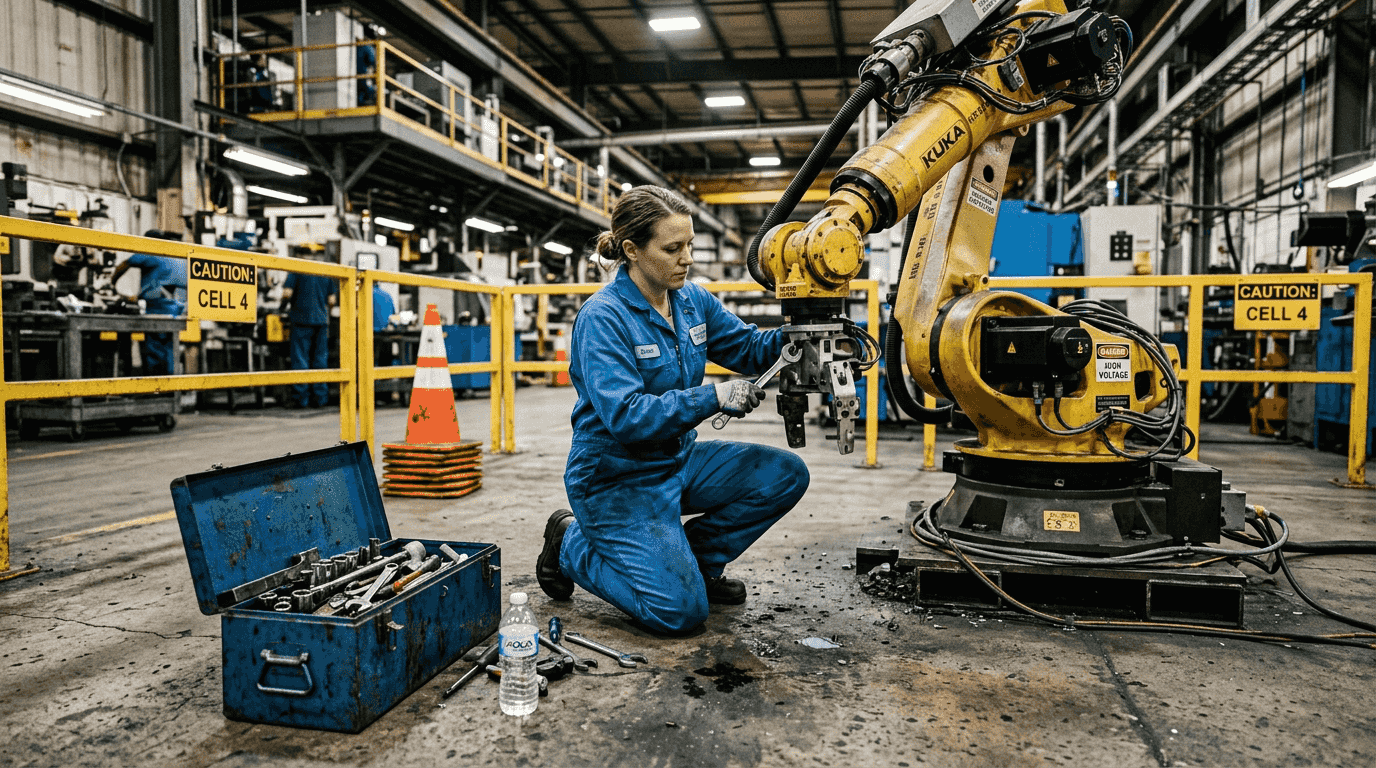
Physical AI brings intelligence directly onto the shop floor through advanced robotics and autonomous systems. Autonomous mobile robots navigate dynamic factory environments, adaptive robotic arms handle variable part geometries, and vision systems perform quality inspections with superhuman consistency. These systems learn from operational data, continuously improving performance without reprogramming.
Industry-specific AI agents enhance operational relevance by understanding sector workflows, terminology, and constraints. A pharmaceutical manufacturing agent comprehends regulatory compliance requirements, batch traceability, and contamination risks that generic AI models miss entirely. This specialization accelerates deployment and improves decision quality.
Human-in-the-loop AI copilots assist rather than replace workers, improving decision quality while maintaining human judgment for complex situations. Maintenance technicians receive AI-generated diagnostic suggestions and repair procedures, but retain authority over final decisions. This collaboration model reduces errors while preserving institutional knowledge and worker autonomy.
Digital workers automate complex service and maintenance operations, boosting technician efficiency. These AI systems analyze equipment sensor data, predict failures, generate work orders, and guide repair procedures. Technicians focus on physical repairs while digital workers handle documentation, parts ordering, and knowledge base updates.
Key implementation considerations for these trends:
- Start with high-impact, low-complexity use cases to build organizational confidence
- Invest in data infrastructure that supports real-time AI decision-making
- Develop change management programs that position AI as workforce augmentation
- Establish governance frameworks for AI oversight and accountability
- Monitor AI integration types to match solutions with operational needs
Pro Tip: Prioritize Industry 4.0 trends that complement your existing workforce skills rather than requiring wholesale operational redesign. Adoption accelerates when workers see AI as a tool enhancing their expertise.
Comparing AI adoption success and pitfalls in manufacturing
Understanding why AI initiatives succeed or fail provides critical insight for strategic planning. The contrast between stalled pilots and transformative implementations reveals patterns that guide better decision-making.
| Outcome | Failure Pattern | Success Pattern |
|---|---|---|
| Project completion | 70-95% fail to scale beyond pilots | Phased approach with clear ROI gates |
| Production transition | Only 20% move from pilot to full deployment | Industry-specific models with proven use cases |
| Financial impact | Unclear ROI and abandoned investment | Savings exceeding $500 million documented |
| Environmental benefit | No measurable sustainability gains | Massive CO2 reductions through optimization |
| Data utilization | Collection without purpose or analysis | Actionable insights driving decisions |
The staggering failure rates reflect common strategic mistakes. Organizations collect vast amounts of sensor and operational data without defining specific business questions to answer. AI projects launch without clear ownership, success metrics, or integration plans. Generic AI models fail to understand industry-specific workflows and constraints.
Successful implementations share distinct characteristics. They begin with narrowly defined problems where AI delivers obvious value. Leadership establishes measurable KPIs before deployment and monitors progress rigorously. Teams select industry-trained models or invest in customization that reflects operational reality.
Barriers to successful AI scaling include:
- Data overload without analytical focus or business context
- Lack of industry-specific AI models understanding operational constraints
- Insufficient integration planning with existing systems and workflows
- Unclear ROI definitions and measurement frameworks
- Resistance from workforce fearing displacement rather than augmentation
Organizations that overcome these barriers typically adopt phased approaches, starting with high-impact pilots that demonstrate clear value. They invest in change management, positioning AI as workforce augmentation rather than replacement. Leadership maintains realistic timelines, recognizing that sustainable AI transformation requires cultural adaptation alongside technical implementation.
The financial and environmental gains from successful AI adoption justify the strategic focus required. Companies achieving production-scale deployment report cost reductions, quality improvements, and sustainability benefits that fundamentally reshape competitive positioning. Review AI automation success stories to understand implementation patterns that deliver measurable results.
Choosing the right Industry 4.0 strategy for your business in 2026
Selecting Industry 4.0 trends and AI methods tailored to your operational needs requires balancing ambition with pragmatism. The most successful implementations reflect careful strategic planning rather than technology-first thinking.
Adopt a phased approach starting with pilots followed by scaling proven solutions. Identify one high-impact operational challenge where AI can deliver measurable improvement within 90 days. Run a time-boxed pilot with clear success criteria, dedicated resources, and executive sponsorship. Scale only after demonstrating ROI and understanding integration requirements.
Prioritize AI copilots for human-in-the-loop support over fully autonomous systems. Technologies that augment worker expertise face less organizational resistance and handle edge cases more gracefully than those attempting complete automation. Maintenance technicians using AI diagnostic assistants maintain authority while benefiting from pattern recognition across thousands of equipment failures.
Select industrial AI models trained on your specific operational data and workflows. Generic AI systems require extensive customization and struggle with industry terminology, regulatory requirements, and operational constraints. Purpose-built solutions for manufacturing, logistics, or process industries deliver faster time to value and higher accuracy.
Monitor measurable KPIs to evaluate progress and ROI consistently. Define specific metrics before deployment: cycle time reduction, defect rate improvement, energy consumption decrease, or maintenance cost savings. Track these metrics weekly during pilots and monthly during scaling to identify issues early and demonstrate business value to stakeholders.
Plan integration carefully to avoid disruption and maximize employee adoption. Map how AI systems will connect with existing ERP, MES, and SCADA platforms. Design workflows that feel natural to operators rather than forcing process changes around technology limitations. Invest in training that builds confidence and demonstrates personal benefit to frontline workers.
Strategic considerations for 2026 implementation:
- Align AI initiatives with broader business strategy and competitive positioning
- Secure executive sponsorship with accountability for results, not just exploration
- Build cross-functional teams combining operational expertise with technical capability
- Establish governance frameworks defining AI decision authority and human oversight
- Create feedback loops capturing worker insights to continuously improve systems
Pro Tip: Document lessons learned from every pilot, successful or not. This institutional knowledge accelerates future initiatives and helps avoid repeating expensive mistakes. Organizations that implement AI automation successfully treat each project as a learning opportunity building toward comprehensive digital transformation.
Explore customized AI and software solutions to accelerate your Industry 4.0 journey
Transforming Industry 4.0 strategies from concept to operational reality requires specialized expertise in AI integration, software development, and agile project delivery. NULLBIT partners with innovative enterprises to build AI solutions that generate measurable ROI through operational efficiency improvements and competitive advantage.
Our team designs scalable AI copilots and automation systems tailored to your industry workflows, regulatory requirements, and existing technology infrastructure. We leverage custom software development to create solutions that integrate seamlessly with your ERP, MES, and operational systems, avoiding the disruption common with off-the-shelf platforms.
Using an agile development approach, we deliver working functionality in rapid iterations, incorporating your feedback and operational insights throughout development. This methodology ensures solutions address real business challenges rather than theoretical requirements, accelerating time to value and reducing implementation risk. Whether you’re launching your first AI pilot or scaling proven innovations across global operations, our expertise helps you navigate complexity and achieve sustainable digital transformation.
What are the biggest challenges of Industry 4.0 AI adoption?
What are the biggest challenges of Industry 4.0 AI adoption?
The primary obstacles include collecting data without clear business purpose, leading to analysis paralysis rather than actionable insights. Many organizations also struggle with AI projects that succeed in pilots but fail to scale to production due to integration complexity, unclear ROI, or workforce resistance. Additionally, generic AI models often lack the industry-specific knowledge needed to handle operational nuances, regulatory requirements, and edge cases effectively.
How can businesses ensure AI projects move beyond pilot stages?
Start with narrowly defined use cases where AI delivers obvious, measurable value within 90 days. Establish clear success criteria and ROI metrics before launching pilots, then monitor progress rigorously. Invest in integration planning early, ensuring AI systems connect seamlessly with existing operational technology and business systems. Secure executive sponsorship with accountability for scaling successful pilots, and build cross-functional teams combining operational expertise with technical capability to address challenges quickly.
What role does human oversight play in Industry 4.0 AI applications?
Human oversight transitions workers from performing routine manual tasks to strategic decision-makers who guide and validate AI recommendations. AI copilots handle data analysis, pattern recognition, and routine decisions while escalating complex situations, edge cases, and high-stakes choices to human experts. This collaboration model leverages AI’s computational power and consistency while preserving human judgment, institutional knowledge, and adaptability. Organizations adopting human-in-the-loop approaches report higher worker satisfaction, faster adoption, and more reliable outcomes than those pursuing full automation.
Why are industry-specific AI solutions preferred in 2026?
Industry-specific AI models understand the terminology, workflows, regulatory constraints, and operational challenges unique to manufacturing, logistics, pharmaceuticals, or other sectors. Generic AI trained on broad datasets misses critical nuances, requiring extensive customization and delivering lower accuracy. Purpose-built solutions integrate faster, require less training data, and handle industry-specific edge cases more reliably. They also align better with existing processes, reducing change management complexity and accelerating time to measurable ROI.