

What is enterprise-grade AI in 2026? 45% efficiency boost

Most IT leaders believe deploying a large language model equals enterprise AI. They’re wrong. LLMs alone cannot handle tasks like numerical predictions or compliance-critical decision making, making them insufficient for true enterprise needs. Enterprise-grade AI in 2026 demands hybrid architectures, rigorous governance, and deep workflow integration. This guide clarifies what genuinely constitutes enterprise-grade AI and how it transforms operations for innovative organizations seeking measurable efficiency gains and competitive advantage.
Table of Contents
- Defining Enterprise-Grade AI: Core Characteristics
- Hybrid Architectures: The Backbone of Enterprise AI
- Embedding AI Into Core Enterprise Workflows
- Governance And Compliance In Enterprise AI
- Common Misconceptions About Enterprise AI
- Scaling Enterprise AI: Strategies And Frameworks
- Explore Custom AI And Software Solutions For Your Enterprise
- Frequently Asked Questions About Enterprise-Grade AI
Key takeaways
| Point | Details |
|---|---|
| Enterprise AI definition | True enterprise-grade AI operates responsibly at scale, combining foundation models with domain knowledge and strict governance frameworks. |
| Hybrid architecture advantage | Over 70% of enterprise AI deployments by 2027 will use hybrid architectures integrating multiple models and knowledge systems for superior accuracy. |
| Workflow integration impact | Embedding AI directly into core workflows can boost operational efficiency by up to 45% in software development and related functions. |
| Governance imperative | Compliance with frameworks like the EU AI Act and NIST standards ensures AI systems remain auditable, ethical, and legally sound. |
| Scaling strategy | Successful AI scaling requires strategic alignment, ethical governance, organizational readiness, and continuous impact measurement. |
Defining enterprise-grade AI: core characteristics
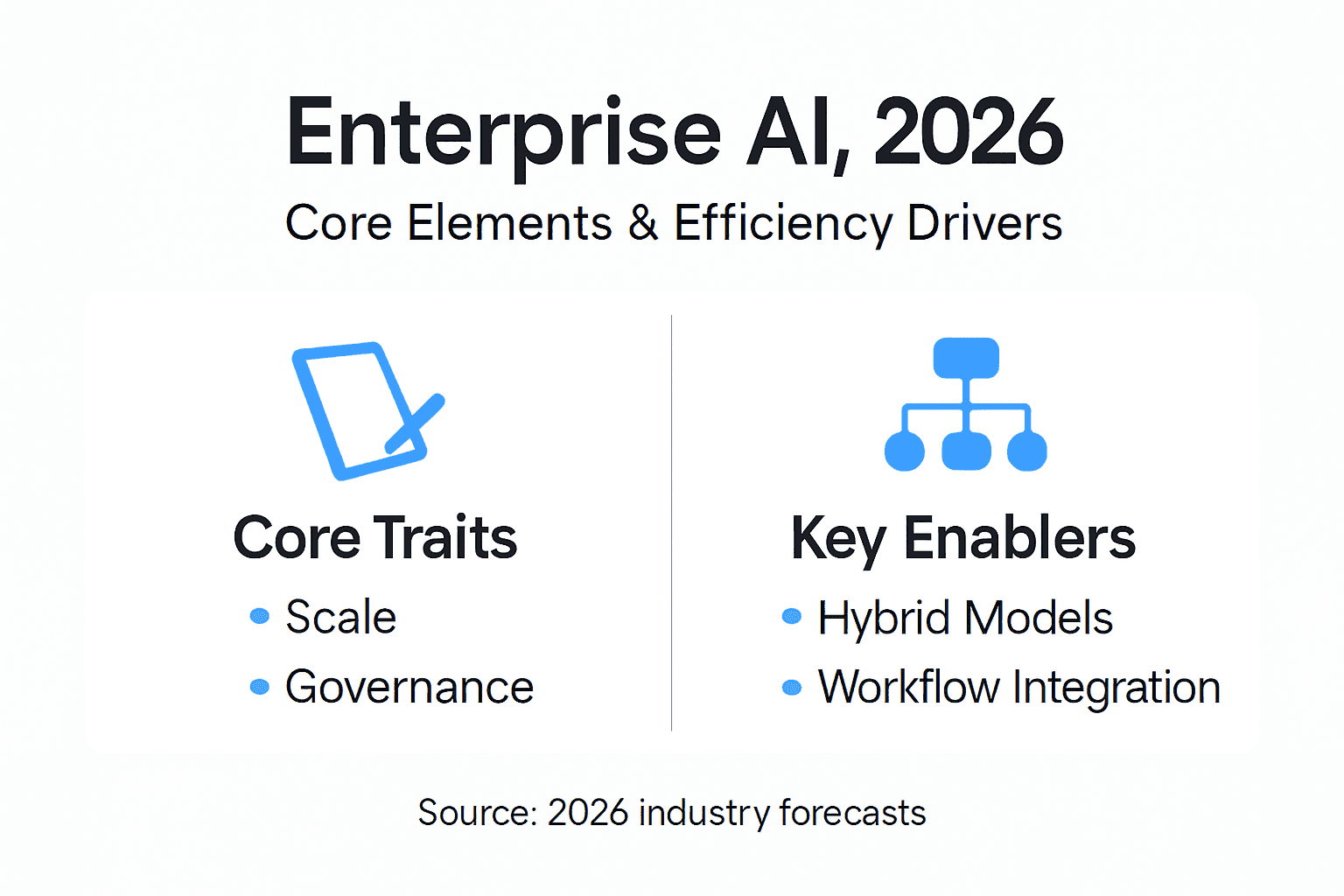
Enterprise-grade AI systems in 2026 operate responsibly at scale across changing policies, data, teams, and risk tolerances. This definition separates real enterprise solutions from simple consumer tools or limited automation scripts. Understanding what makes AI truly enterprise-grade helps you invest wisely and avoid costly missteps.
Enterprise AI integrates hybrid architectures that combine foundation models with domain-specific knowledge systems. It doesn’t rely solely on generative AI capabilities. Instead, it blends structured data, business rules, and advanced analytics to deliver accurate, contextually relevant outcomes. This approach supports complex decision-making across finance, supply chain, compliance, and operations.
Governance, auditability, and compliance form the foundation of enterprise AI. These systems must adapt continuously to shifting regulatory landscapes, evolving data availability, changing organizational structures, and fluctuating risk appetites. Without these capabilities, AI deployments fail to meet enterprise standards and expose organizations to legal and operational risks.
Core attributes of enterprise-grade AI include:
- Scalability across diverse business units and geographies
- Integration with existing enterprise systems and workflows
- Transparent decision-making processes with full audit trails
- Compliance with industry regulations and ethical standards
- Continuous learning and adaptation to new data and contexts
- Security and privacy safeguards protecting sensitive information
These characteristics distinguish enterprise AI from experimental projects or narrow applications. They also guide strategic decisions about AI vendor selection, architecture design, and deployment priorities. Before committing resources, verify your AI solution meets these criteria to understand artificial intelligence basics in enterprise contexts.
Hybrid architectures: the backbone of enterprise AI
Foundation models like large language models provide a starting point, but they lack the precision needed for enterprise applications. Hybrid architectures solve this by combining general-purpose AI with structured domain knowledge. This combination delivers accuracy, compliance, and operational relevance that foundation models alone cannot achieve.
70%+ of enterprise AI deployments will integrate hybrid architectures by 2027, reflecting the industry’s recognition of this approach’s superiority. Hybrid stacks often blend open-source and proprietary systems deployed across multiple cloud environments. This flexibility controls costs, maintains compliance, and prevents vendor lock-in while maximizing performance.
Integrating foundation models with business data enables advanced decision-making beyond simple text generation. Predictive analytics, numerical forecasting, compliance monitoring, and dynamic resource allocation all require hybrid approaches. These systems learn from your organization’s unique data while leveraging the broad capabilities of foundation models.
Pro Tip: Evaluate your AI solution for hybrid architecture flexibility before deployment. Ensure it can integrate multiple model types, connect to your data sources, and adapt as your needs evolve. This future-proofs your investment and prevents costly rework.
Key components of effective hybrid AI architectures:
- Foundation models for general reasoning and language understanding
- Domain-specific models trained on industry or organizational data
- Knowledge graphs representing business rules and relationships
- Real-time data pipelines feeding current information to models
- Orchestration layers managing multiple AI components seamlessly
| Architecture Type | Primary Use Case | Integration Complexity | Governance Requirements | Scalability Potential |
|---|---|---|---|---|
| Foundation Model Only | Content generation, basic queries | Low | Moderate | Limited |
| Hybrid Open Source | Cost-sensitive deployments | High | High | High |
| Hybrid Proprietary | Mission-critical operations | Moderate | Very High | Very High |
| Multi-Cloud Hybrid | Global enterprise scale | Very High | Very High | Exceptional |
This table illustrates how different architectural approaches serve distinct enterprise needs. Scaling AI architectures effectively requires matching your technical choices to your business requirements and risk tolerance. Hybrid AI architectures provide the adaptability and governance capabilities vital for sustained enterprise success.
Embedding AI into core enterprise workflows
AI delivers value when it becomes an active participant in your operations, not just an advisory tool. Agentic AI systems autonomously execute multi-step workflows at enterprise scale, from processing invoices to managing supply chains. This evolution transforms AI from helper to collaborator.
Embedding AI into workflows can improve operational efficiency by up to 45% in software development, with similar gains appearing in finance, logistics, and customer service. These improvements stem from AI handling repetitive tasks, identifying patterns humans miss, and making decisions faster than manual processes allow.

Commonly automated workflows include complex compliance tasks requiring continuous monitoring and dynamic supply chain adjustments responding to real-time disruptions. AI analyzes data streams, applies business rules, and executes decisions without human intervention. This capability frees your team to focus on strategic initiatives while AI manages operational details.
Pro Tip: Prioritize user-centric AI design during implementation. Systems that fit naturally into existing workflows see higher adoption rates and deliver faster ROI. Involve end users early to identify friction points and design intuitive interfaces.
Steps to embed AI effectively into workflows:
- Assess current workflows to identify high-impact automation opportunities
- Select AI technologies matching your technical requirements and compliance needs
- Integrate AI systems with existing enterprise platforms and data sources
- Train users on AI capabilities and establish clear escalation protocols
- Monitor performance continuously and iterate based on feedback and outcomes
This systematic approach ensures AI deployments align with operational realities and deliver measurable benefits. AI workflow implementation tips emphasize starting small, proving value, then expanding. AI automation in enterprise environments succeeds when it solves real problems rather than chasing technological trends. The agentic AI impact on efficiency and decision quality makes workflow integration a strategic imperative for competitive enterprises.
Governance and compliance in enterprise AI
AI governance encompasses traceability, auditability, privacy protection, and ethical risk management. Without robust governance, AI systems create legal liabilities, operational risks, and trust issues among stakeholders. These frameworks ensure AI operates within acceptable boundaries while delivering business value.
Regulatory frameworks like the EU AI Act and NIST guidelines are critical for AI governance, establishing standards for transparency, accountability, and safety. Compliance isn’t optional; it’s foundational. Organizations deploying AI in regulated industries face severe penalties for governance failures, making investment in proper frameworks essential.
Governance frameworks underpin trust in AI outputs. When stakeholders understand how AI reaches decisions and see evidence of ethical operation, they’re more likely to accept and act on AI recommendations. This trust accelerates adoption and amplifies AI’s organizational impact.
Key governance components for enterprise AI:
- Data privacy safeguards ensuring compliance with regulations like GDPR and CCPA
- Audit trails documenting AI decisions for accountability and troubleshooting
- Compliance monitoring systems tracking adherence to regulatory requirements
- Ethical guidelines preventing bias and ensuring fair treatment across populations
- Risk assessment processes identifying and mitigating potential AI failures
These elements work together to create responsible AI systems. Data privacy protects individuals while enabling AI to learn from sensitive information. Audit trails make AI transparent, allowing you to understand and explain decisions to regulators or customers. Compliance monitoring catches issues before they become violations.
Ethical guidelines address concerns about bias, fairness, and unintended consequences. Regular risk assessments identify vulnerabilities in AI systems before they cause harm. Together, these governance mechanisms transform AI from a potential liability into a trusted business asset. AI governance frameworks provide structure for managing these complex requirements systematically.
Common misconceptions about enterprise AI
Many IT leaders mistakenly believe enterprise AI simply means deploying large language models. Reality proves more complex. Enterprise AI is more than large language models alone; it requires integration and governance. Foundation models lack the structured domain knowledge and compliance capabilities enterprises need.
Another common misconception suggests quick DIY no-code AI apps suffice for enterprise needs. While these tools work for simple tasks, they lack scalability and compliance readiness. They cannot integrate with complex enterprise systems or adapt to evolving regulatory requirements. This limitation makes them unsuitable for mission-critical applications.
Some leaders believe AI can be deployed without deep workflow integration and governance. Such deployments typically fail to deliver business value because they operate in isolation from real work processes. AI must embed into daily operations and comply with organizational policies to generate meaningful impact.
| Criteria | Generative AI Only | Hybrid Enterprise-Grade AI |
|---|---|---|
| Functionality | Text generation, basic queries | Multi-modal analytics, predictions, automation |
| Integration | Standalone or minimal connections | Deep integration with enterprise systems |
| Governance | Basic content filtering | Comprehensive audit trails, compliance frameworks |
| Scalability | Limited by model constraints | Scales across business units and geographies |
| Reliability | Variable, context-dependent | Consistent, validated, auditable |
This comparison clarifies the gap between simple AI tools and true enterprise solutions. Generative AI handles certain tasks well but cannot replace comprehensive enterprise AI architectures. Hybrid systems deliver the reliability, governance, and scalability enterprises require.
Major myths debunked:
- AI equals LLM deployment (reality: requires structured data and governance)
- No-code tools meet enterprise needs (reality: lack compliance and scalability)
- AI works without integration (reality: isolated AI delivers minimal value)
- Governance can wait until later (reality: governance must be built in from start)
- One AI solution fits all use cases (reality: hybrid approaches serve diverse needs)
Understanding these misconceptions helps you avoid common pitfalls in AI initiatives. Enterprise AI misconceptions often stem from marketing hype rather than operational reality. Focusing on proven architectures, governance, and integration ensures your AI investments deliver promised returns.
Scaling enterprise AI: strategies and frameworks
Scaling AI from pilot projects to enterprise-wide impact requires clear strategy aligned with organizational goals. Strategic alignment of business, data, and technology is critical for AI scaling; ethical governance supports sustainable deployment. Without this alignment, AI initiatives fragment across departments, delivering inconsistent results and wasting resources.
Common challenges in scaling include organizational readiness gaps, change management resistance, technical infrastructure limitations, and stakeholder engagement failures. Addressing these issues early prevents stalled deployments and maximizes AI’s potential impact. You need executive support, user buy-in, and technical capabilities working together.
Ethical governance must be integrated early in AI scaling, not added as an afterthought. As AI systems expand their influence, governance failures create larger risks. Building ethical frameworks into your scaling process ensures AI remains trustworthy as it grows.
Essential steps for scaling AI successfully:
- Establish strategic alignment connecting AI initiatives to business objectives and KPIs
- Adopt hybrid architecture approaches providing flexibility and compliance capabilities
- Embed AI into core workflows where it delivers measurable operational improvements
- Implement comprehensive governance frameworks covering ethics, compliance, and risk
- Prepare organizational readiness through training, change management, and infrastructure upgrades
These steps create a foundation for sustainable AI expansion. Strategic alignment ensures resources focus on high-impact opportunities. Hybrid architectures provide technical flexibility. Workflow embedding makes AI valuable to users. Governance protects the organization. Organizational readiness enables adoption.
Focus on measuring impact and iterating to sustain AI benefits. Track efficiency gains, cost reductions, revenue improvements, and user satisfaction. Use these metrics to refine AI systems and demonstrate value to stakeholders. Continuous improvement keeps AI aligned with evolving business needs.
Scalable AI strategies emphasize building capabilities incrementally rather than attempting enterprise-wide deployments immediately. AI workflow implementation guidance helps you translate strategy into action, turning AI from experimental technology into operational reality.
Explore custom AI and software solutions for your enterprise
Transforming your organization with enterprise-grade AI requires expertise, strategy, and tailored technology. Custom AI and software development services enable you to deploy hybrid architectures that meet your specific operational and compliance needs. Expert system engineering and integration support ensure AI embeds seamlessly into existing workflows, delivering the efficiency gains and competitive advantages discussed throughout this guide.
Whether you’re beginning your AI journey or scaling existing initiatives, partnering with experienced providers accelerates success and reduces risk. Explore enterprise AI solutions designed for innovative organizations seeking measurable operational improvements. Custom software development creates the infrastructure AI needs to thrive. System engineering and integration services connect AI with your enterprise ecosystem, maximizing impact and ensuring compliance. Contact us to discover how tailored solutions can transform your enterprise AI vision into operational reality.
Frequently asked questions about enterprise-grade AI
What differentiates enterprise-grade AI from consumer AI?
Enterprise-grade AI operates at scale with governance, compliance, and integration capabilities consumer tools lack. It combines hybrid architectures, handles sensitive data securely, maintains audit trails, and adapts to complex regulatory environments. Consumer AI focuses on ease of use for individuals, while enterprise AI prioritizes reliability, accountability, and organizational impact.
How can enterprises ensure AI governance and compliance?
Implement comprehensive frameworks covering data privacy, ethical guidelines, audit trails, and regulatory monitoring from the start. Adopt standards like the EU AI Act and NIST guidelines as baselines. Conduct regular risk assessments, maintain transparent decision processes, and involve legal and compliance teams in AI design. Governance must be built into systems, not added later.
What are practical first steps to embedding AI into workflows?
Begin by assessing current workflows to identify high-impact automation opportunities with clear ROI potential. Start small with pilot projects in well-defined areas, measure outcomes rigorously, and iterate based on feedback. Involve end users early to ensure AI fits naturally into their work. Expand successful pilots gradually while maintaining focus on measurable business value.
Can hybrid AI architectures improve predictive accuracy?
Yes, significantly. Hybrid architectures combine foundation models’ broad capabilities with domain-specific knowledge, structured data, and business rules. This integration delivers far more accurate predictions than foundation models alone, especially for tasks requiring numerical precision, compliance awareness, or context-specific decision-making. Over 70% of enterprises will adopt hybrid approaches by 2027 for this reason.
What are key challenges in scaling AI beyond pilot projects?
Common obstacles include organizational resistance to change, insufficient technical infrastructure, lack of executive alignment, and inadequate governance frameworks. Data quality issues, integration complexity, and skill gaps also slow scaling. Address these by building strategic alignment early, investing in infrastructure and training, establishing governance upfront, and demonstrating clear value through measured outcomes.